
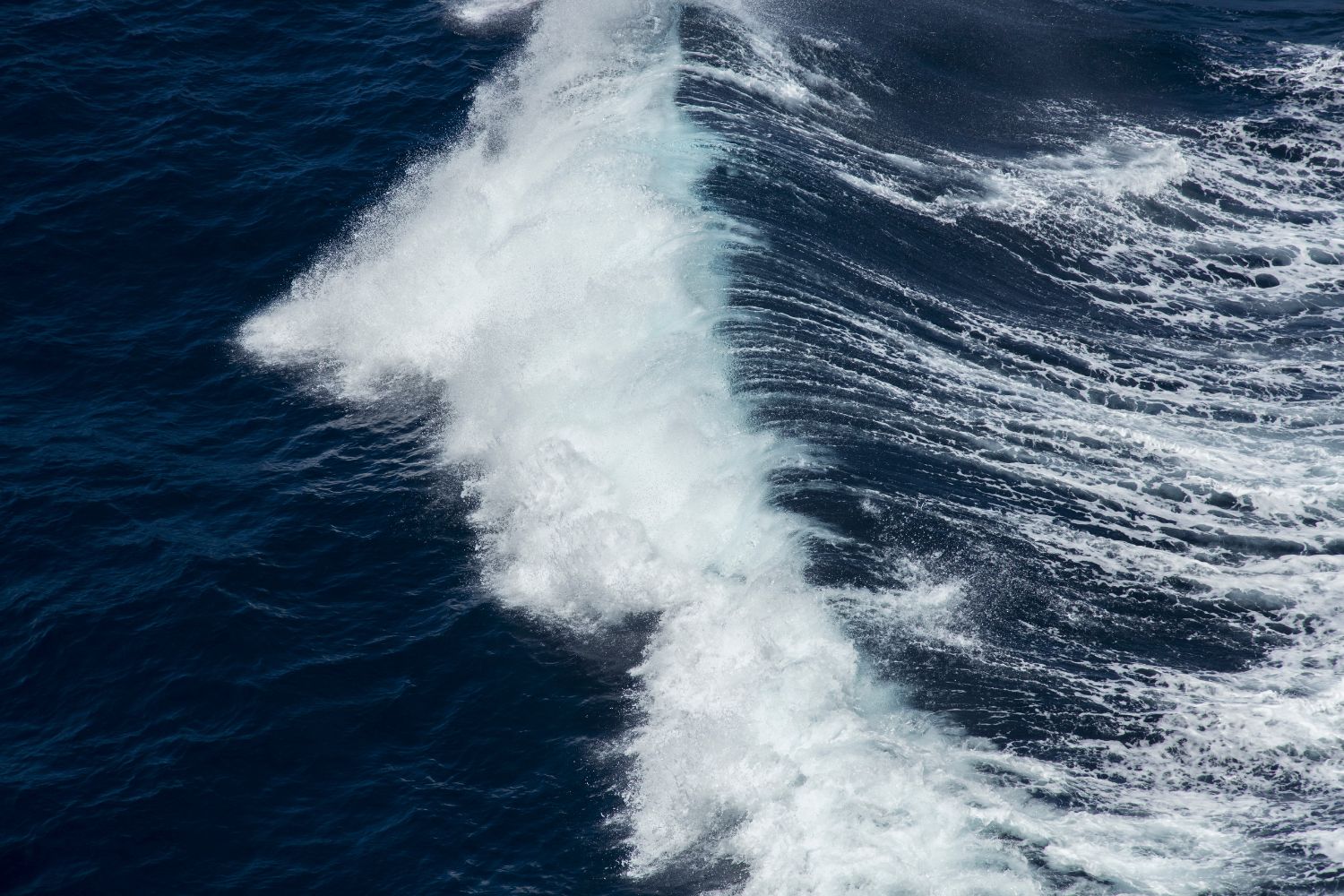
They rise in the sea apparently “from nothing” (or almost) and can be truly devastating: the abnormal waves, however, are not anomalous at all, but have a rational explanation that is independent of the case. The discovery is the work of an international research group led by Georgia Institute of Technology.
The “history” of the anomalous waves
In history and sometimes on the borders of legend, there are many stories of anomalous waves that have caused irreparable disasters to ships and other boats. But what happened in 1995 was a widely documented fact, which touched the tragedy.
On January 1 of that year, in fact, the oil platform Draupneroffshore in the North Sea, was hit by an anomalous wave of over 26 meters, as detected by the laser devices placed on the platform itself.
There were no victims, but the platform was damaged. And yes, a storm was underway, but the waves were on average 12 meters high. Therefore that of 26, more than double and isolated, was called “anomalous”.
The dominant theory on the formation of anomalous waves is a phenomenon called modular instability, a phenomenon with which small variations in the timing and spacing between the waves cause the concentration of energy in a single wave. Instead of remaining uniformly distributed, the model of the waves therefore changes, making one become suddenly much larger than the others.
In 2016, a team of researchers from the Institute of Marine Sciences of the CNR and the European Center for Medium-Range Weather Forecasts He analyzed the case again, in particular the weather-oceanographic conditions that generated the wave.
Their study has shown, through a sophisticated model that combines physics and meteorology, that the anomalous wave of Draupner It was generated by the convergence of two wave systems with different meteorological origin and direction, respectively from the north and north-west.
The new study
The team led by the Georgian Institute has now analyzed 27,500 waves collected in 18 years in the North Sea, the data set of this most complete kind ever collected, with each registration that has captured 30 minutes of detailed wave activity (height, frequency and direction).
The results questioned consolidated hypotheses: in fact, they highlighted how, to occur, these imposing waves do not require “exotic” or extraordinary forces at all, but only a particular alignment of the “normal” ones.
The anomalous waves follow the natural orders of the ocean, are no exceptions – explains Francesco Fedele, who guided the study – this is the most evident concrete test ever obtained so far
The researchers underlined in particular that modular instability is accurate when the waves are confined within channels, as in laboratory experiments, where energy can only flow in one direction. In the open sea, however, energy can spread in several directions.
When they analyzed the data of the North Sea, in fact, scientists did not find any proof of modular instability in the anomalous waves. Instead, they discovered that larger waves seem to be the product of two simpler effects:
- Linear focus, which takes place when in order to travel at different speeds and directions they align at the same time and place: in this way they “accumulate” forming a much higher ridge than usual;
- Second-order non-linearity, due to natural effects of the waves that lengthen the shape of a wave, making the ridge more steep and flattening and flattening the belly: this distortion makes the waves higher than 15-20%.
In other words, when these two standard behaviors of the waves align, the result is a much larger wave. The non -linear nature of the ocean waves provides further impulse, pushing them to expand further.
What changes now (or rather, what should change)
The researchers stressed at this point the urgency to apply this research in the real world: the abnormal waves are not only theoretical, unfortunately, and we have seen it. They are real, powerful and represent a danger to ships and structures offshore.
Many forecast models still deal with anomalous waves as unpredictable events. And it is absolutely not good.
They are extreme, but explainable
And therefore, potentially predictable: but it is necessary to update these models for the safety of naval navigation, coastal structures and oil platforms.
All this must be designed to resist these extreme events
At the moment the researchers are updating the automatic learning model to analyze decades of data on the waves, training algorithms to detect the subtle combinations – height, direction, timing – which precede extreme waves, with the aim of providing meteorologists with more accurate tools to predict when an anomalous wave could hit.
Although ocean waves may seem random, in fact, extreme waves like the anomalous follow a completely recognizable natural scheme. Each anomalous wave brings with it a sort of “digital footprint”, or a group of waves structured before and after the peak that reveals how it was formed.
The anomalous waves are simply a bad day at sea – they are extreme events, but they are part of the language of the ocean. We are finally learning to listen to them
The work was published on Scientific Reports.
Don’t you want to lose our news?
Sources: Georgia Institute of Technology / Scientific Reports
