
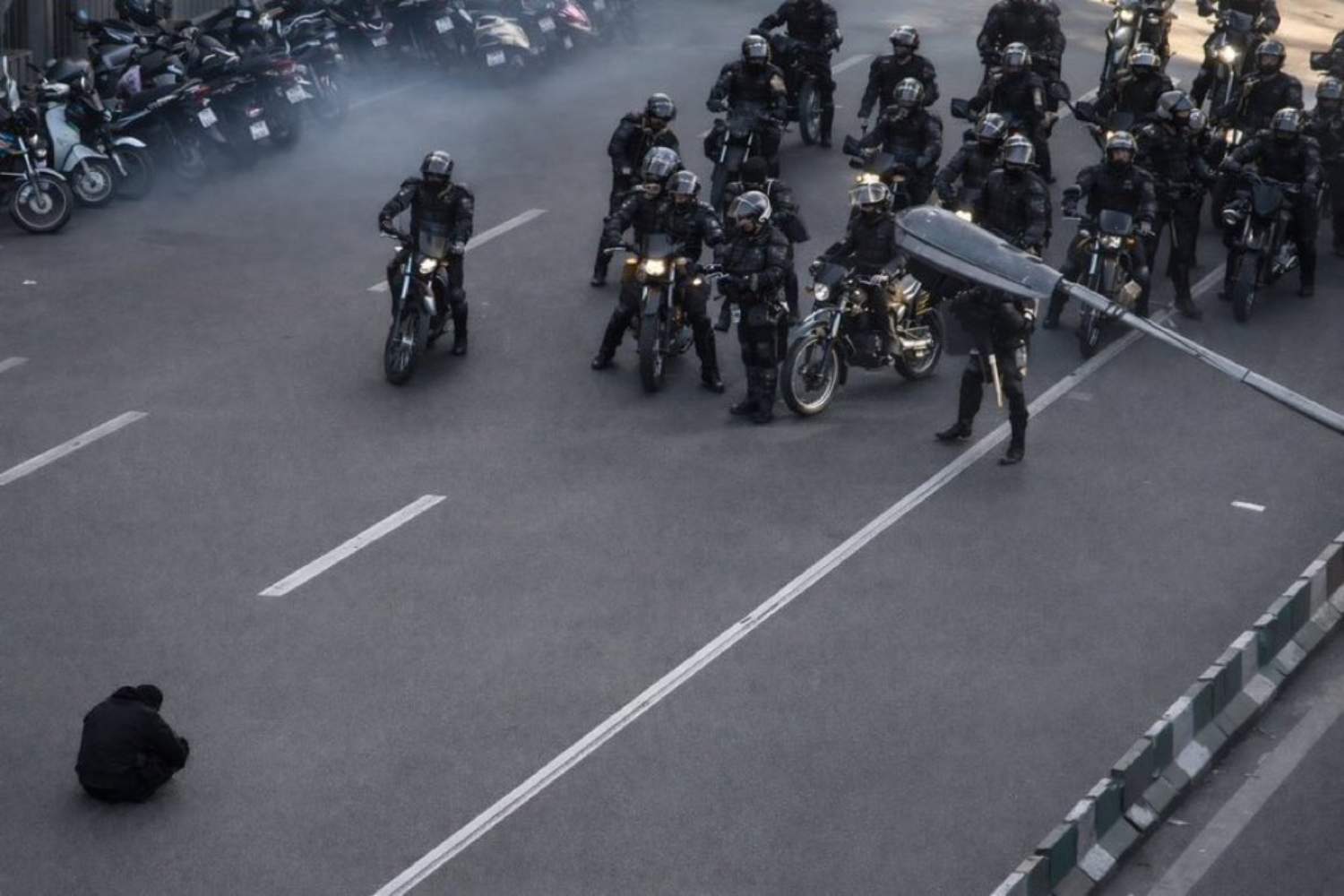
Iran is experiencing a new and profound wave of protests, the largest in recent years. Taking to the streets are not only individual groups, but university students and traders, two historically central categories in the political life of the country. And in these hours the symbol of this collective awakening has become a boy who challenged the police alone, sitting in the middle of the street.
At the basis of the mobilization is a suffocating economic crisis: out of control inflation, continuously rising prices of essential goods and a collapse of the rial which has drastically reduced the purchasing power of families. Daily life has become unsustainable for large sections of the population.
The demonstrations started from the markets of Tehran, with the closure of shops and spontaneous strikes, and then quickly spread to the universities of Tehran, Isfahan and other cities. The slogans are no longer limited to economic demands, but directly attack the top of political and religious power. The protest thus takes on a broader dimension, becoming an open challenge to the theocratic regime that has governed the country since 1979. The authorities’ response alternates tight controls, repression and attempts at political containment.
Faced with growing pressure, President Massoud Pezeshkian tried to tone down the situation, calling for dialogue and asking to listen to the protesters’ “legitimate demands”. A message addressed above all to traders, who in the past have played a decisive role in turning points in Iranian history. At the same time, however, the presence of security forces remains massive and in some cities there have been episodes of violence, fueling tension and mistrust towards the institutions.
The boy on the asphalt: an image worth more than a thousand slogans
In this context, a video shot in Tehran has captured the world’s attention. It shows a young man sitting in the middle of the street, motionless, while policemen on motorbikes advance in front of him and behind him the crowd flees amid tear gas. A simple, almost silent gesture, which many have compared to the famous “Tiananmen moment”. That boy doesn’t scream, he doesn’t throw objects, he doesn’t run away: he stays still, transforming his body into a border line between power and fear.
pic.twitter.com/Ob9dwFdFF2
Video từ Tehran, thủ đô của Iran, cho thấy lòng dũng cảm phi thường của một người biểu tình đơn độc.What’s the matter with you, what’s the point? tiếp với họ
— VUI LÊ (@VuiVuil23103079) December 30, 2025
The strength of that scene lies in its stubborn fragility. The boy represents a generation crushed between economic crisis, repression and lack of prospects. It is not just an act of defiance, but a silent question addressed to the State: how far can we go on like this? In a country where images are often worth more than words, that body sitting on the asphalt has become the visual symbol of a restrained anger, which continues to grow beneath the surface.
Courage, there is elegance in the depths
Gloire et honneur aux peuples courageux against les tyrans pic.twitter.com/Dar450vr5t— Michel Goya (@Michel_Goya) December 30, 2025
You might also be interested in:
