
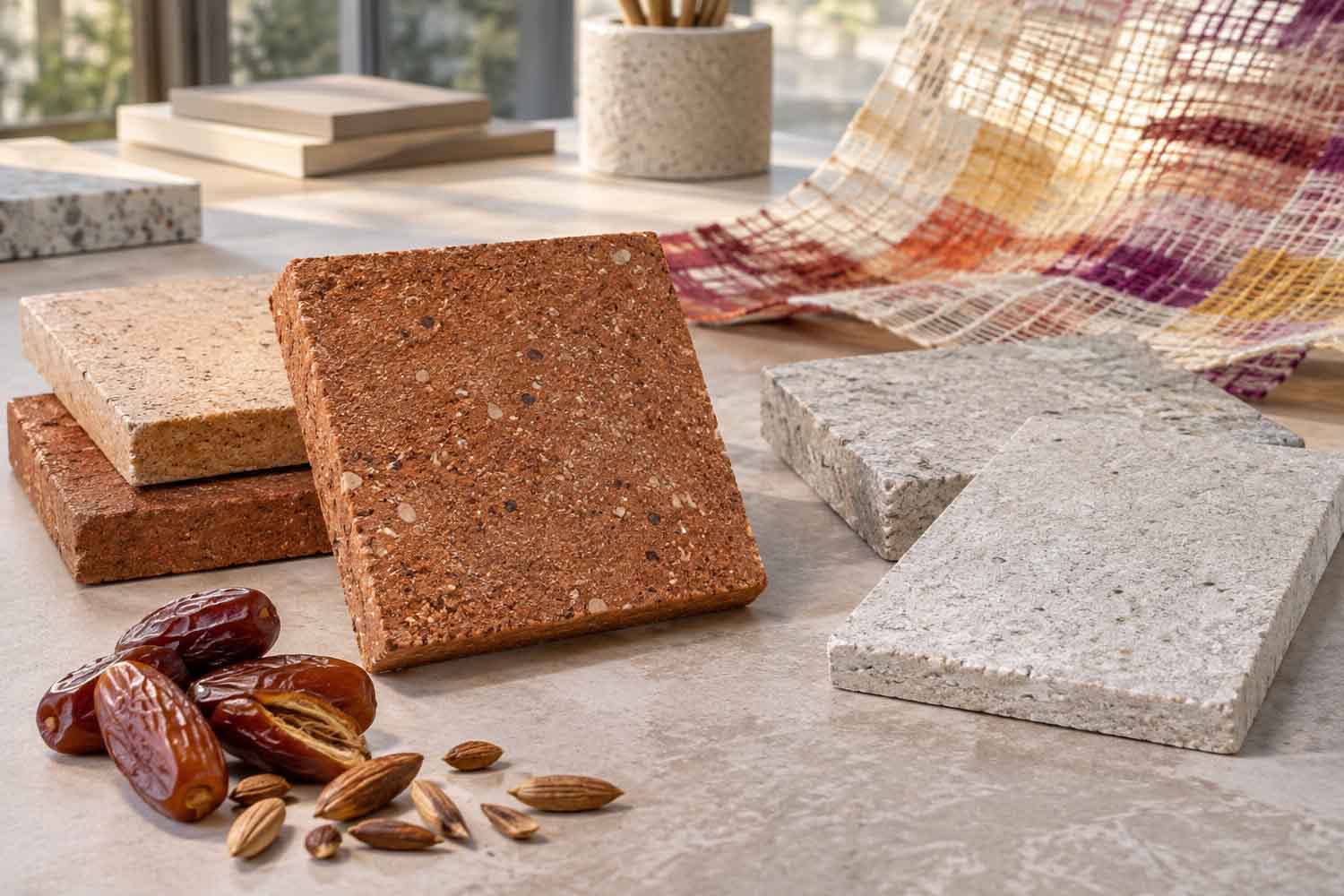
Thirty-five tons of flooring made with date stones. Thousands of visitors to Expo 2025 in Osaka walked on it, perhaps without knowing that the concrete-looking floor was produced by recovering fruit waste. It’s called Datecrete and yesterday, November 16, it won the award for sustainable design of the year at the Dezeen Awards 2026, awarded in London.
But the dates had some rather unusual competition. Among the awarded materials there are also Mimmik Tile, a tile that solidifies thanks to the action of bacteria, and Bianni Wool Paper, a paper-like material obtained from wool discarded during the production of traditional Mexican carpets. Three projects that seem to have come out of an experimental laboratory, and which have instead already found applications in architecture and furniture. Some have even reached industrial production.
The ninth edition of the Dezeen Awards awarded 16 categories dedicated to design. The main award went to the Fieldwork Facility studio for the signage system of the V&A East Storehouse museum in London. But among the projects dedicated to alternative materials, some ideas have emerged that show how interesting it can be to look at what normally ends up in the garbage.
Datecrete: a material similar to cement is born from date stones
In the United Arab Emirates, dates are an important agricultural resource. Their processing also produces large quantities of kernels, which are generally considered a low-value by-product. Architect Sara Abu Farha and engineer Khaled Shalka decided to start from these wastes to develop Datecrete, a material that resembles concrete, but is produced without using Portland cement or petroleum-derived resins.
The process is quite simple to explain: the stones are collected from the factories that process dates, dried and ground until a very fine powder is obtained. This is mixed with a natural binder and poured into molds, where the mixture is left to harden.
The result can be used to make tiles, coverings, furniture, lamps and other architectural elements. And we are no longer just prototypes. In fact, during Expo 2025 in Osaka, 35 tons of Datecrete were used to floor some external areas of the United Arab Emirates pavilion.
Part of the tiles were colored with four different shades of sienna. Another also incorporates the stronger fibers of date palm leaves, generally discarded because they are too difficult to work with. In practice, a floor made by recovering two materials that come from the same plant.
The project convinced the jury above all for the possibility of producing this material directly in the regions where dates are grown, exploiting an already abundant local resource. You don’t even need to imagine futuristic applications: the tiles have already been laid and used by thousands of people.
Mimmik Tile: the tile that grows thanks to bacteria
The second award-winning material arises from an even more curious process. To produce Mimmik Tile, winner of the category dedicated to innovation in materials, sand, mineral aggregates and bacteria are needed. The project was developed by the Dutch platform Front together with the biotechnology company Biomason, which studied a way to exploit the ability of some microorganisms to produce calcium carbonate.
In nature, mineralization processes contribute to the formation of resistant structures. The researchers also took inspiration from coral reefs to develop a system capable of obtaining a solid material without resorting to the high temperatures needed to produce traditional cement.
As Front explains in the description of the production process, the bacteria are introduced into a mixture of sand and aggregates and fed with nutrients. During their activity they favor the formation of calcium carbonate crystals, which progressively bind the particles together.
In about 40 hours the mixture becomes a solid tile, ready to be used. The interesting thing is that Mimmik is already produced on an industrial scale in the Biomason factory in Ikast, Denmark. The tiles are mainly intended for interior floors and walls and have already been used in projects in the Netherlands, Denmark and the United Kingdom.
Then there is the question of emissions. According to the manufacturers’ preliminary estimates, the processing could reduce the climate footprint by approximately 60% compared to a comparable Portland cement-based tile, considering the production phases up to leaving the factory. The independent evaluation is still ongoing. The advantage derives above all from the absence of the very high temperature processes necessary for the production of clinker, one of the main components of traditional cement.
The jury awarded precisely this characteristic, together with the possibility of bringing biological technology into the industrial production of building materials. In short, bacteria have already found another use. And this time they build something we can walk on.
Bianni Wool Paper: when wool waste becomes paper
For the third awarded project we need to move to the other side of the world, to Mexico, precisely to Teotitlán del Valle, in the State of Oaxaca. Here the artisanal processing of wool has a centuries-long tradition. Local communities produce carpets and colorful fabrics using traditional looms, but during processing there inevitably remain scraps, threads and portions of material that are too small or irregular to be reused.
The Mexican studio Arudeko decided to recover these leftovers, creating Bianni Wool Paper, winner of the award for best textile design. The material comes from the interweaving of recycled wool and recycled paper. The artisans first work the wool on treadle looms, then insert strips of paper made by local producers, using cotton threads to join them.
The resulting fabric is flexible, lightweight and partially translucent, which can be shaped to create lampshades, room dividers, decorative panels and other furnishing accessories. The peculiarity also lies in the light. When it passes through the material, in fact, it highlights the colored fibers of the wool, creating an effect that suggested the designers to experiment especially with lamps.
The project, presented by Arudeko under the name Bianni Wool Paper, thus recovers the waste from traditional processing and transforms it into a contemporary product, keeping a large part of the production in the hands of local artisans. And this is perhaps the most interesting aspect: to innovate an ancient material like wool it was not necessary to invent a new industrial process. All it took was waste, recycled paper and skills that already existed.
From waste to building and furnishing materials
The other winners of the Dezeen Awards 2026 also include Basic Third, a covering tile made by the Dutch company Pretty Plastic using PVC recovered after consumption. The material has already been used to clad Plus Ultra III, a laboratory building in the Netherlands, reusing over 30 tonnes of plastic. Dates, bacteria, wool and recovered plastic. Very different materials, as well as the processes used to transform them.
Datecrete exploits agricultural waste that is particularly abundant in the Middle East. Mimmik uses microorganisms to obtain a mineral binder without the traditional cement ovens. Bianni recovers the fibers left over from wool processing, also enhancing the work of Mexican artisan communities. These are projects that have already passed, at least in part, the idea phase. Datecrete was used in an international event, Mimmik is industrially produced and Bianni has found applications in furniture.
Of course, to become widespread alternatives to conventional materials they will have to continue to demonstrate that they are competitive also in terms of costs, performance and availability of raw materials. In the meantime, however, thousands of people have already walked on a floor made with date stones. Without noticing anything, as should happen with a good floor.
