
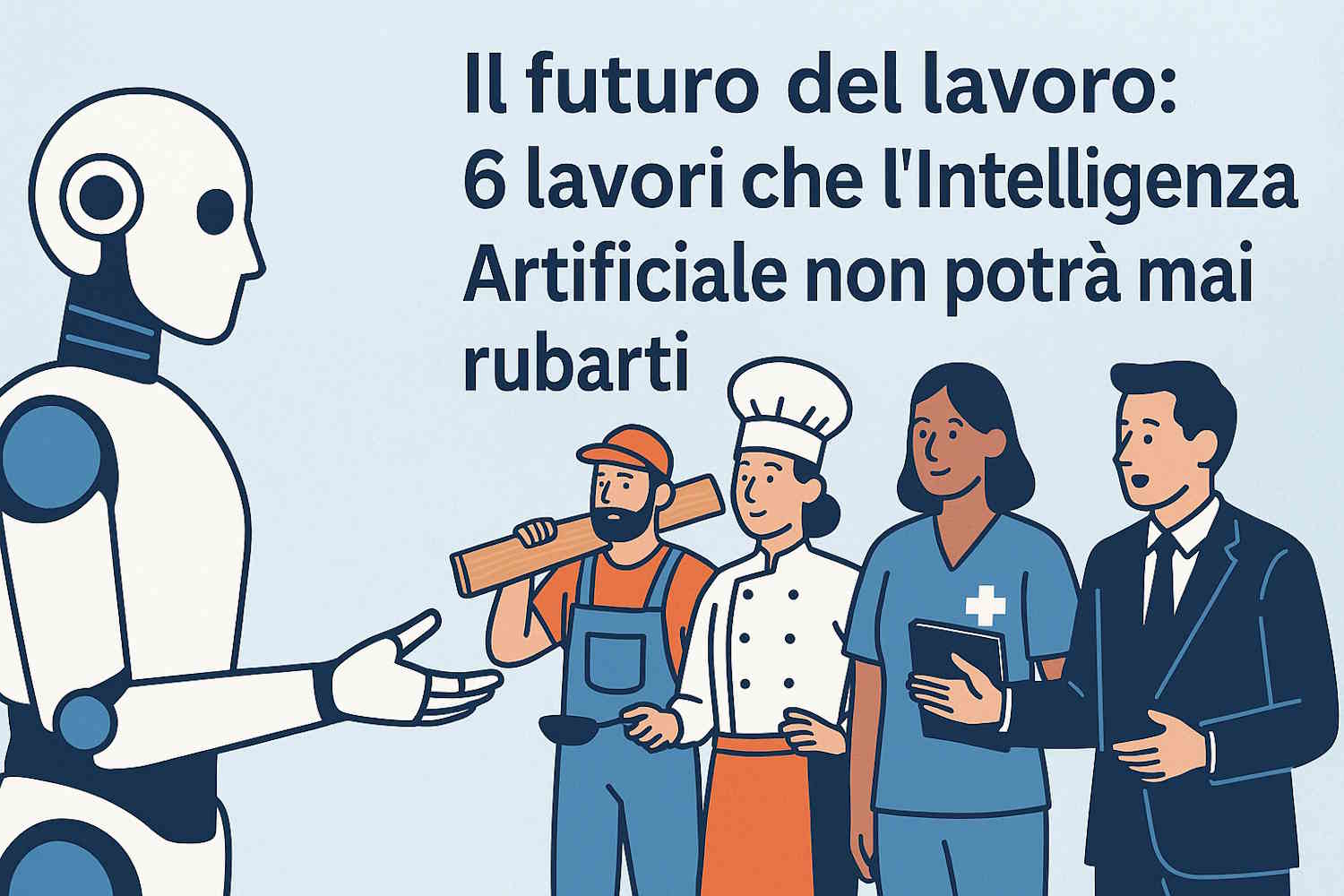
Artificial Intelligence is revolutionizing the world of work, automating processes and transforming entire professions. However, not everything can be digitized. There are roles that require a level of empathy, intuition and sensitivity that machines cannot imitate.
In this overview we analyze six categories of professions that seem destined to resist, at least for now, the advance of AI. These are not “eternal” jobs, but professions in which the human component remains essential.
Creativity and authenticity: artistic and cultural professions remain human
Artists, musicians, writers, designers and directors share one characteristic: the ability to transform human experience into emotion. AI can compose a song, design a logo or write a text, but it struggles to create original works that tell an authentic experience or convey a profound message.
When an author’s vision, a personal voice or an emotional language is needed, the human being remains irreplaceable. Intuition, cultural sensitivity and the ability to read the present time cannot be programmed into an algorithm.
Care professions and empathy: where human contact makes the difference
Doctors, psychologists, teachers, social workers and educators carry out jobs based on listening and relationships. AI can provide data, diagnoses or educational tools, but it will never be able to look a patient in the eye or understand the tone of a trembling voice.
In the educational field, a teacher does not just transmit notions: he shapes minds, supports emotions and builds trust. It is this type of connection, made of presence and sensitivity, that machines cannot replicate.
Craftsmen and technicians: manual skills that no robot can copy
Electricians, mechanics, plumbers, restorers and specialized bricklayers work with their hands and ingenuity.
Each intervention is different from the other, and often requires improvisation and adaptation. Even the most advanced robots encounter difficulties when faced with unpredictable environments or decisions that have to be made on the fly.
These professions represent the heart of practical wisdom: a wealth of experience and tact that no artificial intelligence can ever completely replace.
Decisions, ethics and vision: jobs where human judgment is needed
Managers, jurists, ethical consultants and applied philosophers operate in areas where there are no right or wrong answers, but choices to be pondered. AI can analyze data and simulate scenarios, but the responsibility to decide remains human.
The value of an executive or ethics consultant lies in the ability to intuit consequences and consider context — something no algorithm can truly do.
Emergencies and unexpected events: when only humans can react
Firefighters, paramedics and rescue workers work in situations where speed and intuition save lives.
In these cases, you need empathy, promptness and the ability to read the moment. AI can offer logistical support, but it cannot replace human presence when everything is happening in real time.
Coaching, leadership and relationships: the power of emotional intelligence
Coaches, mentors and leaders capable of motivating a group represent another example of professionalism that will remain human. The success of a good leader is measured in the ability to inspire, listen and guide people. An algorithm can suggest strategies, but it cannot understand feelings or build trust. Authentic leadership, like the relationship between mentor and mentee, arises from human contact, body language and sensitivity.
These professions are not “immune” to AI, but resilient. Artificial Intelligence will be able to modify tasks, but not delete them. The future of work will not be a challenge between man and machine, but rather a collaboration. Those who know how to use AI as a tool, without losing their humanity, will be truly ready for change.
You might also be interested in:
