
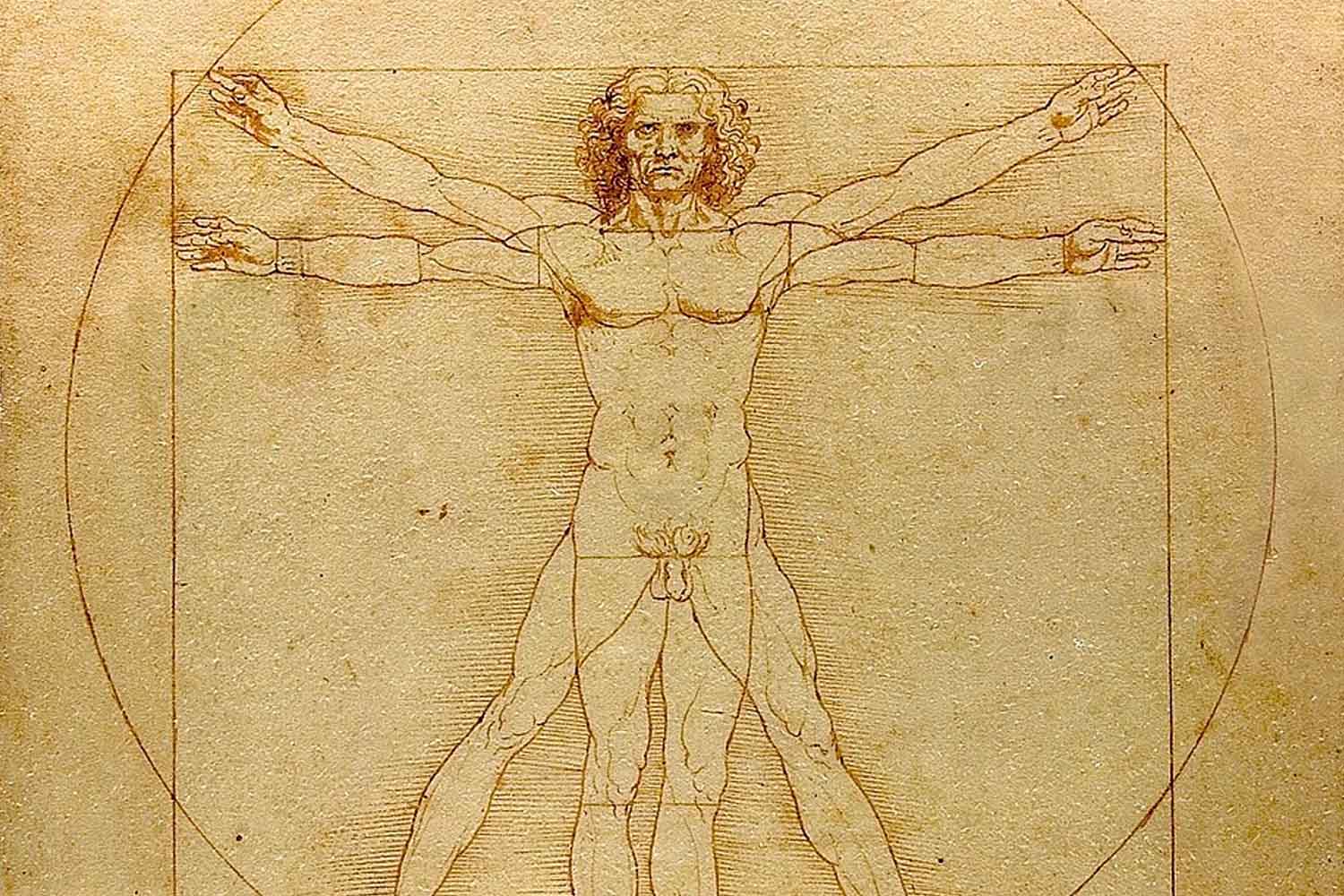
There is a drawing that we have seen a thousand times. In school books, in art history textbooks, even on one euro coins. Yet, theVitruvian man has continued to ask us the same question for more than five centuries: How is it possible that the human body is both inside a circle and a square? Today, finally, someone really tried to answer.
A new scientific study has revealed that behind that perfectly balanced body there is not only Renaissance poetry, but a precise mathematical structureelegant and surprisingly modern. For centuries it was thought that Leonardo da Vinci had limited himself to translating the Roman architect’s indications into images Vitruvius. In reality, as often happens with Leonardo, the truth is much more complex – and much more fascinating.
A study published in the scientific journal Arts et Sciences ISTE Open Science shows that the Vitruvian Man is built on a real mathematical gridwhich has remained invisible to this day. The research is signed by the mathematician Jean-Charles Pomerolprofessor emeritus at Sorbonne Universitytogether with Nathalie Popisscholar of Leonardo’s works.
Their conclusion is clear: Leonardo did not copy Vitruvius. He put it to the test, compared it with the real body, with movement, with direct experience. And then he built something new.
Mathematics that speaks the language of the body
According to the study, Leonardo would have used a duodecimal measurement systembased on number 120. Not just any number: it is highly divisible and allows you to transform many fractions into whole numbers. In practice, it is perfect for describing a human body without forcing.
Neck, chest, pubis, knees, arms: every part of the body is built like precise segmentinserted into a coherent system that works both in height and width. The result is a body that “returns”, that holds up, that seems natural even when it is inscribed in very rigid geometric shapes.
And here comes the creepy part: the hand has the same length as the faceand coincides with the distance between the navel and the pubis. The foot is equivalent to the forearmand to the distance between the navel and the chest. The proportions repeat, double, multiply, following simple relationships, often linked to the number six. It’s not aesthetic. AND internal harmony.
An ancient, symbolic, deeply human number
The 120 is not only convenient from a mathematical point of view. It is also a number full of meaning. It is the product of the first five whole numbers and was considered sacred in the Pythagorean tradition, a symbol of order and harmony in the world.
We find it in many ancient cultures as a measure of time, life and the body. And it has its roots even further back, in Mesopotamian measurement systems based on the number sixtythe same ones we still use today to divide the hours and degrees of the circle. Leonardo, as he often did, takes all this ancient knowledge and makes it dialogue with the direct observation of nature. Without dogmas. Without rigidity.
Because the center of the body is not where we think
There is another detail that this study highlights and which completely changes the interpretation of the Vitruvian Man. Vitruvius placed the center of the body in the navel. Leonardo no. Leonardo moves it at the height of the pubis. A choice that is anything but random. By doing so, it modifies the triangle formed by the legs and takes into account not only the static, but also the movement and balance. The body is not a stationary object: it is a living system.
This idea runs through all of Leonardo’s work. In his botanical studies, also collected in Arundel Codexobserve that the sum of the thicknesses of the branches is equivalent to that of the trunk. The same measure that returns, that holds everything together. In the end, what emerges from this discovery is something that perhaps we already felt, but had never been able to demonstrate. For Leonardo, the human body is not just beautiful. AND the key to understanding the order of the world.
Mathematics, observation of nature, ancient philosophy: everything converges in a design that never stops speaking to us. And which today, thanks to this study, we can look at with new eyes. Perhaps this is also why the Vitruvian Man continues to excite us. Because it reminds us, without the need for words, that we are made of measure, balance and relationship. And that, if we look carefully, there is much more order inside us than we imagine.
