
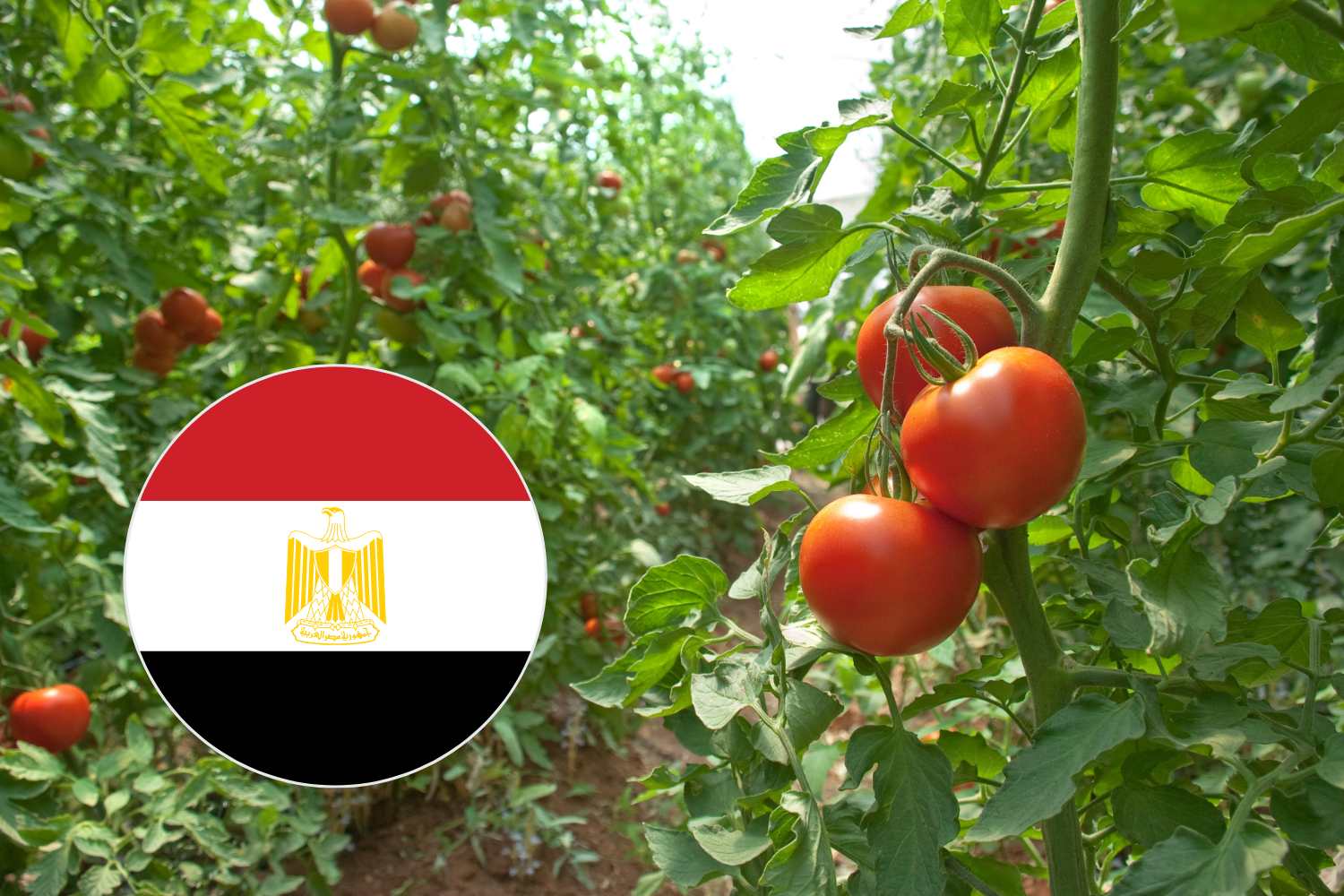
An artificial canal over 100 kilometers long, more than a million hectares to be reclaimed from the desert and an ambitious goal: to transform Egypt into an agri-food export power. It is called the New Delta Project and it is one of the most impressive agricultural expansion plans ever launched under the presidency of Abdel Fattah al-Sisi. The Italian industrial tomato supply chain is looking with growing concern at what is happening beyond the Mediterranean.
What is the New Delta Project
First of all, a clarification: the project is not exclusively about tomatoes. This is a huge agricultural conversion plan for desert areas west of the Nile Delta, built around a water infrastructure system that channels treated and reused agricultural drainage water towards new cultivable surfaces. The planned crops range from wheat to corn, from sugar beet to vegetables and among the latter there is also the industrial tomato. The objectives declared by the Egyptian government are two: to increase the country’s food self-sufficiency and to strengthen exports to Europe, the Middle East and Africa.
We had already talked about this ambitious project here on GreenMe: the New Delta is an artificial canal of 112 kilometers that promises to transform approximately 9,200 square kilometers of desert into arable land, thanks to a colossal pumping station in Al-Hamam capable of treating and distributing 7.5 million cubic meters of water every day from underground aquifers, agricultural drainage and surface water. A work that is impressive in scale, but which experts look at with critical eyes: the massive diversion of water could alter fragile ecosystems, the management of salts and contaminants in irrigated soils remains an open challenge, and the creation of extensive monocultures in a desert environment exposes the entire production to high risks of disease and loss of biodiversity.
Because Italy is worried
Italy is not just any observer in this story. It is the second largest tomato processor in the world after the United States and the largest European exporter of derivatives, with a supply chain worth around 5.5 billion euros and which depends on exports for more than half of its turnover. But it’s not just the puréed and peeled tomatoes we find on the shelves: a significant portion concerns semi-finished products such as concentrate, pulp and pizza bases, ingredients intended mainly for the Northern European food industry. And it is precisely there that the real competitive match could open up.
There is no shortage of warning signs. According to Eurostat data, in the last months of 2025 exports of tomato derivatives from Egypt to the European Union would have grown by 88% in six months. A figure that should be read with caution – it may depend on a limited starting point or on seasonal dynamics – but which nevertheless indicates a precise direction.
The issue has also come to the attention of the Italian Parliament: Mirco Carloni, president of the Chamber’s Agriculture Commission, submitted a question to ministers Lollobrigida and Schillaci to ask what initiatives the Government intends to adopt to protect the industrial tomato supply chain, in the face of growing Egyptian competition.
The question, also welcomed by Anicav (National Association of Vegetable Food Preservers), highlights the risks linked to sharply increasing exports, the use of pesticides not permitted in Europe and working practices not aligned with European standards.
Two weights and two measures
The problem is not competition itself, which is part of the rules of the market. The problem is unfair competition. Egypt can count on lower labor costs, fewer environmental constraints, supportive energy policies and phytosanitary standards different from those in Europe. Some Italian industrial associations have raised the issue of the possible use of pesticides banned in the EU, even if at the moment there are no official notifications from the European alert system that constitute systemic irregularities.
This is what the experts call “level playing field“: is it right to compete in the same market with profoundly different social and environmental rules? It’s a question that doesn’t just concern the tomato, but the entire European agricultural model.
The concrete risk for Italian farmers
The most immediate danger is not seeing Italian shelves invaded by Egyptian pastries, Italian consumers in fact remain very attached to the national origin of the product. The real risk is more subtle: downward pressure on the prices of semi-finished products, a reduction in margins for the processing industries, a progressive loss of shares in Northern European markets.
Then there is a question that goes beyond commercial competition. Is intensive farming in the desert using treated drainage water a sustainable choice in the long term? In a basin like the Nile, already under increasing water pressure, agricultural expansion into arid areas raises serious questions about water consumption, soil quality and climate resilience.
For Italy, the response to all this cannot be just defensive. We need rigorous controls on imports, transparency on production standards, coherent European policies on the environment and competition, and above all an ability to communicate the real value of a supply chain that focuses on quality, traceability and sustainability.
Sources: Anicav / Egyptian Government
