
An ancient parchment reduced to coal during the eruption of Vesuvius in 79 AD was finally deciphered: the author is the Greek philosopher Filodemo and the text is an ethical treaty.
For over two thousand years, the roll called Pherc. 172 It was considered illegible: too fragile to be open, too blackened to distinguish words. But an international team of researchers, thanks to advanced X -ray imaging technologies and the use of artificial intelligence, managed to perform an authentic enterprise: identify the author and title of the document.
The roll, kept in the Bodleian Libraries of the University of Oxfordwas attributed to the epicurean philosopher Filodemo di Gadara. The complete title, “On vices, on opposite virtues, on who he owns them and what they are”reveals a work that we could define as an ancient manual of personal ethics.
A philosophical voice that re -emerges from the ashes of Vesuvius with the help of modern science
Filodemo, philosopher and epicurean poet who lived in the first century BC, studied in Athens under the guidance of Maestro Zenone and lived for a long time in a lively Roman intellectual community, attending figures such as Horace and Virgil. Numerous his writings were found in the eighteenth century among the ruins of the Villa dei Papiri In Ercolano, presumably belonging to Lucio Calpurnio Pisone Cesonino, father -in -law of Julius Caesar and bitter opponent of Cicero.
The recently deciphered roll, Pherc. 172, is one of the three present in the Bodleian collection, donated in the 19th century by Ferdinand IV of Naples and Sicily. Although he does not coincide with the first book of the series previously identified (On ruffianism), scholars hypothesize that it can still represent the initial volume of a large ethical treaty.
Among the first words recognized in the manuscript, terms such as “confusion”, “fear” And “disgust”suggesting a direct approach to negative feelings. Other passages mention perfumes and barber shops, probably as a moral metaphors.
The Vesuvius Challenge: as two students have overcome centuries of bankruptcies
The turning point came thanks to the Vesuvius Challengea competition launched in 2023 with the aim of deciphering the Herculaneum rolls without having to unroll physically. Two German doctorals, Marcel Roth of the University of Würzburg e Micha Nowak By Gray Swan Ai, they succeeded in the company that had frustrated generations of scholars.
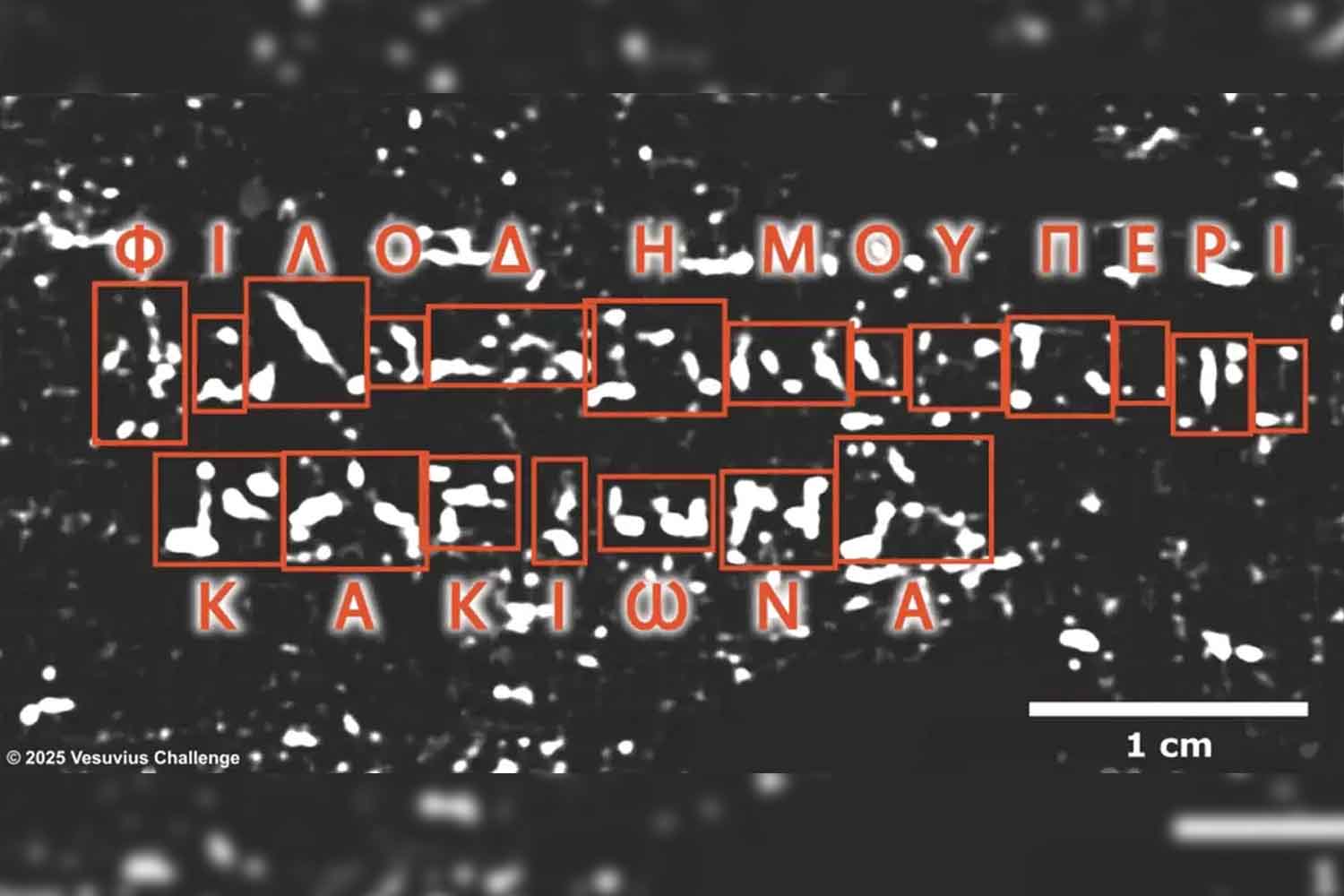
The two adapted a model of IAs born for medical imaging, applying it to very high resolution scans made with a particles accelerator of Diamond Light Sourcelocated near Oxford. After manually noted thousands of sections of the roll, the IA learned to recognize the traces of ink invisible to the human eye. The result? The identification of the Greek string Φιλοδημου περι κακιωνthat is to say Philodemus on the vices.
The work has yielded them a prize from 60,000 dollars. In parallel, also another participant in the challenge, Sean Johnsonhas come to the same conclusions, receiving equal recognition.
“An extraordinary goal,” commented Richard Orten, director of the Bodleian Library. “He demonstrates how IA can transform humanities and awaken the voice of lost civilizations.”
The lost library of Herculaneum and the hope of new finds
Pherc. 172 is only one of the approximately 800 rolls found in the Villa dei Papirithe only one Greek-Roman antiquity library come up to us. Discovered in 1750 by a farmer, the villa kept classic sculptures and texts of priceless value, miraculously charred – but not incinerated – thanks to the absence of oxygen during the eruption.
For centuries, reading attempts have led to irreparable damage: corrosive acids, scalpels, even surgical cuts. Today, the union between IA and technology allows you to explore these treasures without touching themguaranteeing integrity and future access.
The newly deciphered text is part of a wider collection dedicated to practical ethics, a central theme of epicurean thought, which conceives pleasure as absence of pain and disturbance. In addition to the fragments of Pherc. 172, they also know each other On ruffianism (book I), On the administration of property (book IX) e On arrogance (Book X), also read thanks to traditional methods.
According to Bodleian, the book number could be “alpha”, which would confirm that it is the first volume of the treaty. But it is not excluded that instead indicates the fourth (“delta”): the academic debate remains open.
A new era for ancient knowledge thanks to technology
For some time, scholars have been hypothesized that the villa of the papyrus can hide even more famous and lost works: Aristotle, Euripides, perhaps even Sappho. Most of the villa, and a possible adjacent library ,.
If the research continues, we can find ourselves in front of a real rebirth of classical literaturecomparable to that of humanism. For now, a single roll has found her voice after two thousand years, offering us a cross -section on the moral reflection of the ancients – and a taste of knowledge still buried.
