
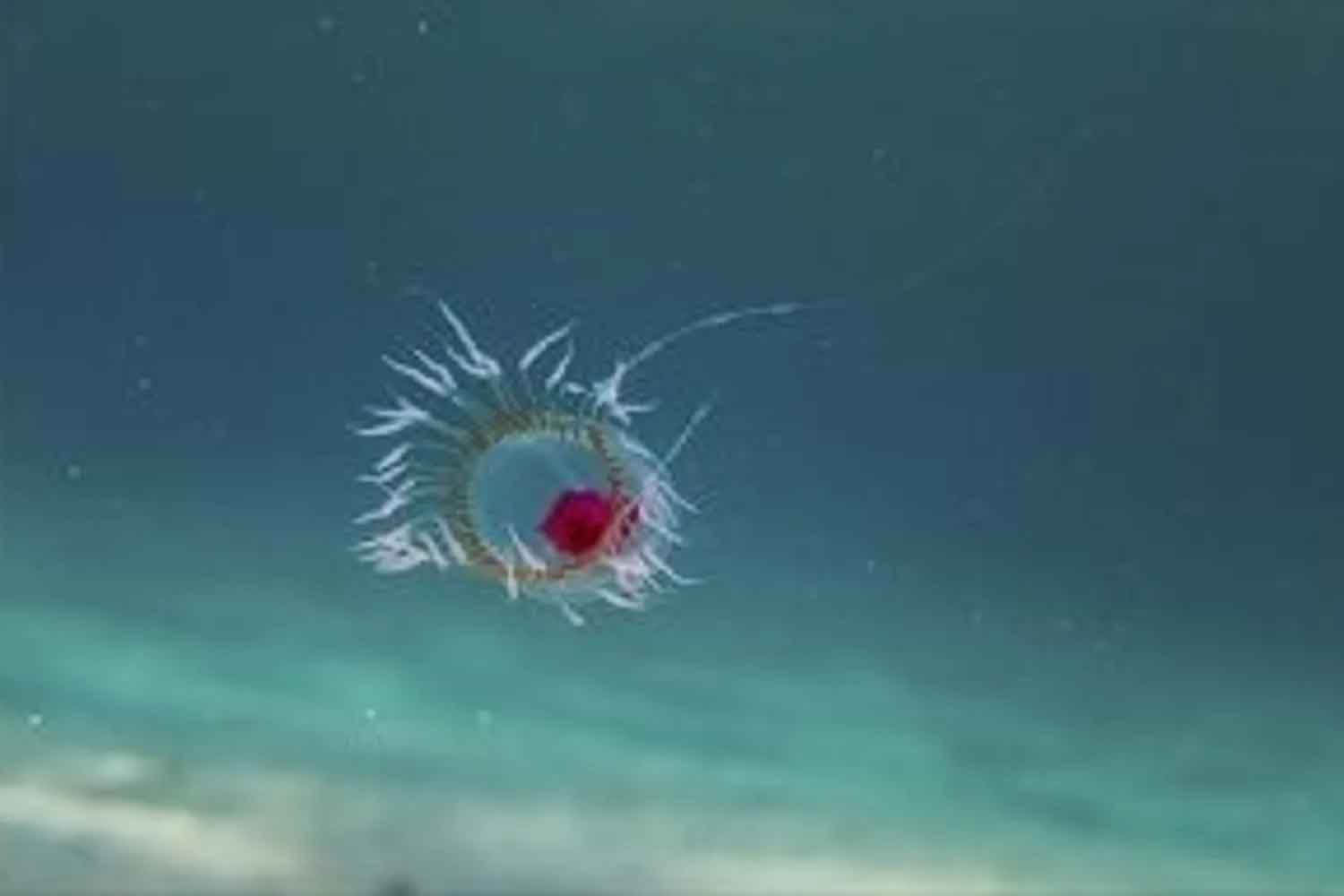
There is a marine organism that lives in tropical waters and which, unlike any other known animal, is able to go back in its life cycle, escaping death. This is why it is called immortal jellyfish. Its scientific name is Turritopsis dohrnii and its history fascinates biologists, geneticists and researchers from all over the world.
First discovered in 1883, this tiny marine creature revealed its secret only about a century later, when scientists observed its extraordinary ability to completely rejuvenate its body in response to environmental stress or physical damage.
According to Michael Layden, professor of biological sciences at Lehigh University, the immortal jellyfish could offer crucial clues to understanding how to maintain a long and healthy life. This is not science fiction or promises of immortality for man, but a concrete window on real biological mechanisms, already functioning in nature.
Layden also highlights a practical aspect that is anything but secondary: Turritopsis dohrnii is extremely economical to study in the laboratory. This makes it an ideal model for biomedical research, with enormous potential scientific returns at low costs.
Its self-healing system represents a real example of animal self-healing, a process that could pave the way for new therapies for the repair of damaged tissues and organs. No promise of immortality for human beings, but new therapeutic strategies yes.
What is Turritopsis dohrnii and how does it rejuvenate
Turritopsis dohrnii belongs to the hydrozoans, a subgroup of cnidarians, the same large family that includes corals and sea anemones. Although it is commonly called jellyfish, from a biological point of view it has some structural differences compared to the so-called “true jellyfish”.
In size, the jellyfish is almost invisible to the naked eye: it measures about 4.5 millimeters in both height and width, smaller than the nail of a little finger. And it is precisely when it finds itself in difficulty – due to hunger, injuries, temperature changes or other environmental stress – that it activates its incredible survival mechanism.
Instead of dying, the animal rewinds its life cycle. The cells of the adult individual, called medusa, are completely reorganized, transforming into a mass of tissue from which a new polyp is born, i.e. the juvenile form of the organism. This process is called transdifferentiation and can be completed in as little as 24–36 hours.
The biological process that allows you to bypass death
When Turritopsis dohrnii is damaged or stressed, it slowly sinks to the seabed. It is there that a transformation begins which, to human eyes, has something unreal about it. Adult cells, instead of deteriorating, change identity, returning to a more flexible and primitive state.
During this process, genes related to stem cell pluripotency, DNA repair, telomere maintenance, cell replication and cell-to-cell communication are activated. It is an extreme example of cellular plasticity, a phenomenon that in humans is limited almost exclusively to the embryonic phase.
Studies have shown that, under natural conditions, some colonies of Turritopsis dohrnii have managed to rejuvenate up to ten times in two years, sometimes with intervals of just a month between one transformation and another.
Because many cnidarians are considered theoretically immortal
Turritopsis dohrnii is not an isolated case in the marine world. Other cnidarians possess remarkable regenerative abilities, such as the ability to regrow lost body parts or reproduce asexually, creating clones of themselves.
Species such as corals, Hydra and Nematostella are in fact considered theoretically immortal, since they do not show real biological aging in the traditional sense. However, the immortal jellyfish remains unique because it is the only known animal capable of completely reversing its life cycle.
Of course, this doesn’t mean he’s invincible. She too can be killed by predators or extreme environmental conditions. His immortality is biological, not absolute.
According to biologist Christine Schnitzler, for decades it was thought that an adult cell, once differentiated, could no longer change its function. Turritopsis dohrnii demonstrates that this principle is not universal. His body is proof that the differentiated state of a cell can be stable, but not definitive.
Studying these mechanisms could help science develop new techniques for cell therapy, production of mature cells from human stem cells and treatments for degenerative diseases related to ageing.
Maria Pia Miglietta, a marine biologist at Texas A&M University, points out that Turritopsis dohrnii offers a rare opportunity to closely observe the genetic and epigenetic mechanisms of regeneration and aging, processes that are also fundamental to human health.
You might also be interested in:
