
It was a little noon past, the11 September 2024when a fragment of spatial rock crossed the terrestrial atmosphere and has impact on the shoreal shorelinein the province of Cosenza. No roar, no crater. Just a dry blow in the sand, a A few meters from Maurizio Sassoneowner of a bathing establishment, which saw everything with his eyes.
The fragment was immediately recovered and kept carefully. Then he was delivered to scientists, who confirmed: it is a authentic meteoritewith an estimated age of about 4.5 billion yearsthe same as ours Solar system.
A rare event in Italy, where – given to hand – In five centuries, just 48 meteorites were recovered. Scalea’s is the 48th.
The fragment is a condrite
According to the research team that analyzed it, the Calabrian meteorite is one ordinary amnestythe most widespread type of space fragments that reach the earth. Although it is “common” among the meteorites, it remains anyway A precious discoveryespecially in a country like Italy, where recoveries are so rare.
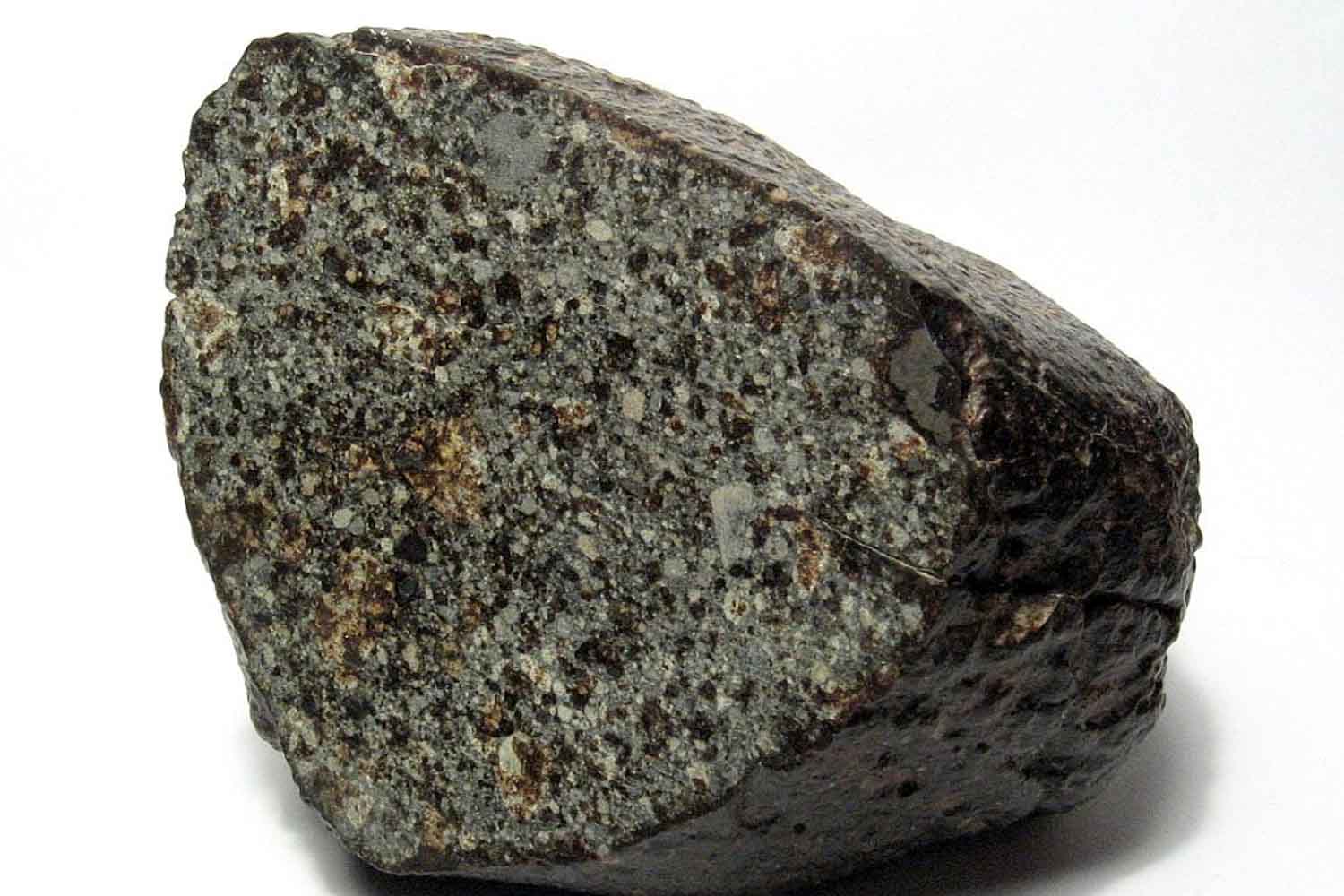
Long 7 centimeters4 wide and weighing about 190 gramsthe fragment is presented to brown colorpartly covered by one fine white powder. The surface shows one melting crusttypical of the meteorites which, entering the atmosphere, overheat until they merge superficially due to friction with the air.
Meteorite contains Olivina, Pyroxes, Plagioclasio and Calcitewith traces of green and white crystals. Elements that confirm the extraterrestrial nature And they make it an object of great interest for those who study the origin and history of our planetary system.
From heaven to science
After the discovery, Sassone did the simplest and most sensible thing: photographed the fragmentput it in one plastic baghe collected the surrounding sand and contacted an expert. From there the analyzes started, initially conducted at the Meteocert workshop of the University of Florenceand continue with the collaboration of various Italian scientific institutions.
The researchers of the meteorite were studying “La Specola” Museumof Department of Earth Sciences of the University of Florenceof theInstitute of Space Astrophysics and Planetology (IAPS) of the INAFof theItalian Space Agency (ASI) and of the Department of Physics of the University of Trento. The work was coordinated by Professor Vanni Moggi Cecchimeteoric expert.
The result of the study was just presented during the National joint congress of the Italian Geological Society and the Italian Society of Mineralogy and Petrologywhich took place at Padua from 16 to 18 September 2025.
In addition to the exceptional nature of the discovery, there is another interesting fact. The Scalea meteorite is part of a wider context, linked to the work of the network PRISMthe Italian monitoring system that supervises the sky to identify meteors and meteorites.
Thanks to Triangulation of images recorded by cameras scattered throughout the territory, Prisma has succeeded in recent years a identify and recover new fragmentscontributing to the growth of knowledge in the field of planetology and extraterrestrial geology.
The complete study is available inScientific Abstract “A New Italian Meteorite from Scalea, Cosenza: Description and Preliminary Data”published among the official materials of the SGI Congress – Simp.
