
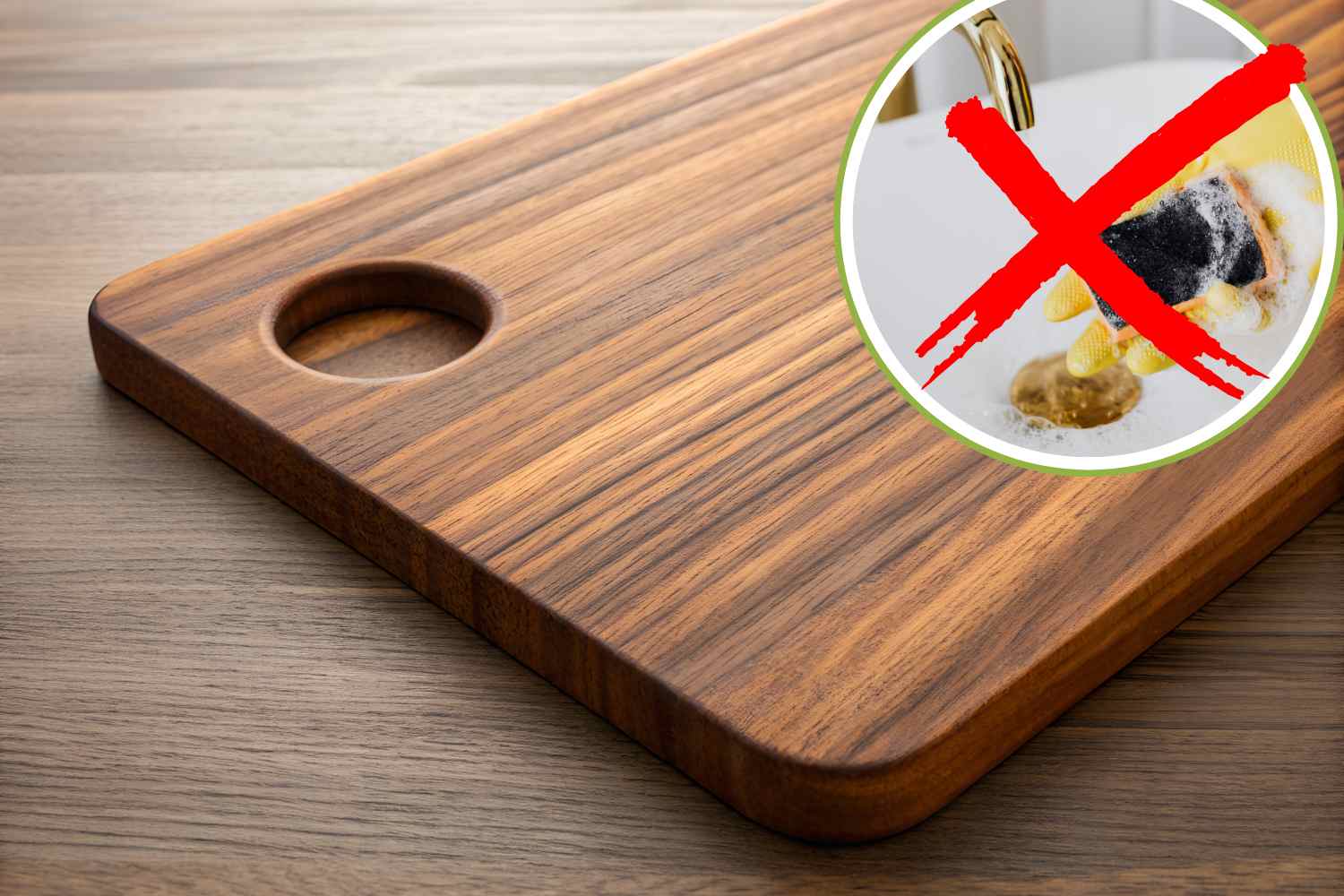
The wooden cutting board is an accessory present in every kitchen: practical, elegant, it guarantees us a solid support for cutting anything – and sometimes also for serving freshly cut food at the table, as in the case of bread or cheese.
However, it is a very difficult object to clean: the great capacity of wood to absorb odors and substances makes the chopping board unhygienic and an ideal breeding ground for the proliferation of dangerous pathogens (this is why wooden chopping boards are never found in restaurant kitchens).
Furthermore, frequent use and many cuts can ruin the surface of the wood and degrade the quality of the cutting board – which is a shame, especially if it is a high-quality cutting board.
How to clean this accessory in the right way, reducing bacterial proliferation to a minimum, and also take care of its “state of health”? Here are our recommendations which, as usual, do not involve the use of chemicals but only natural products.
The rinsing
After each use, it is essential to rinse the surface of the cutting board with very hot water: this will help us eliminate food residues and somehow sterilize the surface.
Let’s not settle for the hot water that comes out of the tap. Let’s boil some water in a saucepan and, when it has reached the boiling point, pour it onto the cutting board positioned inside the sink basin (being careful not to burn ourselves).
Cleanliness
After pouring boiling water on the surface of the cutting board, we proceed with the actual cleaning. We do not recommend using common dish detergent or other chemical substances: as we have said, the wood of the cutting board absorbs odors and substances, and would end up absorbing substances that are harmful to our body.
Our advice is to use natural products that are not harmful to our health. We can, for example, use a “scrub” made with coarse salt and lemon to sanitize the surface of the cutting board, eliminate stains and bad odors.
Pour a generous amount of coarse salt onto the still wet cutting board, then take half a lemon (even used) and use it as if it were a sponge to rub the salt on the wood. The salt will help to physically remove the remaining traces of food while the lemon juice, with its anti-odor and anti-bacterial actions, will help us sanitize the cutting board.
Be careful not to rub too hard, as the wood could become scratched and damaged. Holding the lemon in the center of the palm of your hand, proceed with rotating movements, drawing small circles on the surface of the cutting board clockwise and anti-clockwise.
The treatment
Now that our cutting board is very clean, rinse the cutting board with running water and pat it dry with a clean cloth before letting it air dry. It is important that the wood is completely dry, if we do not want to risk dangerous mold forming on the cutting board.
Once clean and dry, we can “nourish” the wood with linseed oil, which will restore shine and elegance to the cutting board. We pour a few drops of oil directly onto the wood, then massage the entire surface using a cotton ball or dry cotton cloth.
Our cutting board will be like new! The treatment with linseed oil should not be carried out every time the cutting board is cleaned: it is a maintenance operation to be carried out once a month – or even more rarely, if we do not use this object often.
When to replace the cutting board
Even with the best maintenance, your wooden cutting board doesn’t last forever. There are some unmistakable signs that tell us when the time has come to replace it with a new one. Deep cracks are the first alarm bell: it is not just an aesthetic problem, but a hygiene one. In fact, these cracks become real receptacles for bacteria that are impossible to reach and clean, even with the most accurate methods. If our cutting board has very deep grooves or cracks on the surface, it’s time to think about replacement.
Another sign not to be underestimated is the presence of persistent odors that we cannot eliminate even after repeated washing with lemon and salt. This means that the wood has absorbed so much that it can no longer be sanitized effectively. Finally, obvious deformations such as warping or swelling indicate that the wood has suffered damage from water penetration and has lost its structural integrity.
Common mistakes to avoid
Many of the mistakes we make when caring for a wooden cutting board stem from treating it as if it were plastic. One of the most common mistakes is leaving the cutting board soaking in water: this causes the wood to swell which, once dry, deforms and cracks. The wood needs to be washed quickly and dried immediately afterwards.
The dishwasher is the number one enemy of the wooden cutting board. High temperatures, prolonged cycles and aggressive detergents irreparably damage the wood, which splits and loses its compactness. The use of bleach or other overly aggressive chemical products is also not recommended: in addition to being absorbed by the wood (with the risk of ending up in our food), these products excessively dry the wood fibers, making them fragile.
Finally, resist the temptation to speed up drying by exposing the cutting board to direct heat sources such as radiators, stoves or intense sunlight. Sudden heat causes cracks and deformations. Drying must occur naturally, in the air, possibly in a vertical position.
Prevention tips
Prevention is always the best strategy to keep our cutting board in good condition for as long as possible. A golden rule is to use different cutting boards for different foods: one dedicated to raw meat and animal proteins, another for vegetables, bread and cheese. This not only prevents cross-contamination, but also protects our precious wooden cutting board.
In fact, it would be preferable to completely avoid cutting raw meat on wood, instead opting for plastic cutting boards which are much easier to sanitize and can be washed in the dishwasher at high temperatures. Wood is perfect for bread, cheese, cured meats, vegetables and fruit, but for raw meat plastic is safer from a hygienic point of view.
Finally, let’s pay attention to how we store the cutting board when we’re not using it. The vertical position is ideal because it allows air to circulate on both surfaces, preventing the formation of mold and bad odors. If we store it horizontally in a drawer or cupboard, make sure it is completely dry and that there is sufficient ventilation.
We also recommend:
