
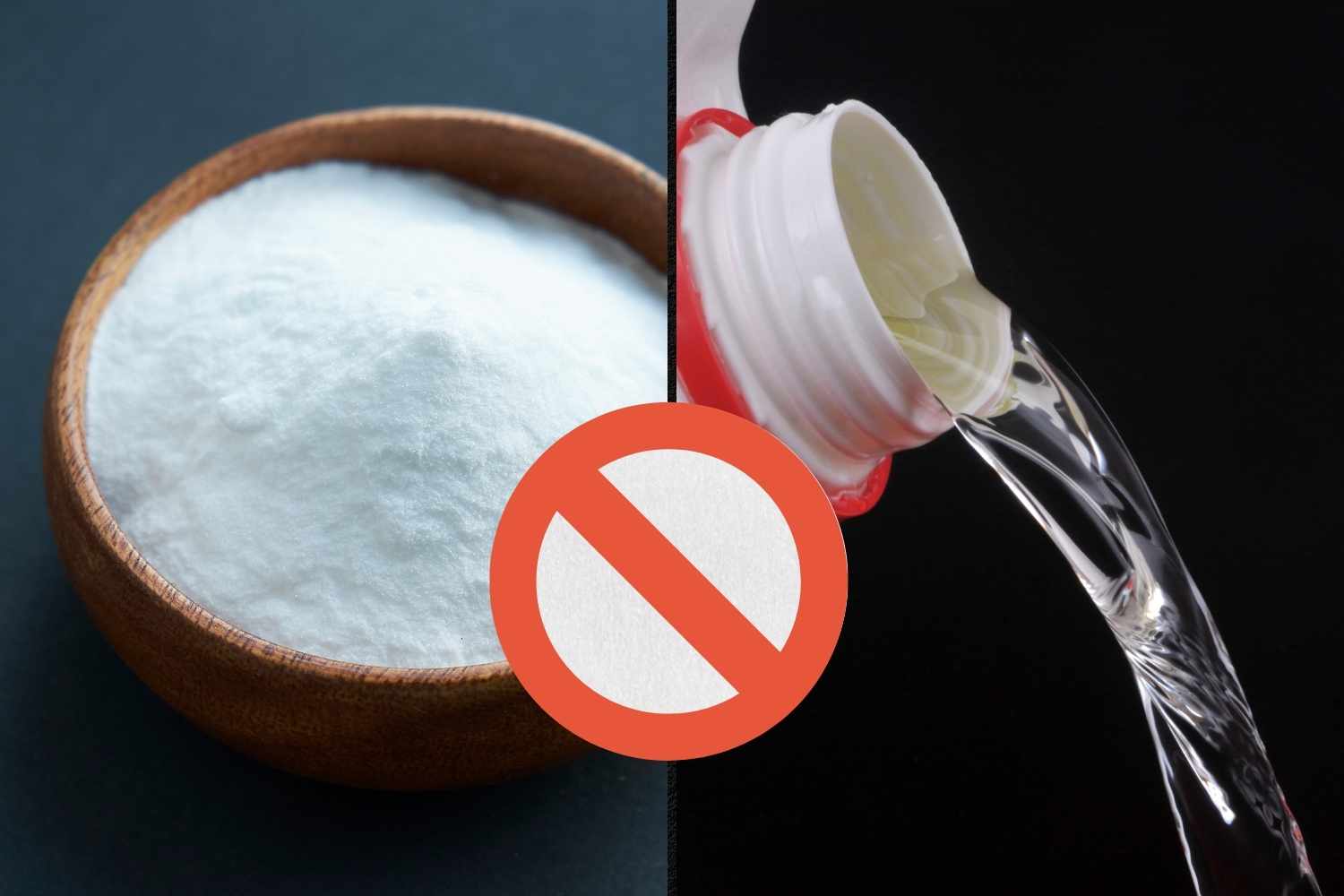
Sodium bicarbonate is one of those products that we all have at home and that we often use for cooking, eliminating bad odors from the refrigerator and for cleaning the most delicate surfaces. The enormous versatility makes it a precious ally for household chores, although there is a very common mistake that can transform this harmless ingredient into something potentially harmful, namely mixing it with bleach. Let’s see why.
A seemingly harmless combination
At first glance it might seem like a good idea, since bleach disinfects, bicarbonate cleans and absorbs odors, so why not combine them to get an even better result? Unfortunately, chemistry doesn’t work like that, and when two substances meet, they can give rise to unpredictable reactions, an aspect that also applies to the products we use every day without problems.
Bleach is a solution of sodium hypochlorite, while bicarbonate is sodium bicarbonate, both have a basic pH, a common characteristic which however does not make them automatically compatible. Hypochlorite is in fact a very reactive substance: a change in pH, or the wrong combination, is enough for it to begin to degrade, releasing irritating compounds. It is not an explosion, of course, but neither is it a neutral mixture without consequences.
Because it doesn’t work the way we think
Many people are convinced that combining baking soda and bleach produces a super-cleaner capable of cleaning better and faster. The reality is exactly the opposite, because hypochlorite works optimally on its own, keeping its disinfectant properties intact. Bicarbonate, for its part, is useful as a light abrasive or to neutralize odors, but it does not “enhance” the action of bleach at all.
When you mix them, you reduce the effectiveness of both products. It’s like wanting to improve a recipe by adding an ingredient that actually alters the flavor: the final result is worse than the sum of the parts.
The health risks
Even though bicarbonate is not an acidic substance, bleach, if destabilized, can still generate small quantities of chlorine or chloramines. The result is a pungent odor and irritation of the eyes and respiratory tract. These are not serious effects like those that would be obtained by mixing bleach and vinegar or ammonia, but they are still annoying and completely avoidable.
Those who have tried this combination have often noticed an unpleasant odor permeating the environment, a signal that should immediately make it clear that something is wrong. Our body reacts to potentially harmful substances, and ignoring these warnings is never a wise choice.
How to use them correctly
The solution is simple: use the two products separately.
The golden rule of cleanliness
In general, when it comes to cleaning products, there is a fundamental rule of never mixing different substances if you are not absolutely certain of the result. Home chemistry may seem simple, but reactions between compounds are often more complex than we imagine. Bleach, in particular, should always be used alone. It doesn’t need “helpers” to do its job, and any addition risks only creating problems.
Separated, bicarbonate and bleach work better and in complete safety, together they represent an unnecessary risk that is not worth taking.
