
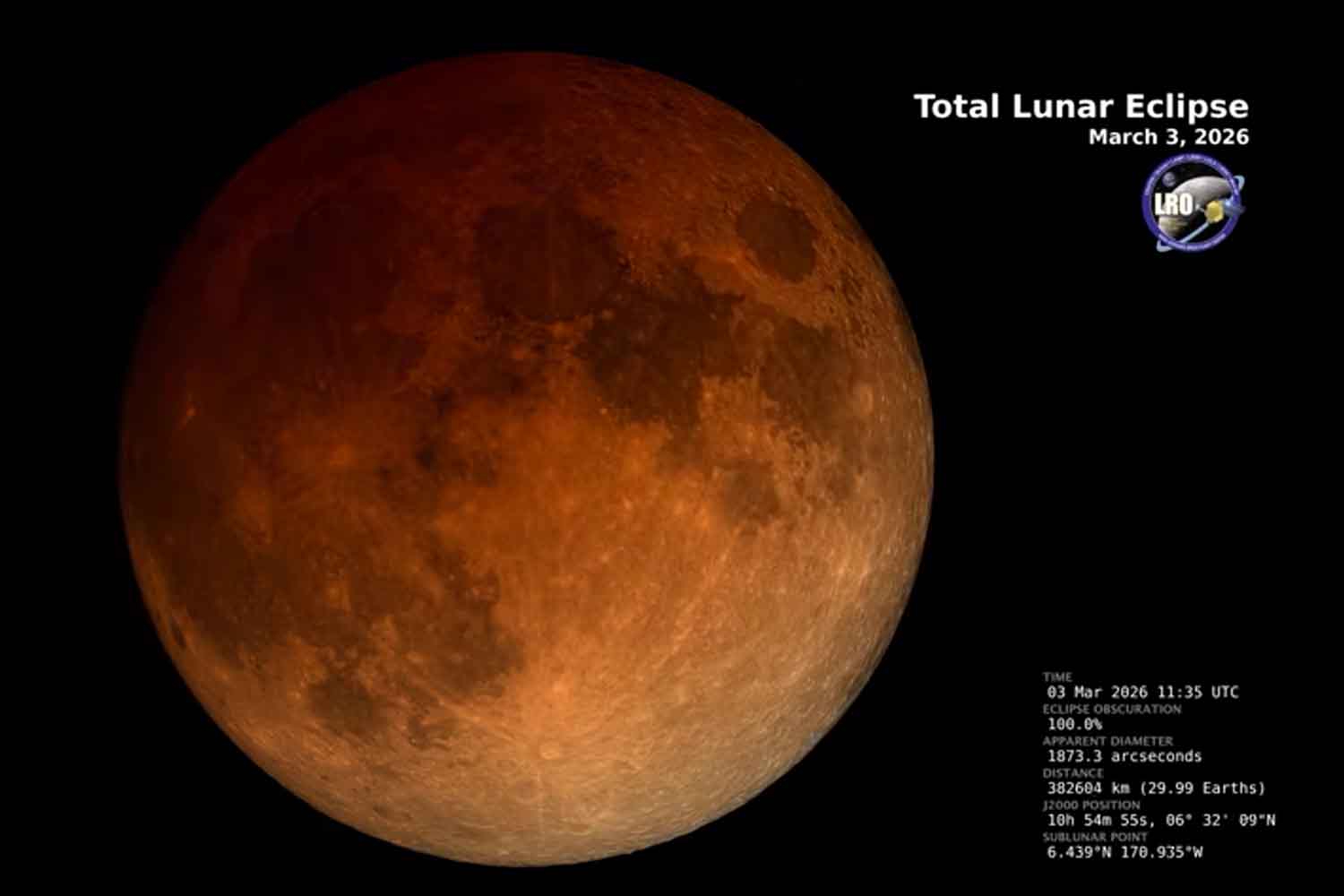
The March 3, 2026 the sky will give one of those shows that make even the most distracted people look up: one total lunar eclipsethe so-called blood moon. For almost an hour our satellite will be colored intense red, transforming into a suspended, almost unreal disk.
THE’total lunar eclipse of March 3, 2026 it will happen during the full moon. At that moment the Earth will be exactly between the Sun and the Moon, casting its shadow on the satellite. When the Moon completely enters the Earth’s shadow cone, the most suggestive phase will begin, the totalitywhich will last approximately 58 minutes.
The entire phenomenon – including the penumbral and partial phases – will extend beyond five hours. The maximum of the eclipse is expected around 11:33 UTCthat is, the 12:33 Italian time (CET).
And it is precisely here that explains why we will not be able to attend the show in Italy: at that time the Moon will be below the horizon. In other words, it will not be in our sky. It doesn’t matter whether you’re in the North, the Center or the South: the blood moon of March 3, 2026.
This is not a rare exception: lunar eclipses are global phenomena, but their visibility depends on geographic location and local time. Sometimes it’s up to us, other times it’s not.
Where the total lunar eclipse on March 3, 2026 will be visible
If Italy remains to watch the streaming images, other parts of the planet will be able to enjoy the scene live. The event will be observable especially in East Asia, Australia, Pacific Regions and Americasespecially the western part of North America
In many areas of the American continent the eclipse will be seen before local dawn, while in the Pacific area and in Australia it will be possible to follow much of the phenomenon during the night.
The good news is that one total lunar eclipse it can be observed in complete safety with the naked eye. No filters or special protections are needed, as happens with solar eclipses. Binoculars can help you grasp the nuances better, but they are not essential.
Why the moon turns red during a total eclipse
The definition of blood moon there is nothing mysterious about it, even if the effect is scenographic. When the Earth comes between the Sun and the Moon, sunlight is not completely blocked. Some passes through the Earth’s atmosphere. And this is where something fascinating happens: the atmosphere filters the light, disperses the blue components and especially lets the red and orange tones pass through. This “deflected” light reaches the lunar surface and colors it red. It is the same principle that makes sunsets spectacular, but projected into space.
THE’total lunar eclipse of March 3, 2026 it will be one of the most anticipated astronomical events of that year. After this appointment, we will have to wait a little longer to witness a new, widely visible totality. For us Italians, as mentioned earlier, the appointment is postponed. And perhaps it is also a reminder: the sky is not a given, it is not always available when we want it. Sometimes you have to wait for the right moment.
