
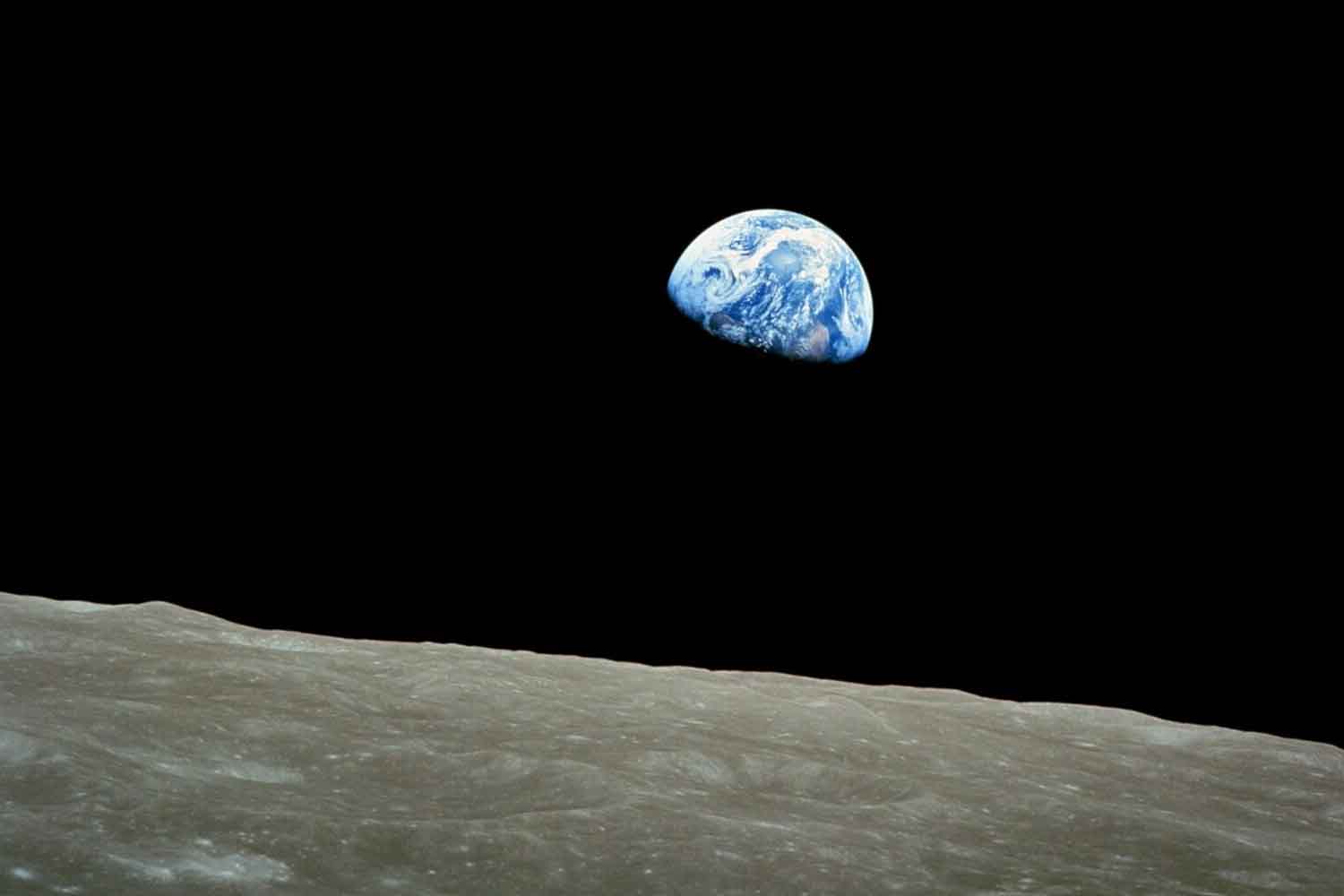
There Moonwhich has always accompanied our nights and influences the tideis moving away from the earth. Every year moves of about 3.8 centimeters further from us. A tiny distance on a human scale, but which over time has real effects: one above all, The days on earth are always becoming a little longer.
It is not a hypothesis: it is a data measured with precision by scientists, who use laser reflected by mirrors left on the moon by the Apollo missions and some space probes. In practice, they shoot a laser beam towards the moon and measure the time it takes to go back. From there they calculate the distance, with a millimeter precision.
All the fault of the tides
But why does the moon go away? The main cause are the tide forcesthat is, the effect that the gravity of the moon exercises on earthin particular on the oceans’ water.
The gravitational force of the moon is stronger on the side of the planet closest to her, and weaker on the opposite one. This creates Two swellings of waterone facing the moon and one on the opposite side. But there is an important detail: because of the rotation of the earththese swellings, but a little later.
These “bozzi” of water, which move together with the rotation of the planet, in turn exercise a force on the moonpushing it slightly forward along its orbit. Result: the moon earn energy And he walks away, a bit like a swing that takes momentum.
In the meantime, however, Earth loses rotational energyand this causes that Its rotation slows down. In other words, i days become longereven if for now only of a few milliseconds every century.
In the past the moon was closer and the days lasted less than 24 hours
If we looked back in time, we would see a moon much closer And much bigger in the sky. It is estimated that approximately has been formed 4.5 billion years agoafter a collision between the primordial land and a celestial body as big as Mars. The fragments of this impact then joined the moon forming.
And with the closest moon, the earth turned faster. How do we know? Studying Fossils of ancient shellspaleontologists have discovered that 70 million years agowhen the dinosaurs were still alive, One day it lasted about 23 and a half hours. A figure that perfectly matches with astrophysic calculations.
What will happen in the next billions of years?
Looking to the future, what could happen if the moon continues to move away? Scientists speculate that, between billions of yearsthe earth and the moon could reach a situation of sea block: Our planet would turn on himself at the same speed with which the moon turns around him. In that case, from one half of the earth you would always see the moon, while on the other it would never be seen.
But this scenario, however fascinating,. Before it happens, the sun will become thus bright from evaporate the oceanseliminating the effect of the tides. And a few billion years later, yes will expand by becoming a red giantmost likely incorporating both the earth and the moon.
All this has no immediate impacts, neither on our daily lives nor on the climate. But it’s a fascinating reminder how dynamic the earth-long system is, and how Small invisible forces to the naked eye They can, in the long run, transform our planet.
And while we enjoy A Night of the full moon or a walk on the beach with the tideit is worth remembering that the moon is doing something more: He is slowly redesigning time on earth.
