
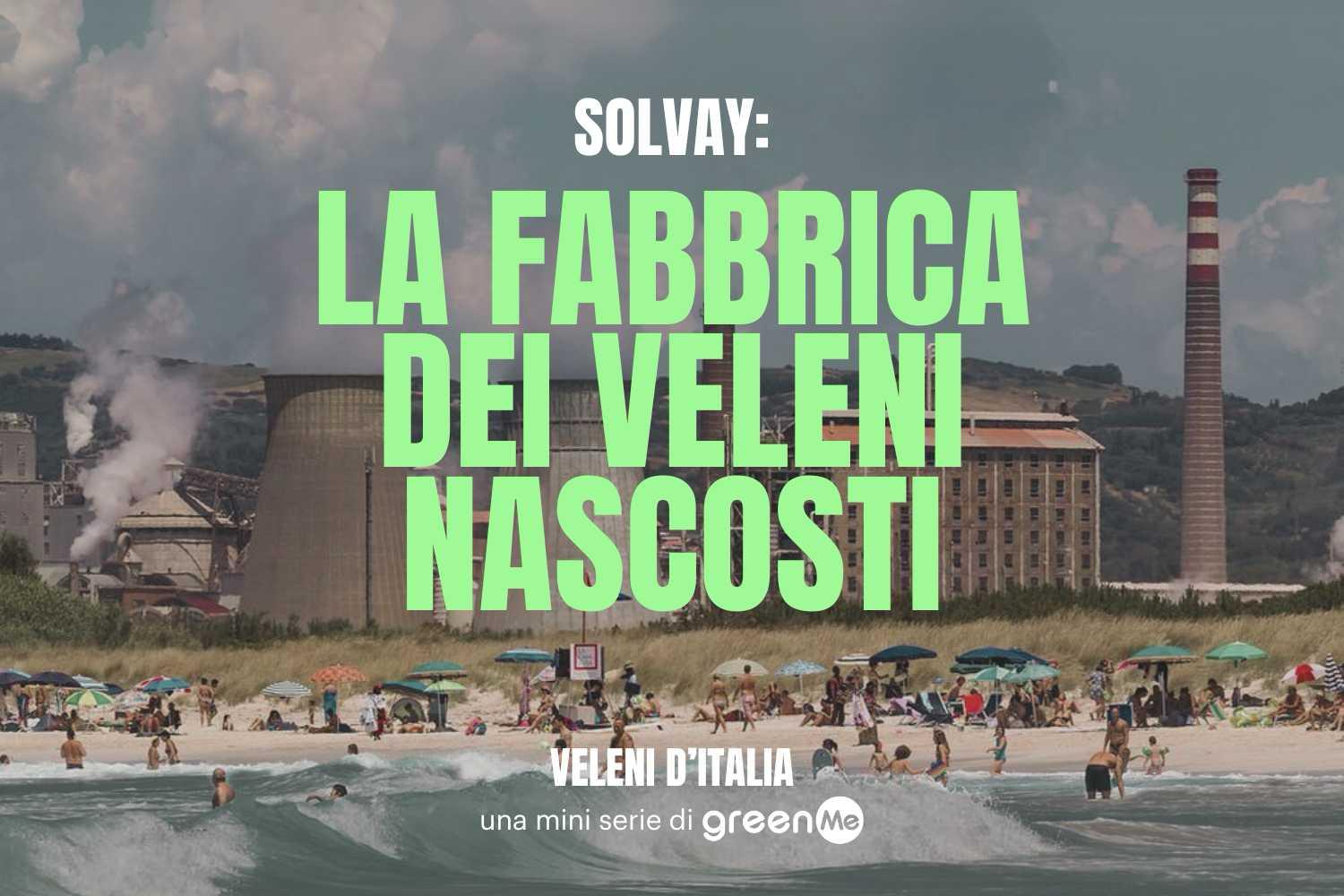
The white beaches of Rosignano tell a complex story: that of a broken balance between industry and the environment. An artificial beauty that, beneath the surface, hides a toxic legacy. Come with us in the fifth and final episode of “Veleni d’Italia”, to find out what’s really under that white sand
At first glance, the beaches of Rosignano Marittimo, in the province of Livorno, seem like a corner of the Caribbean transplanted into the heart of Tuscany. White sand, blue water and breathtaking landscapes. But behind this apparent beauty lies one of the most polluted areas of the Mediterranean Sea.
The reason? The Solvay plant, among the largest in Europe for the production of sodium carbonate (commonly known as soda), has been active in the area for over a century.
Founded in 1912, the company has transformed the local landscape and community, undoubtedly bringing economic development and jobs. But the environmental price is very high. It’s serious.
The white beaches and the chemical effect
The characteristic white color of the sand is due to the residues of calcium carbonate and soda resulting from the industrial process. The turbid water is instead full of chalk and limestone, and marine vegetation has been virtually absent for decades.
The main drain, called White Ditchreleases tons of chemicals into the sea every day, including arsenic, mercury, chromium and benzene. We are talking about millions of cubic meters of wastewater every year. And, incredibly, all of this is legal.
The law that allows toxic discharges
Since 2015, the so-called “Sblocca Italia” Decree (DL 91/2014, converted into Law 116/2014) allows exemptions from industrial waste based on the production capacity of the plant, even when the substances exceed the concentration limits normally envisaged. In practice, a company can continue to pollute, as long as it is “authorized”.
In any case, UNEP, the United Nations Environment Agency, has included Rosignano among the most compromised coastal areas in the world, estimating the costs for a complete cleanup at over 40 million dollars.
Furthermore, to produce bicarbonate you need water and salt, which Solvay extracts locally: water from the Cecina river, salt from the Volterra salt pans. Water consumption exceeds 10 million cubic meters per year, paid by the Belgian multinational less than 4 cents per cubic meter. A withdrawal which, over time, has contributed to problems of hydrogeological instability and environmental stress throughout the area.
Health, legality and contradictions
Despite restrictions on bathing in some areas and signs indicating the ban, the white beaches continue to attract tourists, who are often unaware of the situation. A contradiction that has been discussed for years.
According to a study by the CNR of Pisa, in the areas surrounding the plant there is a tumor risk up to 300% higher than the regional average. Furthermore, numerous judicial investigations have highlighted irregularities in the disposal of industrial sludge, including documented incidents of fish deaths and contamination of the seabed.
And today?
In 2024, the European Parliament approved an update to the Water Framework Directive, requiring Member States to carry out greater monitoring of industrial discharges and require public transparency on environmental data. But, at the moment, Italy has not yet fully implemented the new rules.
In the meantime, the local community, environmental committees and scientific associations are calling for a review of the environmental authorizations granted to Solvay and a serious plan for the reclamation and sustainable reconversion of the area.
Meanwhile, the paradox: Solvay, with a turnover of over 10 billion euros globally, continues to hold the monopoly on bicarbonate production in Italy, also thanks to multi-year state concessions for salt extraction.
