
Smog in Italian cities? Good but (obviously) not great. It is reducing, of course, but not enough to consider us safe. In 2025, the number of provincial capitals that have exceeded the daily PM10 limits (50 micrograms per cubic meter for a maximum of 35 days a year) will drop to 13, compared to 25 in 2024, 18 in 2023 and 29 in 2022.
This is one of the most positive data in recent years, but it should not make us lower our guard. Let’s see why.
This is what emerges from the new report “Mal’Aria di città 2026” by Legambiente, which photographs a situation made of lights and shadows: the number of capitals that exceed the daily PM10 limits is decreasing, but the reduction of pollution is proceeding too slowly to guarantee a real turning point.
Cities that exceeded PM10 limits in 2025
Last year, 13 provincial capitals exceeded the daily PM10 limit (50 micrograms per cubic meter for more than 35 days), one of the best figures in recent times but still worrying.
The black jersey goes to Palermo, with 89 overruns recorded by the control unit called “Belgium”. They follow:
In the rest of the monitored capitals, no exceedances beyond the legal limits were recorded and, as in recent years, no city exceeded the annual values expected for PM10, PM2.5 and nitrogen dioxide.
The good news
The most encouraging data is precisely the reduction in the number of illegal cities, which fell from 25 in 2024 to 13 in 2025 (they were 18 in 2023 and 29 in 2022).
A significant improvement, partly linked to favorable weather conditions and the progressive decline in emissions thanks to technological innovation. However, Legambiente warns, this is not yet the result of truly effective structural policies: without more incisive interventions the positive trend risks stopping.
European 2030 objectives (still far away)
The scenario changes radically when looking at the new EU limits which will come into force from 1 January 2030:
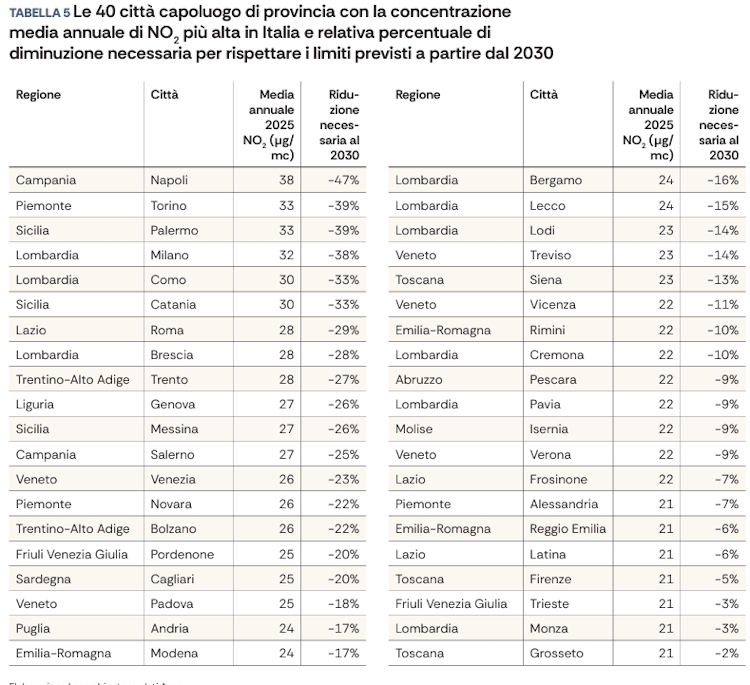
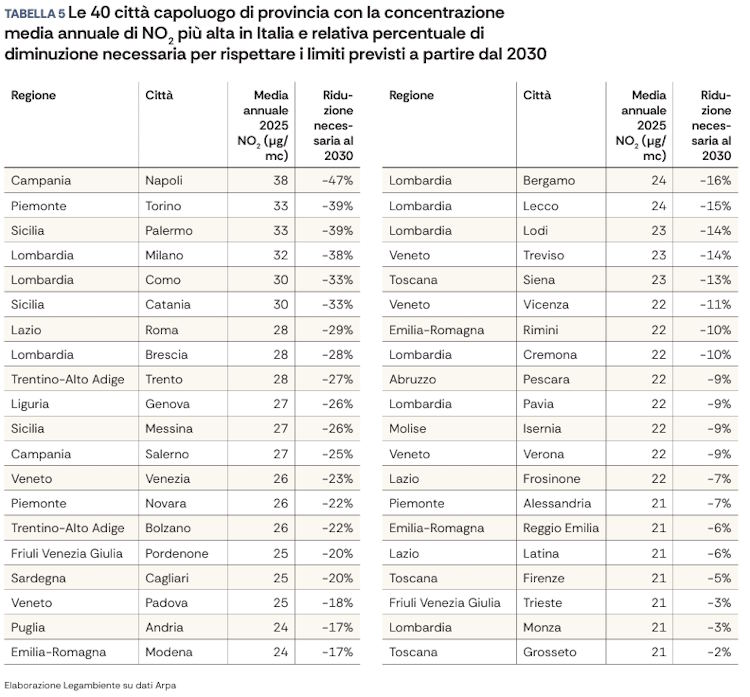
Many cities should drastically reduce concentrations: among the most critical situations are Cremona, Lodi, Verona, Turin and Naples for PM10, while for PM2.5 Monza, Cremona, Rovigo, Milan and Pavia stand out. Regarding nitrogen dioxide, the greatest distances from the target are recorded in Naples, Turin, Palermo and Milan.
The picture is also worsened by the new European infringement procedure launched in 2026 against Italy for failure to update the national air pollution control program.
The analysis of trends over the last fifteen years shows that 33 cities risk not reaching the 2030 targets by maintaining the current rate of decrease in PM10.
Among these: Cremona, Lodi, Verona, Cagliari, Naples, Milan, Turin, Palermo and Ragusa.
On the contrary, centers such as Rome, Florence, Bologna, Bari, Trento and Ravenna are on the right trajectory to fall within the new limits.
The Po Valley is still a critical area
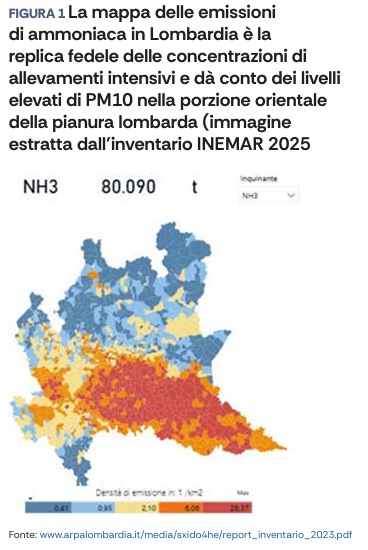
The Po Valley remains one of the most polluted areas in Europe. Today the critical issues do not only concern large cities, but increasingly small towns and rural areas, also due to the impact of intensive farming. A transformation that requires targeted policies and adequate resources, put at risk by recent cuts to funds allocated to air quality.
What does it really take to change course?
Well, the fact is certain: reversing the trend of air pollution requires structural, coordinated and continuous interventions, in an overall strategy capable of acting on all the main sources of emissions.
The first front is that of mobility, with decisive investments in local and regional public transport, the extension of low-emission zones and the widespread development of cycling and pedestrian mobility. Reducing the use of private cars, especially in the most congested urban areas, remains one of the most effective levers for reducing fine particles.
It is also essential to intervene on buildings and domestic heating. The energy requalification of the building stock and the progressive abandonment of the most polluting boilers are key steps to reduce emissions, particularly in the Northern regions where heating significantly affects air quality.
Another issue concerns industrial activities, for which more stringent limits on emissions are needed, plans to remediate contaminated sites and a technological transition towards less impactful production processes.
No less important is the transformation of agriculture and intensive livestock farming, responsible for a significant share of ammonia and other precursors of fine particles. Improving wastewater management, reducing the intensity of farming in the most critical areas and promoting sustainable agricultural practices therefore becomes essential.
All this, underlines the environmentalist association, must be based on certain economic resources and on strong coordination between the State, Regions and Municipalities, avoiding cuts that risk compromising the progress already achieved. At the same time, it is necessary to strengthen the pollutant monitoring systems, expanding the detection networks and introducing more precise controls also on substances that are currently less monitored but which are crucial in the formation of smog.
Only with integrated and long-term action, concludes Legambiente, will it be possible to truly reduce air pollution and protect people’s health.
The positive signs of 2025 demonstrate that improvement is possible. But without courageous political choices and continuous investments, Italy risks remaining among the European countries with the most polluted air and the greatest health impacts linked to smog for a long time to come.
HERE you can find the complete report.
