
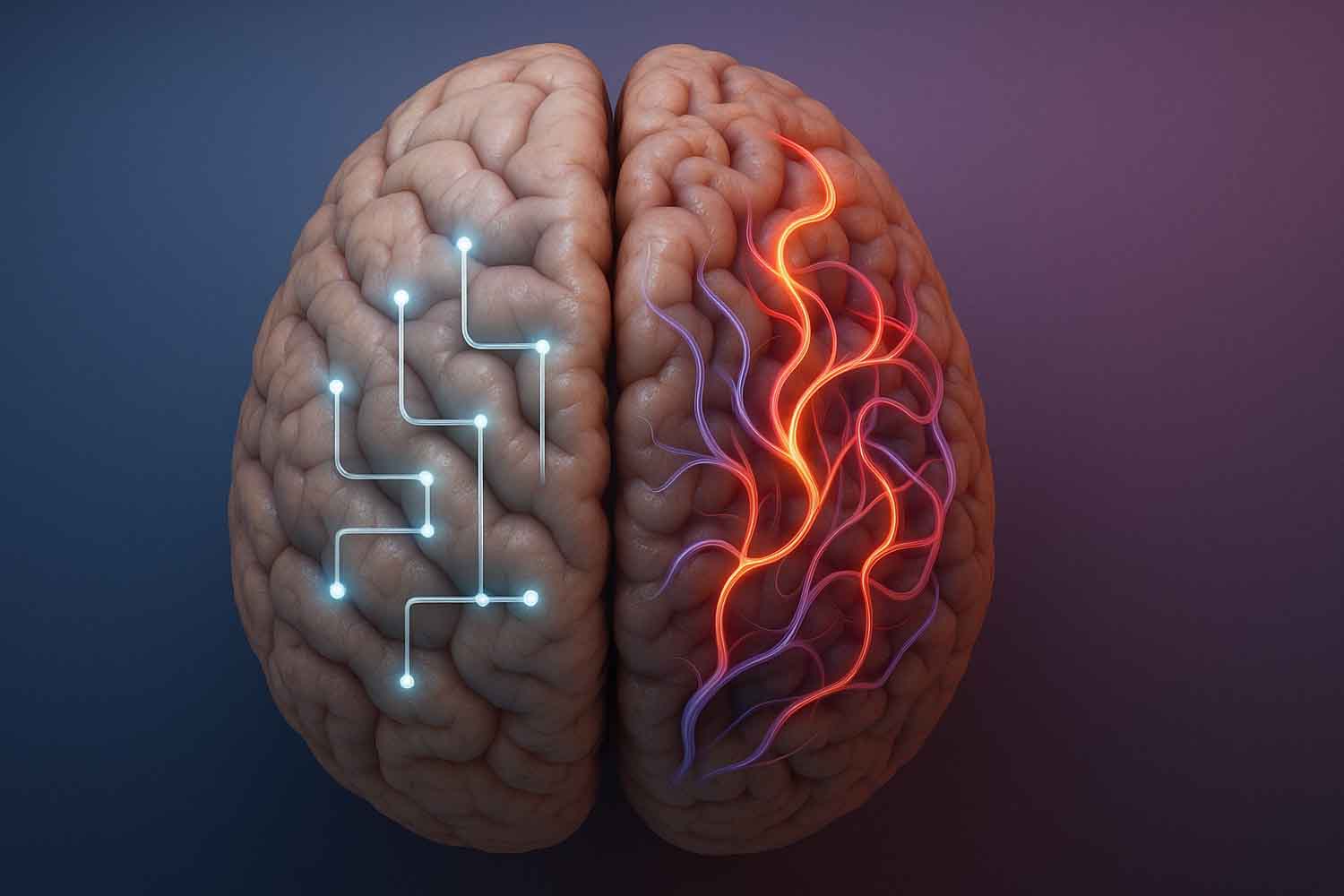
When we talk, we do not just use grammatical words and rules: we are setting in motion entire brain networks. A recent study published on Neuroimage He has shown that the mother tongue does not remain only in memory, but leaves a physical imprint in the adult brain.
The researchers analyzed the “wiring” of the white substance of two groups of adults: native speaker and mother tongue with the “wired” and native Arabi. The comparison revealed that the two languages, deeply different by structure and use, are reflected in distinct ways of connection between the brain areas.
Talk German or Arabic: the brain is structured in a different way
According to the results, those who speak German since childhood show more dense connections within the left hemisphere, specialized in the elaboration of the syntax. It is no coincidence: the German language is characterized by long phrases, complex subordinates and a rigid grammar that requires a great work of syntactic organization.
Arabophon adults, on the other hand, present a different pattern. Arabic, based on consonantic roots and strongly dependent on the context and meaning, seems to strengthen the connections between the two hemispheres. The connections are in fact more marked between the linguistic areas of the left side and those of the right hemisphere, promoting greater integration between shape and content.
What surprises is that these differences do not concern children in the development phase, but adults already trained. This indicates that the mother tongue shapes the structure of the brain in a lasting way, and that the characteristics of the language learned in childhood continue to model neuronal networks even in old age.
Not a limit, but an adaptation
The authors point out that these are not advantages or disadvantages, nor a superiority of one language on the other. Each idiom stimulates the brain differently and leaves an imprint that reflects the specific processing needs of that language.
The main result of this study is that the linguistic experience does not reduce to a set of memories: it is physically incorporated into our brain architecture. A further confirmation of how much language is a decisive factor in the construction of our cognitive identity.
You may also be interested in:
