
Every day thousands of people cross Place de la Concorde to Paris without actually stopping to look at it. THE’Luxor obelisk it is there, in the center of the square, solid, silent, apparently immobile in time. Yet, today we know that it was never a simple decorative monument. Those engravings that seem distant and incomprehensible hide a refined language, designed to be understood only by those who possessed the right tools to understand.
A recent discovery has brought attention back to this granite giant: some of its hieroglyphics were not intended for everyone, but for a small elite of ancient Egypt, capable of reading multiple messages engraved in the stone.
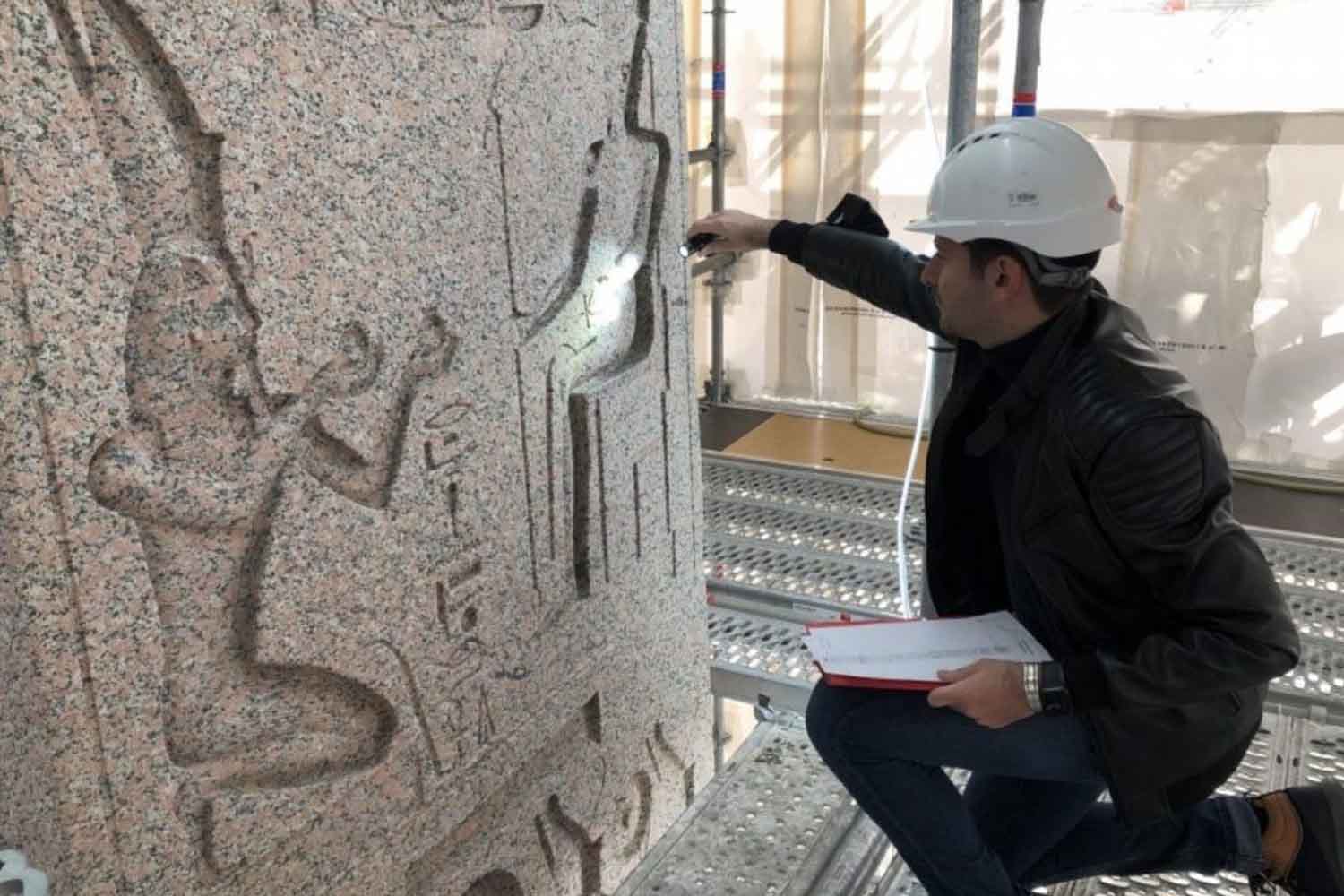
The turning point came during the restoration work on the obelisk, allowing for the first time to closely observe parts that were normally unattainable. Right up there, where the gaze of passers-by cannot reach, there are engravings that change meaning depending on the angle from which they are read.
He studied them Jean-Guillaume Olette-PelletierEgyptologist and lecturer atUniversity of Sorbonnewhich for years has been analyzing the way in which the ancient Egyptians planned the use of sacred inscriptions. They didn’t write just to tell stories, but to guide the gaze, select the audience, construct different meanings in the same space.
Reading the right way changed everything
Hieroglyphics don’t work like our alphabet. The figures indicate the reading direction and, in some cases, the meaning of the words changes completely if you start from the wrong point. In some inscriptions on the Luxor obelisk, scribes deliberately stretched these rules, creating a form of cryptic writing.
Only those who knew rare phonetic values and advanced conventions could grasp the hidden message. For everyone else, those same engravings remained silent. This is also why, even today, only very few specialists are able to really read these texts.
A monument designed for the Nile
When the obelisk stood in front of the temple of Luxor, its audience was not that of the crowded squares. During the Opet festival, elite boats sailed up the Nile and observed the monument from a precise perspective. From there, some scenes suddenly became clear.
On one side, the pharaoh Ramesses II he appears while making offerings to the god Amun. Read from the correct angle, that scene conveyed a very powerful political message: the sovereign was not just a king, but a figure chosen and legitimized by the divine, impossible to question.
Details matter too. A different crown, engraved on only one side, unites Upper and Lower Egypt in an image that speaks of unity and control. Elsewhere, the presence of bull horns next to an offering table suggests ritual instruction, an invitation to appease the deities through gifts and incense. Text and image merge, creating a complex language that didn’t need to be explained. It was enough to know how to read it.
From sacred propaganda to urban element
In the 19th century the obelisk was donated to France and placed in Place de la Concorde. Standing over 23 meters tall and weighing more than 200 tons, it became part of the Parisian landscape. But by changing location, it lost its original context. Those inscriptions, designed for a selected audience and for precise observation points, were transformed into simple ornamentation. Only the recent restoration has allowed the modern look to be realigned, at least in part, with the ancient one.
According to Olette-Pelletier, Egyptian cryptic writing can change the way we read many already known pharaonic texts. There is no need to discover new monuments: we just need to learn to look better at those we have had before our eyes for centuries. The Luxor obelisk reminds us that the past is never completely silent. Sometimes he speaks in a whisper, and only to those who are willing to really listen.
