
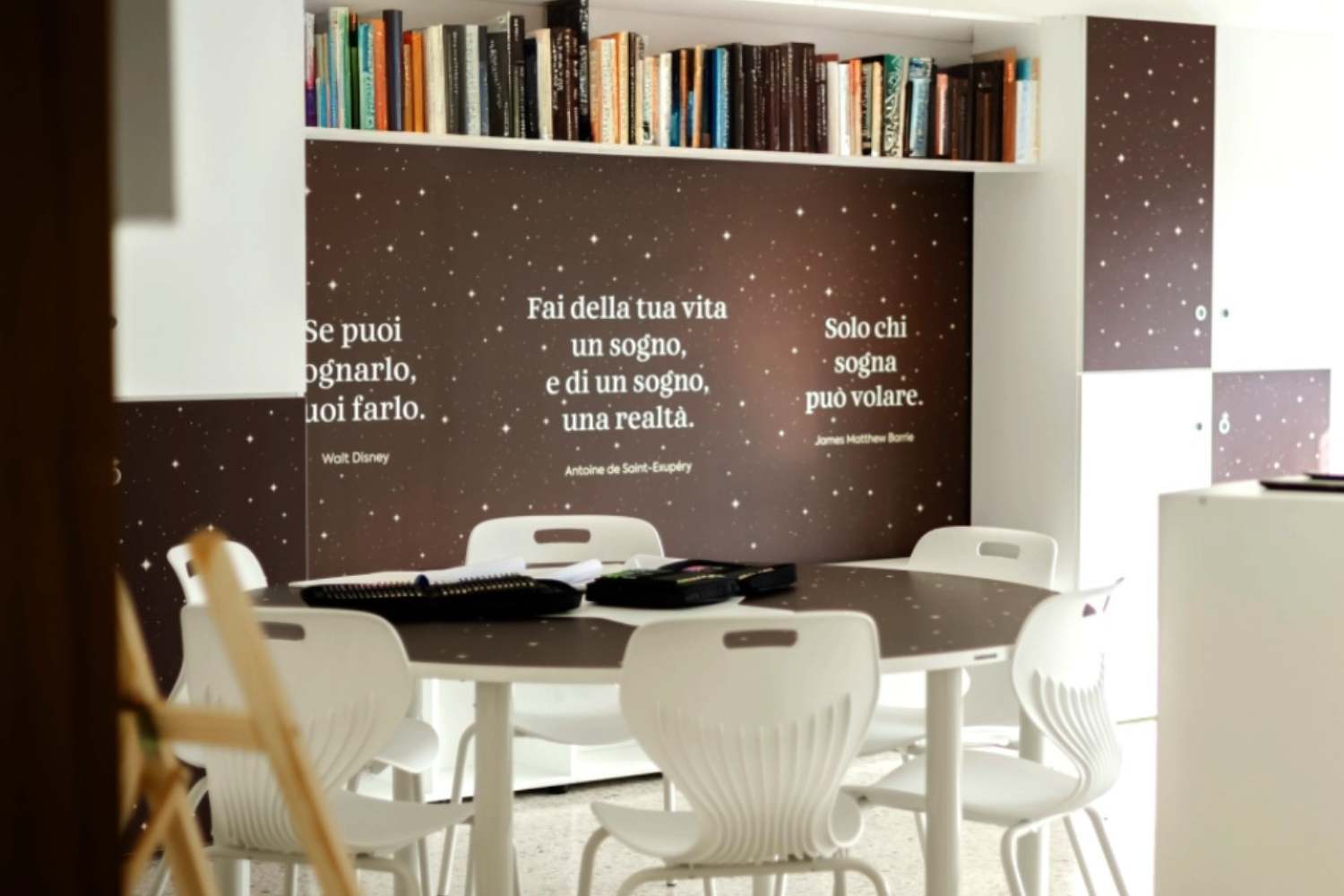
You may have heard of “Dream and believe to the stars“, the Barilla initiative which involves around 3,000 primary schools with the promise of multifunctional spaces worth 15,000 euros and colorful furnishings designed to stimulate creativity and imagination. All very nice, except that, in the winning schools, furniture and walls are covered with stars and painted in ‘biscuit’ brown colour, recalling the aesthetics of a very famous industrial product with a high sugar content: the Pan di Stelle.
The Order of Doctors and Dentists of Turin did not take it well and presented a formal complaint to the Children’s Guarantor, the Competition Guarantor, the Ministries of Education and Health. The question is legitimate: where does the educational project end and where does advertising begin?
The report was triggered by the testimony of a parent:
My son’s school has been invaded by tables shaped like industrial biscuits and Pan di Stelle posters. I have always prepared fruit for school snacks but now my son wants biscuits.
It’s one of those sentences that strikes you because it tells something very concrete. We are not in the field of hypotheses or abstract concerns. Here is a child who changes his food preferences after being immersed daily in an environment that visually celebrates a specific product. And this happens in the place that should be, by definition, protected from commercial pressures.
Neuromarketing and children
Guido Giustetto and Marta Mello, respectively president of the OMCeO and of the Dental Register Commission, explicitly speak of “persuasive techniques attributable to neuromarketing“. It’s not an accusation thrown away. Neuromarketing studies precisely how certain visual, chromatic and repeated stimuli create familiarity and preference towards a brand, especially in the most vulnerable subjects.
A child exposed daily to that visual universe of gold stars on a brown background isn’t just using cute furniture. It’s internalizing a brand. He is building an emotional bond with a product that he will then recognize on the supermarket shelves. And he will do it by associating it with positive emotions: school, classmates, play, learning.
In the complaint, the Order does not ask for the immediate withdrawal of the initiative, but urges the competent authorities to verify whether the project is compatible with the protection of minors’ health, with the educational role of the school and with the rules regulating advertising aimed at children.
The company’s position
Barilla, through the information available on the initiative’s website, describes “Dream and believe to the stars” as a free donation of furniture and teaching materials for schools, created in collaboration with an organization accredited by the Ministry of Education and Merit and designed to stimulate children’s imagination and the value of dreams.
According to what was reported, there would be no recognizable logos, products or packaging in the classrooms, and no food or promotional training activities linked to Barilla products would be carried out. The initiative is presented as a training course with targeted educational activities, aimed at encouraging children to understand the “importance of dreams” rather than influencing their consumption choices.
The problem, highlighted by doctors and critical observers, however, is that explicit logos are not needed when the entire aesthetics of the environment faithfully reproduces the colours, shapes and symbols typical of an industrial product: the brand becomes so pervasive that it transforms into the environment itself.
The worrying numbers
Beyond the ethical issues, there are health data that weigh like rocks. In Piedmont, 24.7% of children between 8 and 9 years old are overweight or obese. 44% of Italian 12-year-olds suffer from tooth decay, often untreated. Excessive sugar consumption is the common denominator of both problems.
The World Health Organization recommends limiting free sugars to less than 10% of your daily energy intake, possibly below 5%. The Italian guidelines on school catering go in the same direction: limit sugary foods, reserve them for main meals, educate on healthier food choices.
In this context, turning a classroom into a visual homage to industrial biscuits seems to go in exactly the opposite direction.
There is a principle that should be untouchable: school is a public, educational space that belongs to the community and above all to the children who spend hours in those places. They absorb not only the lessons, but also the environment, the implicit messages, the behavior models. If that environment is saturated with references to a commercial product, the message that passes is unequivocal: that product is normal, it is right, it is desirable.
Now regarding the question of “Dream and believe to the stars“the ball passes to the guarantors, the ministries, the regional school offices. They will have to evaluate whether this initiative respects the principles of protection of the health of minors, whether it is compatible with the educational role of the school and whether it does not violate regulations on advertising aimed at children.
HERE you will find the complaint from the medical association of the province of Turin.
