
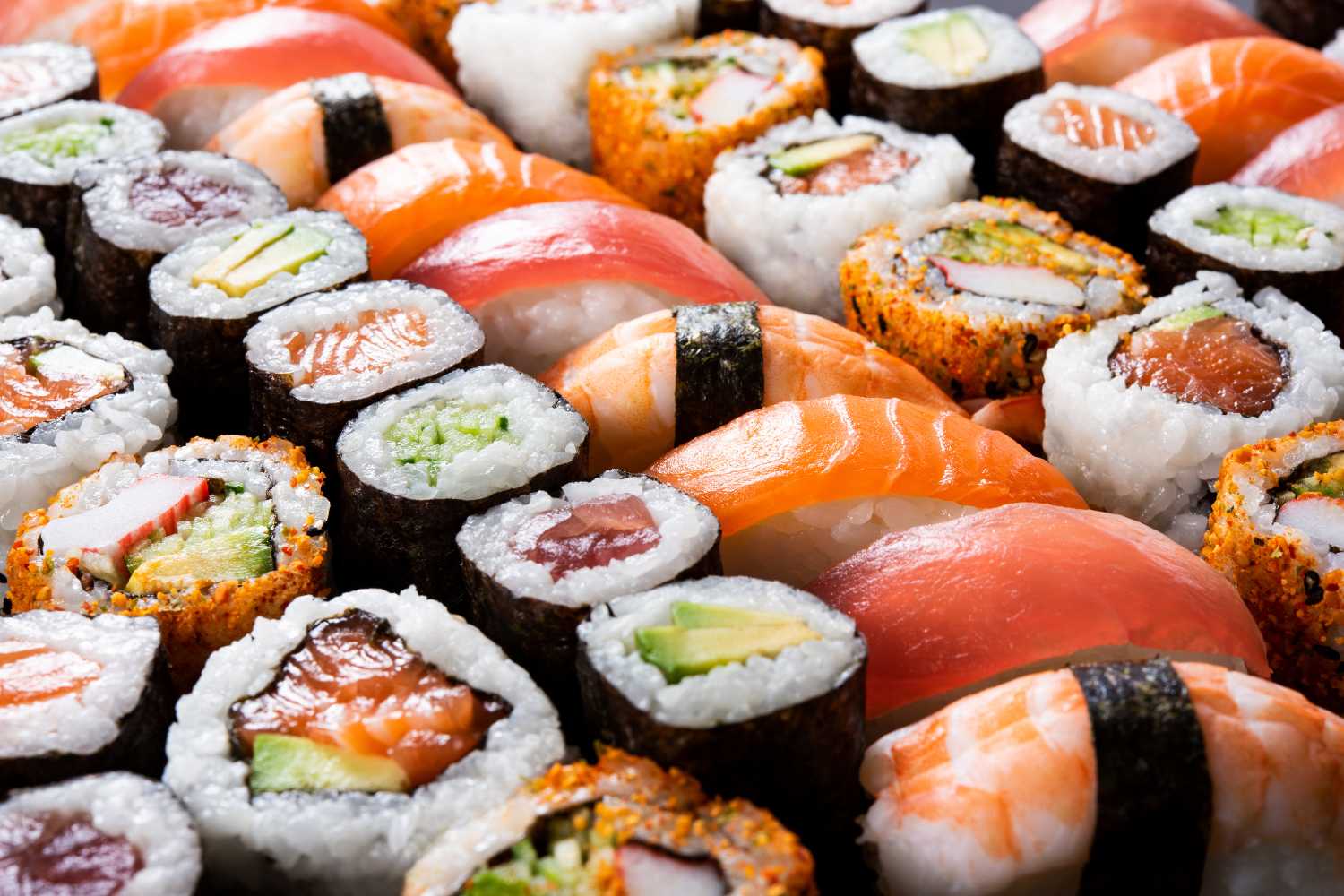
Do you think you know everything about sushi? Salmon, icon of globalized Japanese cuisine, hides a huge environmental impact. Find out why it would be better to leave him out of the plate.
There is a secret that hovers over the sushi restaurants, between impatient chopsticks and Wasabi jars. It is a secret that nobody says aloud, perhaps because it is too uncomfortable, or too tasty to be questioned. Let’s talk about salmon, the orange, shiny, so photogenic as to end up every day on millions of Instagram dishes and profiles. What we think is the heart of sushi, the undisputed king of the combinations Nigiri and Uramaki. And instead …
Salmon in sushi is an intruder
Traditional Japanese cuisine, the real one, did not foresee the use of raw salmon at all. Until the eighties, in Japan, the very idea of eating it fresh would seem absurd. The fish was always cooked, smoked or salty, precisely to avoid the risks related to parasites. To change everything was the Norwaywith a well -studied commercial campaign: in 1986 the Norwegian ministry of fishing made the “Japan project“, With the aim of convincing importers, distributors and supermarket chains to buy his salmon. The manager of the countryside, Bjørn Eirik Olsen, tries a risky move: propose it as an ingredient for sushi. The operation has a positive outcome: the world – and above all the Japanese – will trust the breeding salmon. Gastronomy.
And from there, the Slavine, given that salmon has become the symbol of modern sushi: easy to treat, tender, abundant, almost everyone likes it. But at what price?
The other side of salmon
The problem is not only cultural, but ecological. The intensive salmon farms, especially the Norwegian and Chilean ones, are real outbreaks of marine pollution. Releases of feces, antibiotics, parasites and microplastics threaten entire ecosystems. And it is not an eco-warning exaggeration: The Guardian already talked about it in 2020, putting the devastating impact of these practices on backdrops on backdrops and native species on white.
In Chile, for example, salmon farms are found in fragile marine areas, often protected, such as Patagonia fjords. Yet, every year thousands of tons of feed, chemical residues and drugs end up in the ocean. The result? A disaster. Not only for the environment, but also for workers, exposed to precarious health conditions, and for consumers, who unaware “a mixed sashimi” by believing it is a healthy option.
But does it really hurt?
Even from a nutritional point of view, breeding salmon is not exactly a sample. It has an altered lipid profile compared to the wild one, often contains more saturated and less omega-3 fats. In addition, it can contain traces of heavy metals and chemicals used in feed or pesticide treatments.
In a study published in Science and relaunched by National Geographic, it has been highlighted how the levels of parasites in breeding salmon are often a danger to biodiversity, a certainly not very comforting appearance.
Alternatives exist. And they are delicious
The good news? Sushi does not need salmon, on the contrary, it can do without it. There are local fish, less impacting and equally tasty, such as amberjack, the PalaMita, the Sugarello. Or you can explore the world of vegetable sushi, which in Japan has a deep and refined tradition, made of algae, tofu, roots and fermentations.
The truth is that we got used to it too quickly to the idea that sushi should contain salmon. In reality, true sushi – the artisan one, made with respect – is a delicate balance between flavors, textures and seasonality. Certainly not a standard Food Delivery assembly.
And then there is the tuna, also very criticized, which at least has roots in the Japanese tradition. Salmon, on the other hand, is a fish that we have invented as a symbol of modernity, and which now costs us dear.
A small gesture, a big difference
Of course, you can’t change the world with a dinner. But you can start from there: ask questions, ask for the origin of the fish, try local variants. In Italy, where the sea is culture and abundance, there is no shortage of sustainable options, and a sushi made with blue fish, caught ethically, can also be better.
I know, saying goodbye to salmon in sushi may seem like a renunciation, even if sometimes the best flavors are found where you don’t expect them. And then, it is coolen to be curious than to follow the mass.
