
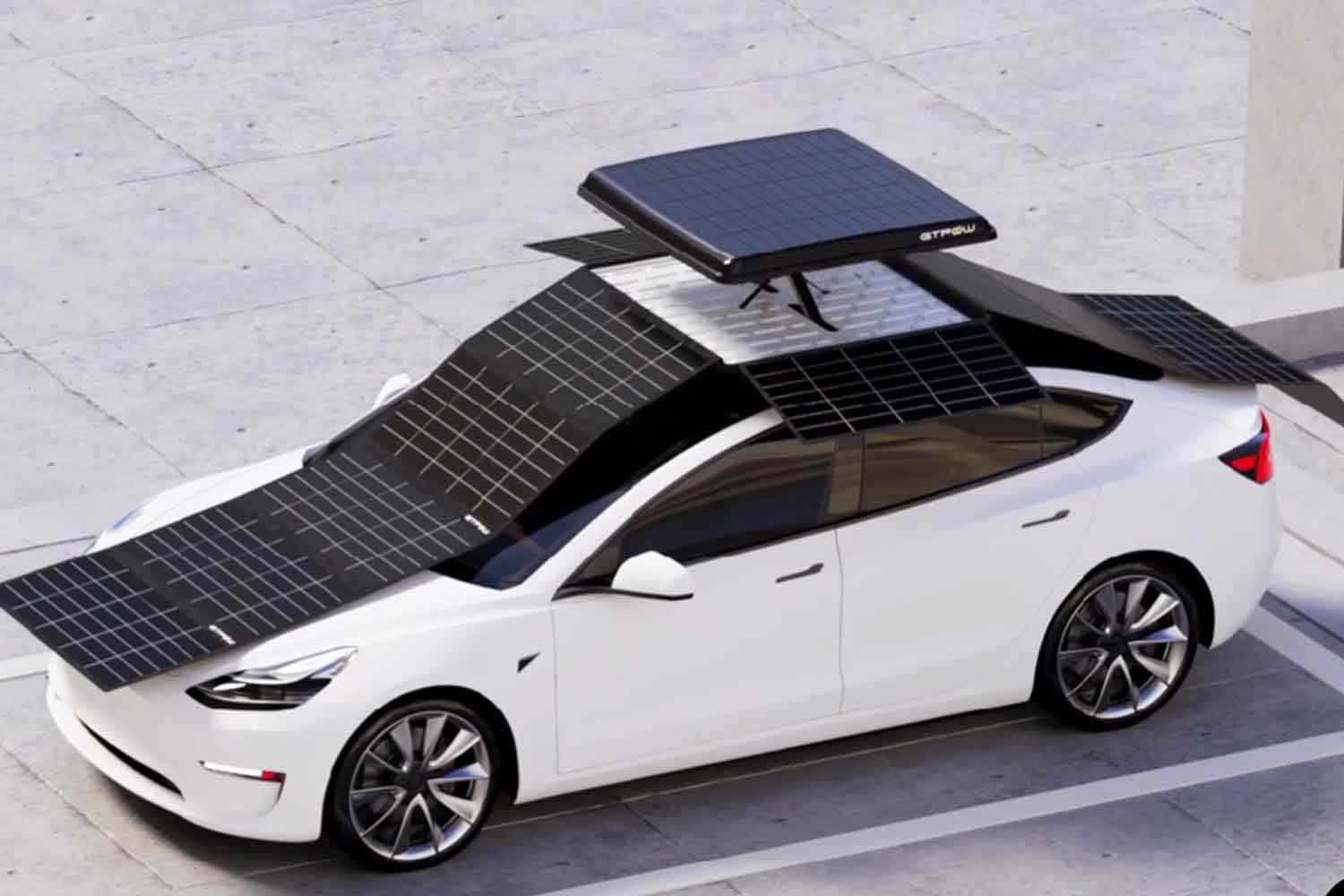
Transforming an electric car into a small mobile solar power plant seems like one of those ideas that usually remain locked up in renderings or trade show concepts. And instead, at CES 2026 in Las Vegas, someone tried to bring it to a more concrete level. Among futuristic prototypes and solutions often far from real life, a roof box with deployable solar panels has attracted attention for a simple reason: it talks about autonomy, sun and that increasingly widespread desire to depend a little less on electrical sockets.
The object in question is a solar roof box, designed to be mounted on an electric car without invasive interventions. At first glance it resembles a normal travel luggage rack, but when opened it reveals photovoltaic panels that extend above the roof of the vehicle. The idea is intuitive: when the car is stationary, parked outdoors or parked for a long time, the sun becomes a direct source of energy to recharge the battery or, at least, to reduce dependence on charging stations.
Designed for those who use electric every day
The concept is not to completely replace traditional charging, but to complement it. According to what was shown at the fair, the system can produce up to 1,600 watts of power, accumulating the energy in an integrated 3.8 kWh battery. Translated into practice, in ideal conditions we are talking about a contribution that can cover a significant part of daily travel, especially for those who use the car mainly in the city or for short journeys.
It’s not a miracle solution, and it’s not meant to be. The actual yield depends on many factors: sun exposure, season, latitude, type of vehicle. But the message that is conveyed is clear and understandable even to those who do not chew technical data: while the car is stationary, it can continue to “work”, producing energy instead of simply remaining parked.
Less anxiety at the charging station and more autonomy
Anyone who drives an electric car knows it: one of the most delicate issues is not so much the declared autonomy, but the daily management of charging. Find a free station, wait your turn, plan your stops. A solar system integrated into the roof box does not eliminate these problems, but it can mitigate them. Even a few kilometers gained every day make a difference, especially if added over time.
During the demonstrations at CES, attention to often overlooked aspects also emerged. The box was designed to resist strong gusts of wind and to have a studied aerodynamic profile, so as not to penalize consumption too much when the car is in motion. There is even a function designed to reduce overheating of the passenger compartment in the summer months, a sign that the idea is not limited to charging, but tries to fit into a broader vision of comfort and sustainability.
An interesting idea, yet to be tested in real life
As often happens with innovations seen at large technology fairs, enthusiasm must be accompanied by a healthy dose of caution. The solar roof box seen at CES 2026 looks promising, but the real test will be on everyday streets, away from the spotlight of Las Vegas. Sun not always guaranteed, parking in the shade, costs still to be clarified: these are all variables that will weigh on the effective diffusion of such a solution.
However, it remains a fact that is difficult to ignore. The idea of exploiting already existing surfaces, such as the roof of the car, to produce clean energy is a move in the right direction. It doesn’t solve everything, but it opens up a concrete possibility, especially in a historical moment in which talking about ecological transition also means imagining practical, imperfect but improvable solutions.
You might also be interested in:
