
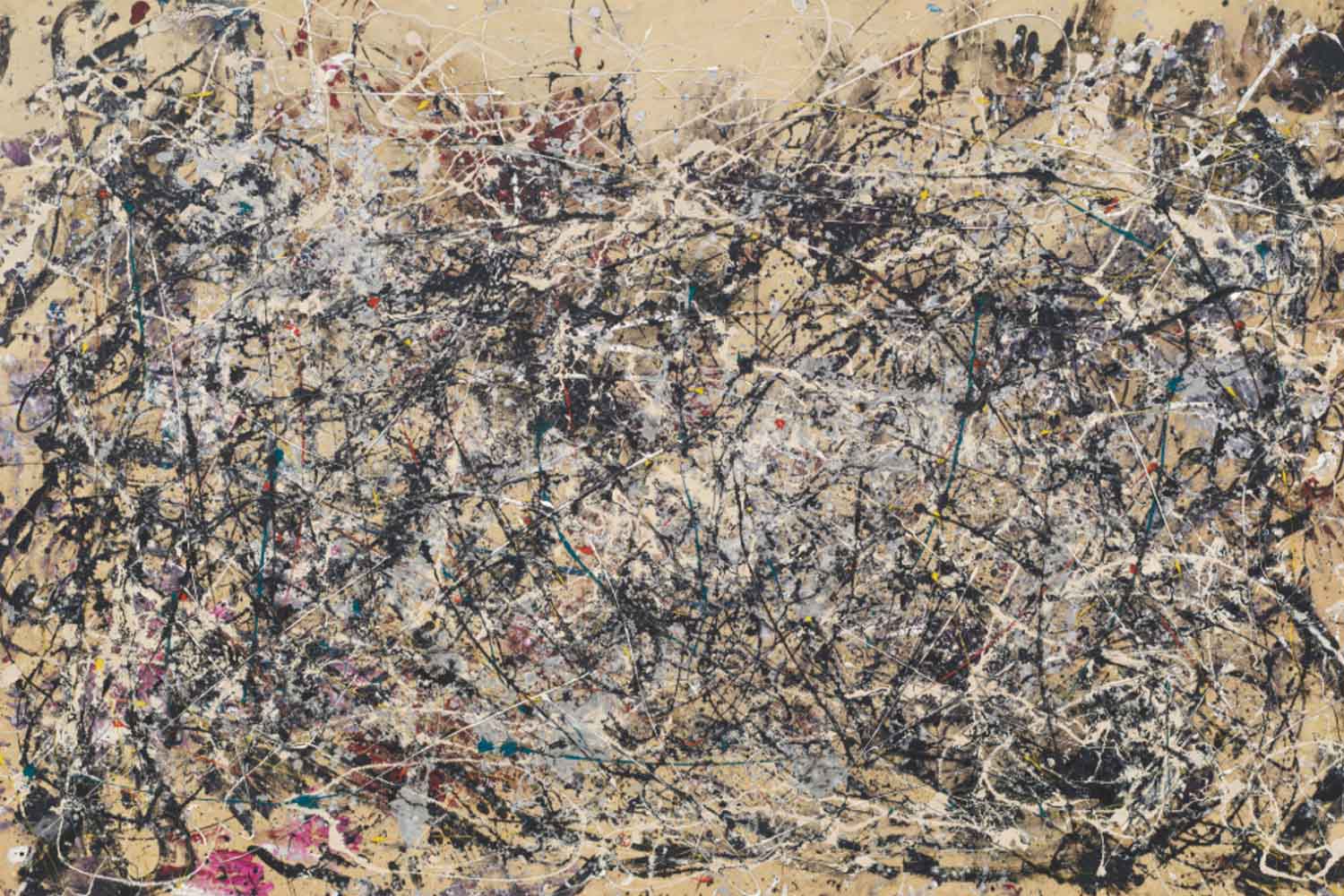
In a corner of the Museum of Modern Art of New York, one of the most famous paintings of 20th century continues to hypnotize those who observe it. Is called “Number 1a, 1948”and bears the signature of Jackson Pollockone of the most revolutionary painters of the twentieth century. But there is a detail that, more than others, has always intrigued critics, artists and scientists: that bright blue, almost electricwhich stands out at the center of the painting as a flash in chaos.
For decades, nobody has known with certainty what color was. Up to today.
A scientific investigation revealed that Pollock used the blue manganese
A group of scholars of MOMA and of theUniversity of Stanford He analyzed tiny painting samples taken directly from the canvas. He did it using a very precise technique: the Spectroscopy Ramanwhich allows you to identify a substance based on how their molecules vibrate when hit by a laser.
The blue used by Pollock is Blue manganesea synthetic pigment discovered in 1907 and marketed only from the 1930s. He was much loved by artists for his bright and clean yieldcapable of returning a heated and transparent turquoise, thanks to the way it reflects the light.
This pigment absorbs green and purple wavelengthsreturning to the human eye a shade impossible to reproduce with natural pigments. Not surprisingly, it was also used in colored cements for swimming pools. But in the 90s he disappeared from the market for environmental reasons.
Edward SolomonStanford’s chemist and co-author of the study, he explained that understanding how such a powerful color works, at a molecular level, allows you to read the work in a new way.
And even if Pollock did not know anything about quantum chemistryhe had chosen that blue precisely because he knew that would have exploded the visual contrast On the canvas. He understood it instinctively.
The research team has not limited itself to hypothesizing: it is the first time that The blue manganese is identified directly on the canvas. In the past he was suspected, but without certain evidence.
To say it is also Gene Hallprofessor of Rutgers University, who did not participate in the study but had conducted similar analysis in the past on other works by Pollock.
I am convinced that these are Blue Manganese.
This type of discovery is not only used to satisfy the curiosity of scholars: it is also useful for the conservation of the work over time. Understanding the composition of pigments allows museums to predict how these materials will react to light, heat or humidity.
As he explains Abed HaddadMoma chemist and co-author of the research, there is an interesting similarity between the scientist’s work and that of the artist:
We also work in layers, letting the materials speak. Exactly as Pollock did.
Art is no coincidence
The idea that Pollock painted chaoticly It is a cliché now overcome. In reality, behind every drop, layer or spray there was a profound knowledge of the matter and gesture. Pollock did not use the brush: directly colasing the painting on the canvasoften without even mixing it. This has left pure and distinguishable layers that, today, researchers can analyze precisely.
Looking closely at “Number 1a”, they notice black footprints in the upper partstrips of color made with a single gesture, and that thin white line which crosses the canvas as a sign left by the case – but which is actually fully controlled.
The same goes for blue: Pollock chose it because he knew he would create a strong visual impact. And he used it with method, mastering the density of color, the force of gravity, and the speed of the gesture.
It wasn’t just painting: it was almost a physical performancea way of being in space, of transforming the floor into a field of action.
Pollock did not give narrative titles to his works. “Number 1a” is deliberately anonymous, without references, without explanations. He did it for Leave room for interpretationso that every viewer could find his own meaning.
But today, thanks to chemistry, We have an extra piece. Now we know that that bright blue, so central in the composition, is the result of a conscious choice, supported by a rare and almost forgotten pigment.
It is a way to Reading art with new toolswhere science does not remove mystery, but adds awareness.
