
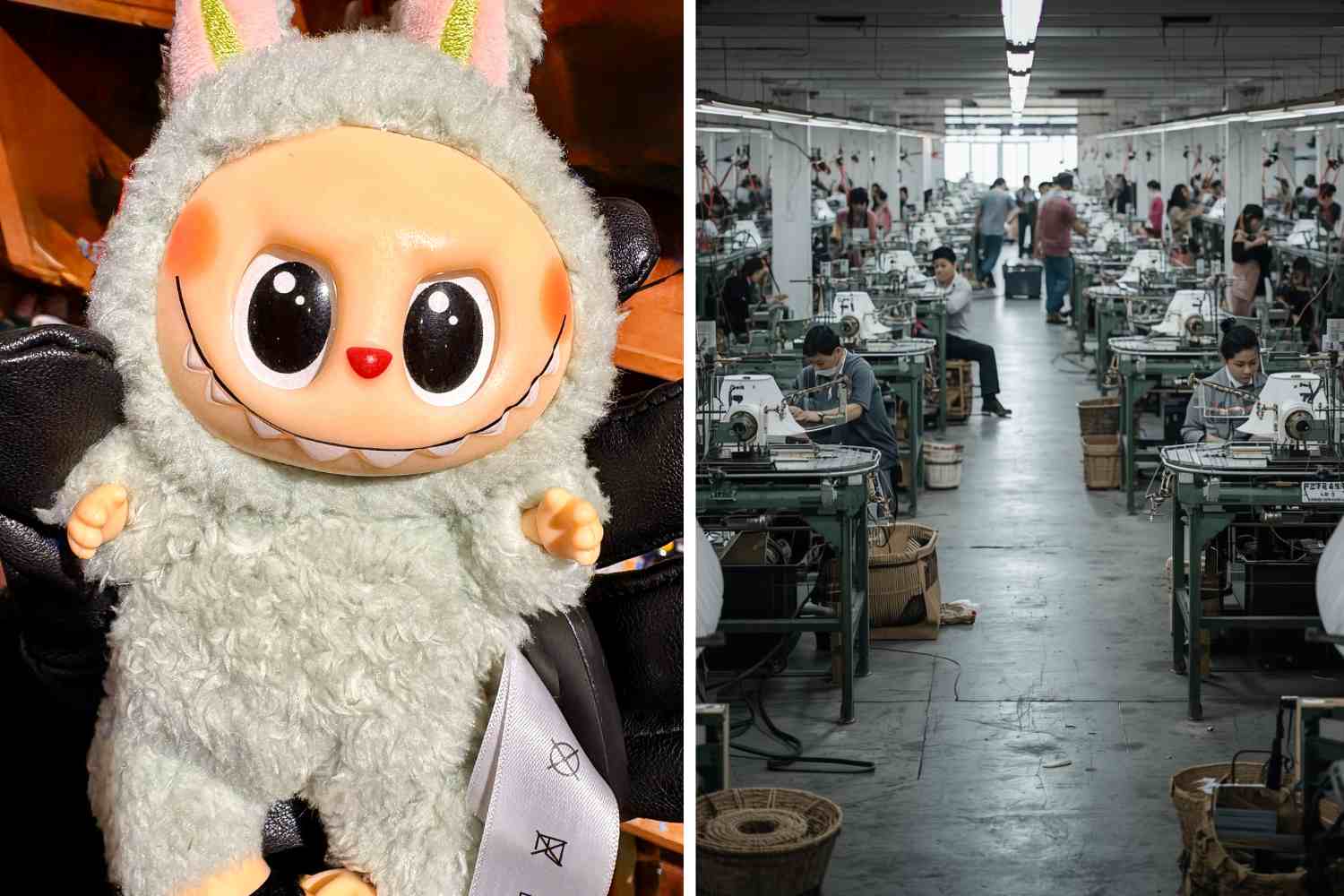
We’ve seen them everywhere in the last year: hanging from backpacks, displayed in shop windows, protagonists of endless queues outside Pop Mart stores. The Labubu, those furry little monsters with fangs and wide eyes, have become a phenomenon that has conquered almost the whole world. But behind their million-dollar success, according to a new investigation, lies a very different reality, made up of exploitation, illegal overtime and systematic violations of workers’ rights.
What are Labubu (and why does everyone want them)
For those who don’t know them yet, Labubu are small collectible toys created by the artist Kasing Lung and produced under license by Pop Mart, a Chinese company specializing in designer toys sold in “blind boxes”. These sharp-toothed puppets are part of the “The Monsters” series and owe their global success to an Instagram post by a Blackpink star in April 2024.
From then on it was Labubu fever. These toys, which normally cost $20-$30, are resold for hundreds of dollars, with limited editions fetching more than $10,000. In the third quarter of 2025, Pop Mart’s foreign revenue grew 370%, and “The Monsters” franchise alone generated $670 million. CEO Wang Ning said the company was on track to reach $2.78 billion in revenue in 2025.
The investigation
But at what price are these toys produced? This was revealed by an in-depth investigation conducted by China Labor Watch (CLW), a non-governmental organization based in New York that has been monitoring working conditions in Chinese factories for years.
Between the summer and fall of 2025, CLW researchers sent undercover investigators to Shunjia Toys Co. Ltd., a factory in Xinfeng County, Jiangxi Province, which is a key supplier for Labubu production. The factory, which opened in July 2024, employs over 4,500 people and is one of Pop Mart’s main manufacturing bases.
The investigation was conducted with a rigorous method: the researchers carried out 51 in-person interviews, of which 15 with workers inside the factory (coming from the assembly, machine sewing, hand stitching and injection molding departments) and 36 with workers interviewed outside the factory. They also reviewed employment contracts, onboarding materials, training records, pay stubs, attendance records and workplace notices.
Documented violations
What the investigation uncovered is a system of systematic exploitation that repeatedly violates both Chinese labor law and international standards.
Among the most serious problems emerged was the employment of 16- and 17-year-olds, a legal age in China but which would require special protections such as a ban on dangerous or strenuous work. Instead these young workers are assigned to standard assembly line positions with the same workloads and production goals as adults. The CLW report highlights that “child workers generally did not understand the nature of the contracts they signed and had no clear concept of their legal status“.
The contracts themselves represent another critical point of the investigation. Workers regularly sign blank or incomplete documents, where only personal data is asked for while key details such as contract duration, job content, salary and social insurance remain “blank and unexplained”. Even more serious, CLW reports that “workers were given no more than five minutes to complete the process and were explicitly told not to read or fill in any other sections“.
Overtime is perhaps the most systematic violation. Chinese labor law clearly limits monthly overtime to 36 hours, but at the Shunjia factory, employees often work more than 100 additional hours each month, nearly three times the legal limit. Added to this are unpaid meetings which further increase an already unsustainable working time.
The production pressure is asphyxiating. To meet the growing demand for Labubu, workers are given goals that appear unrealistic: a team of 25-30 people must assemble at least 4,000 Labubu a day, at a pace that leaves no room for breaks or errors.
Furthermore, while the factory officially claims a production capacity of 12 million toys per year, CLW investigators’ field observations suggest that actual production reaches around 54.6 million units per year, more than four times that planned.
But the list of violations doesn’t end there. The investigation also documented illegal wage deductions, fines imposed for minor infractions, verbal sexual harassment by management, total absence of paid leave including sick leave, lack of social insurance, food and unhygienic living conditions in dormitories.
Occupational health and safety deficiencies are widespread, with inadequate fire safety and emergency preparedness virtually non-existent. Finally, workers find themselves completely without protection, there is no union or any effective complaints mechanism to turn to.
The numbers of exploitation
CLW calculated that, with an estimated daily wage of approximately $29 per worker and production of 182,000 toys per day, the direct labor cost for each Labubu is just $0.70. A negligible figure when compared with retail prices and above all with the astronomical figures of the secondary market.
As the organization points out, these low labor costs are not accidental but the result of “union practices that systematically control workers and reduce production costsShunjia Toys also operates within a multi-level subcontracting system, outsourcing part of its orders to smaller factories nearby, thus extending its exploitative practices to the entire local production network.
However, this pattern is not surprising: unfortunately, as highlighted in numerous reports, the conditions described at the Shunjia Toys factory reflect a common reality in China’s manufacturing sector, where workers regularly face grueling hours for low wages, with little enforcement of legal employment protections.
Pop Mart’s replica
Interviewed by GuardianPop Mart released an official statement:
At Pop Mart we take the well-being and safety of workers in our factories very seriously. We conduct regular, standardized audits of our OEM supply chain partners, including annual independent third-party audits performed by internationally recognized professional audit firms.
We appreciate the information reported to us and are currently investigating the matter. In the future, Pop Mart will continue to strengthen supply chain audit and supervision mechanisms. If the results are substantiated, we will strongly require the affected partners to implement comprehensive corrective actions in accordance with local laws and regulations.
What activists are asking for
China Labor Watch calls on Pop Mart, as the brand owner and main beneficiary of Labubu’s commercial success, to take immediate and concrete measures:
If you want to read the full investigation you can do so HERE.
