
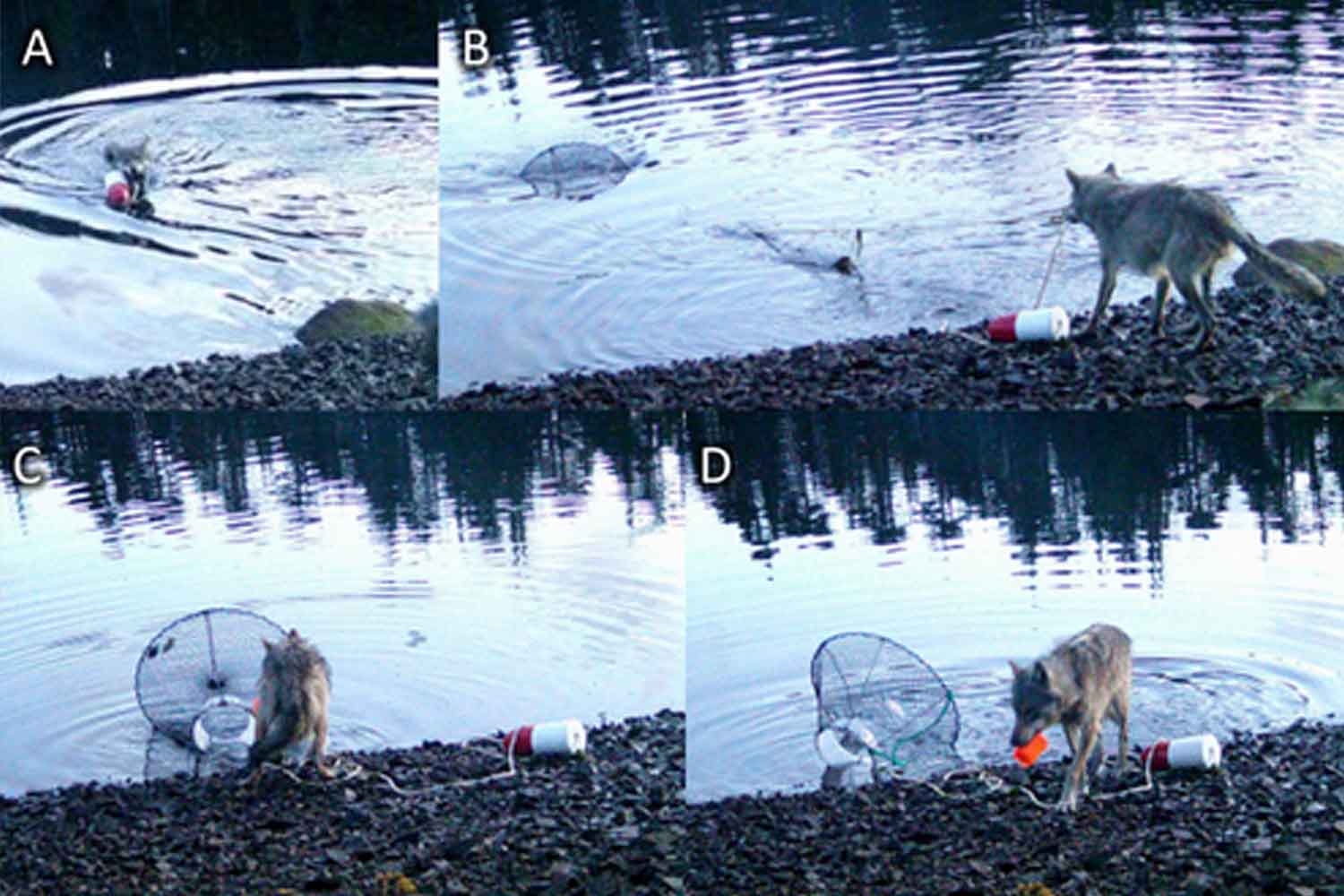
For the first time, a wild wolf has been filmed retrieving a crab trap from the water and eating its contents. The images come from the Heiltsuk Nation, British Columbia. The mystery begins in 2023, when Heiltsuk communities begin using traps to contain the spread of the European crab (Carcinus maenas), an invasive species that is putting the coastal ecosystem at risk. At a certain point, those traps return to shore half destroyed, repeatedly. No storm could have reduced them like this.
To understand what was happening, in May 2024 some camera traps were installed along the beaches near Bella Bella. And on May 29th, what no one expected happened: a wolf emerged from the water, with a buoy tightly gripped between its teeth. An almost cinematic scene: the blue light of the high tide, the silhouette of the advancing animal, the rope that slowly slides out of the water until it reveals the trap.
In the video the wolf drags the buoy on the sand, lets go of the float for a moment and grabs the rope. Then pull, pull again, until the cage lifts completely off the bottom. He takes it higher, tears the lower net and begins to eat the bait. A very quick sequence: less than three minutes, as if he did it every day. The study published on Ecology and Evolution he calls this scene “potential tool use.” A challenging definition, which opens a heated debate among researchers.
In some cases, after that first video, a second wolf was caught trying to drag another trap. The behavior could therefore be shared, perhaps observed, perhaps imitated: an important detail, because many animals learn just like this, by watching others.
Now, calling it “tool use” in the strict sense is another story. Primates break branches and shape them, crows build hooks, dolphins choose the right sponges to protect their snouts while searching for food. The wolf, in this case, didn’t build anything: he understood how something that already existed works. And this is the most interesting part.
He recognized that that buoy is connected to the trap, pulled the line to bring the food closer and opened the structure at the weakest point. It’s not just instinct: it’s observation, experience. It is that opportunistic intelligence that wolves often use to get around barriers, avoid electric fences, and interpret environmental signals.
For the Heiltsuk it is not even a total surprise: in their traditional stories, wolves are described as intelligent animals, capable of complex strategies. Not “wild beasts”, as they are often told, but beings capable of adapting, learning, transforming what they find into resources.
A discovery that forces us to look at the wolf with new eyes
The scene of wolf fishing it’s not a social curiosity. It’s a small scientific earthquake. It shows how a large carnivore is able to reinterpret a human object, understand it enough to use it to its advantage, and perhaps pass this behavior on to other members of the herd. It’s not a little. It’s not even obvious.
And, above all, it reminds us how often we underestimate the cognitive abilities of wild animals just because we don’t see them every day. The wolves of the Canadian coast, the so-called sea wolveslive in an area where human presence is limited. They eat fish, whale carcasses, seafood. They are used to going in and out of the water. It is in this context that a wolf can allow itself to be creative, curious, even bold.
That trap washed ashore is not just an object washed up by chance. It is the mirror of a reasoning. And it is also a message: nature never ceases to surprise us when we stop treating it like a backdrop and really start looking at it.
You might also be interested in:
