
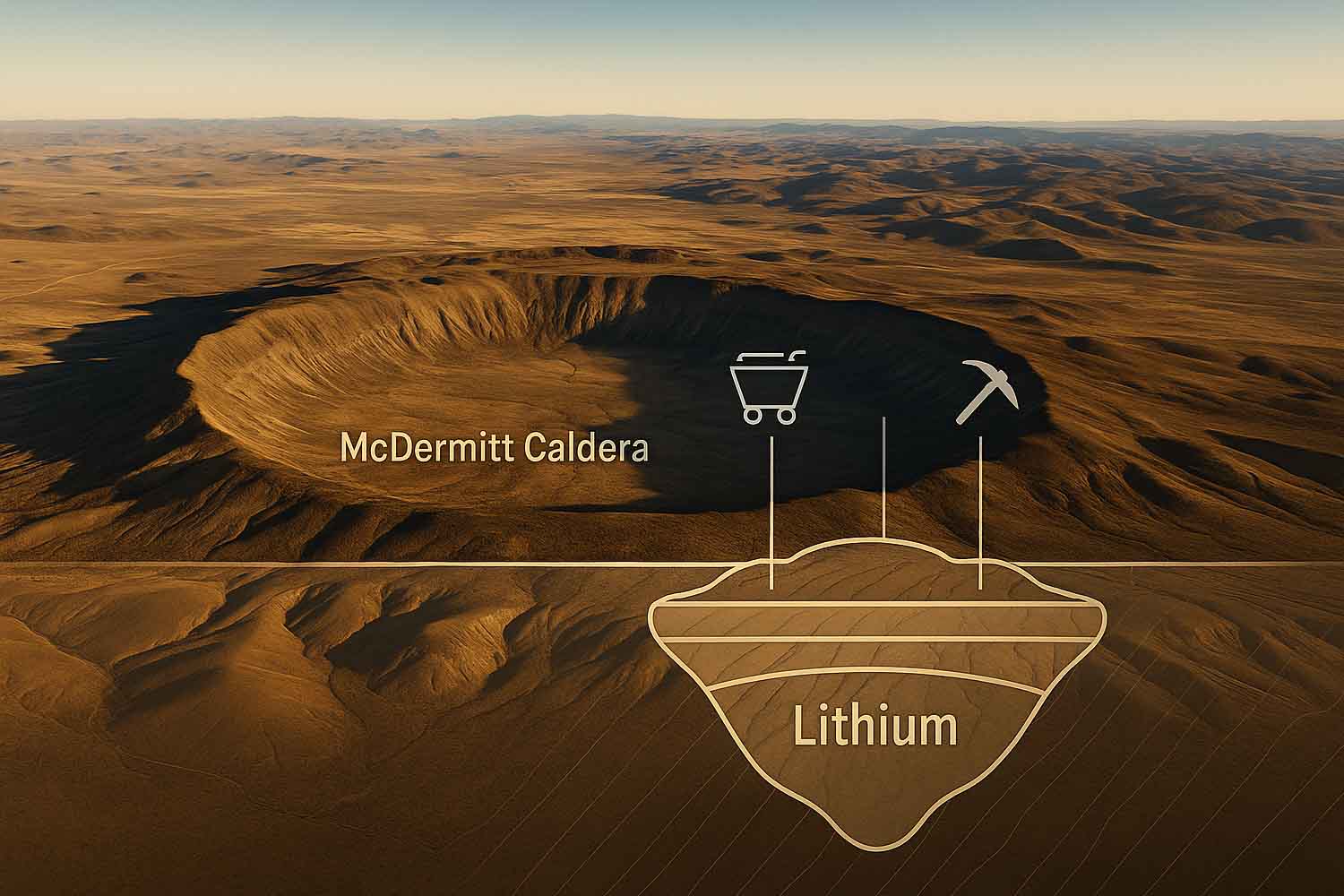
Beneath the ancient McDermitt crater, on the border between Nevada and Oregon, lies an immense deposit of lithium trapped in layers of volcanic clay. A recent scientific analysis hypothesized that between 20 and 40 million tons of lithium are found in the basin, an amount that could influence the entire battery industry for decades to come. Calculating the average value of lithium carbonate in the United States, around 37,000 dollars per ton, the underground assets would be close to 1.5 trillion dollars. Numbers that explain why this area, so silent and remote, has become the new center of geopolitical attention.
How the huge lithium deposit of the McDermitt caldera was formed
The fascination and complexity of the lithium deposit comes from its geological history. About 16 million years ago, a colossal eruption emptied the underlying magma chamber, generating a vast caldera, a crater more than 40 kilometers wide. Over time, the basin transformed into a lake in which ash and volcanic sediments accumulated. Those materials gave rise to thick layers of lake clay, a perfect environment for retaining lithium released from the subsoil.
The real turning point came when the residual magma continued to release hydrothermal fluids, loaded with minerals: these boiling solutions passed through the clay layers and modified their composition. First, smectite was formed, a clay capable of absorbing lithium; then, with higher temperatures, that same smectite was transformed into illite, a variant rich in potassium which retains decidedly higher quantities of lithium.
In Thacker Pass, the most promising area, the illite layer reaches a thickness of almost 30 meters and concentrates between 1.3% and 2.4% lithium by weight, values practically double those of other clay deposits. A not irrelevant detail: this very rich level is located at a shallow depth, a characteristic that allows open-pit mining activities.
Because this lithium deposit can redefine the future of batteries
Lithium is today the key element of rechargeable batteries that power smartphones, laptops, electric cars and storage systems for renewable energy. According to experts, global demand could reach one million tons per year by 2040, about eight times the production in 2022. This is why concentrating so much lithium in one area raises great political and economic interest.
Volcanic clays also have a strategic characteristic: they are large and shallow deposits, therefore requiring a lower ratio between excavation and useful material. Simply put, to obtain each ton of lithium you need to extract less rock than from deeper deposits. At the McDermitt caldera, this dynamic is amplified because the richest layers are located near the surface, allowing for easier extraction than at most existing lithium mines.
Between energy opportunities and environmental fears
The prospect of opening a mine of this size also brings with it delicate questions. Local communities, farmers and indigenous tribes fear effects on waters, ecosystems and sacred places. Supporters of the project, however, believe that a single well-managed mine can have less impact than many small mines scattered elsewhere. However, even a single large quarry can alter the groundwater, generate dust and modify the fauna.
The very nature of the material intervenes to make the picture more complex: the extraction of lithium from clays requires more sophisticated technical steps than the classic salares. The rocks must be crushed, treated with chemical solutions and subjected to controlled processes to recover the metal while limiting water consumption and residues.
A geological model that could rewrite lithium research in the world
Scholars believe that the McDermitt caldera represents a sort of “geological manual”. The mix of peralkaline magma, closed basin and long-lasting hydrothermal activity is a pattern that explorers will now look for elsewhere in the world. But few basins appear to replicate this rare combination of elements.
The American deposit is not only gigantic: it is chemically unique, stratigraphically favorable and located in an inhabited territory, where compromises between environmental protection and energy needs will be inevitable. The debate over the next few years will determine whether this treasure will remain trapped in clays or end up in car batteries, devices and electricity grids.
What is certain is that McDermitt has already revolutionized the way scientists and governments think about the distribution of critical minerals within volcanic systems. A powerful reminder: What lights up our screens and moves electric motors today often has origins in geological events that occurred millions of years ago.
You might also be interested in:
