
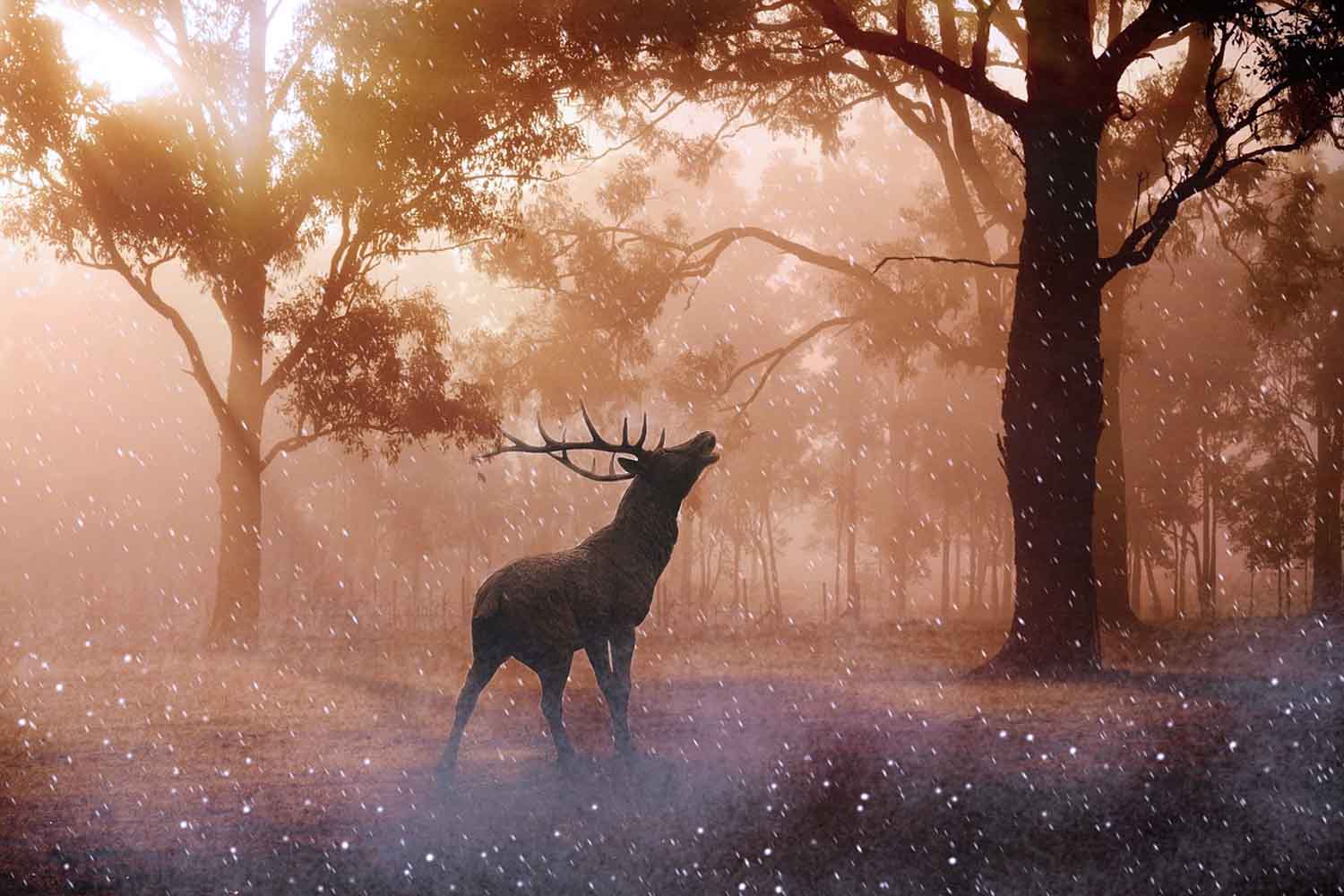
At night the forest seems still. The still branches, the colder air, that silence that almost makes noise. Yet, something happens among the trunks that completely escapes our eyes. Deer leave tracks that glow in ultraviolet. A subtle light, invisible to us, very clear to them.
The discovery comes from a study published in Ecology and Evolution and dedicated to the white-tailed deer, Odocoileus virginianus. The researchers analyzed 146 marking points in a Georgia forest, including rubbings of antlers on trunks and scrapings in the ground. They used ultraviolet flashlights with wavelengths of 365 and 395 nanometers and light measuring instruments. Areas marked by deer appear brighter than intact bark and soil.
When the forest lights up in frequencies that only deer can see
Deer see the world with a different sensitivity than we do. Their eyes perceive short wavelengths best, particularly between 450 and 460 nanometers, and around 537 nanometers. The peaks of light recorded in the study are concentrated there.
When a male rubs his antlers against a tree, he removes the bark and exposes the internal wood. Lignin, a natural substance present in wood, reacts to ultraviolet with a slight luminescence. Urine also contains compounds such as porphyrins and amino acids, capable of emitting light under UV. Measurements show that these tracks clearly stand out from their surroundings.
At dawn and dusk natural light is richer in UV-blue components. At those times the deer are particularly active. The traces become even more visible to their eyes. The forest transforms into a map made of olfactory and luminous signals together.
A luminous signature that becomes more intense in the mating season
When autumn enters the forest, the energy changes. The males move more decisively, rub their antlers against the trunks with repeated and powerful gestures, dig the ground and leave signs that speak of presence. It is an intense, almost electric period.
Precisely in these weeks the traces they release become brighter under ultraviolet light. Scientists have measured it with precise instruments: rubbings carried out closer to the breeding season show stronger radiation. The markings on the ground are also more evident. Communication is strengthened together with competition and the need to assert oneself.
Deer often choose edges between field and forest, paths crossed by twilight. In those open spaces the signal stands out better, stands out from the background, and remains more readable for those who know how to interpret it.
Walking among those trees you only see scratched bark and loose earth. For a deer, those surfaces contain precise information. Each sign tells who passed, at what time, with what energy. The forest becomes a silent network of signals that organize meetings, distances, hierarchies. And we go through all this without realizing it.
You might also be interested in:
