
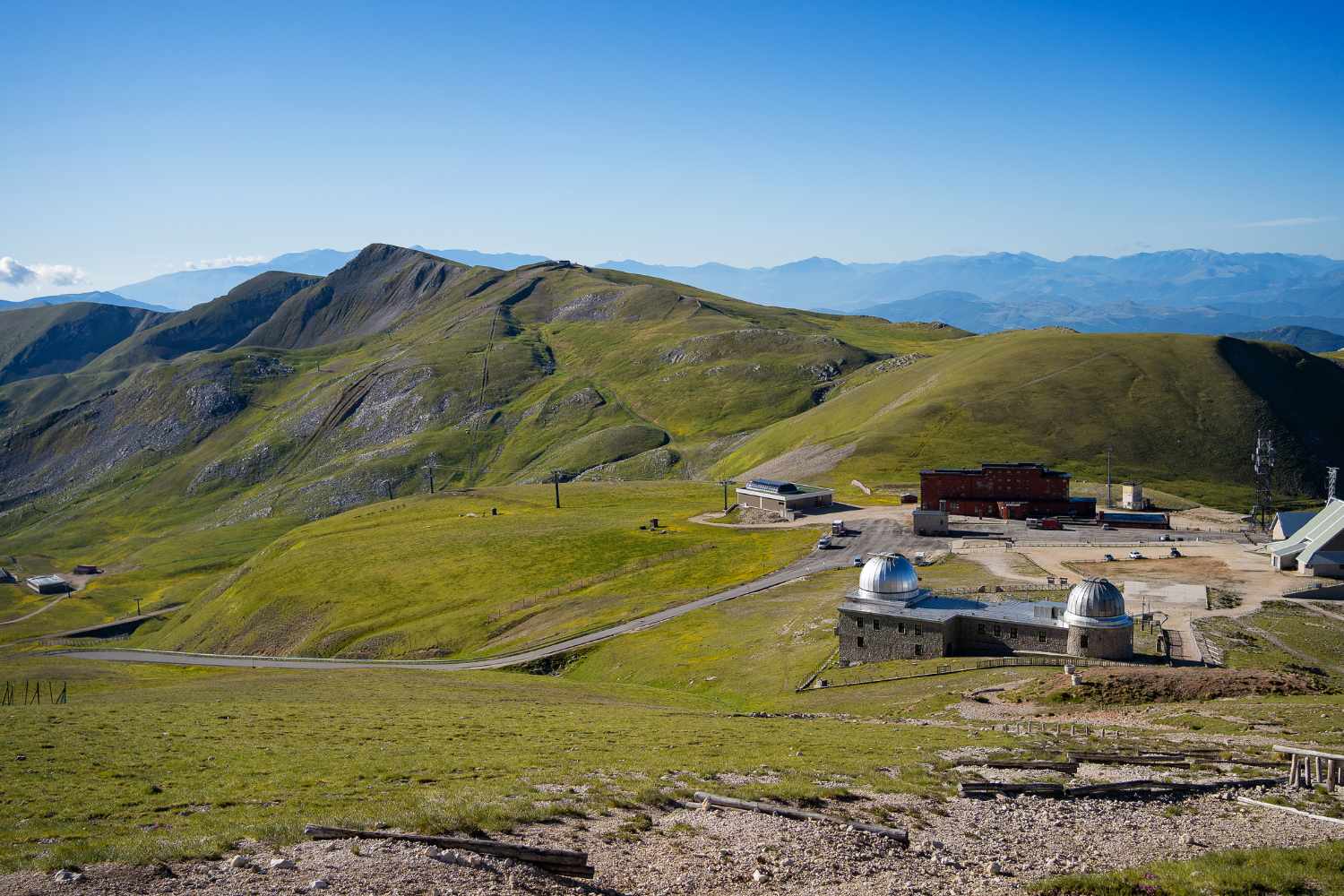
In the heart of the Abruzzo Apennines, a few kilometers from L’Aquila, one of the most fascinating and suggestive landscapes of Italy extends: Field emperor. This majestic plateau, which develops from the 2100 meters of the astronomical observatory up to 1800 meters of the lands of Baronia, is a naturalistic treasure that deserves to be known and preserved.
A land with exotic atmospheres
It is no coincidence that this vast plateau of glacial and karst-high-allery has gained over the years the nickname of “Piccolo Tibet”. Its boundless landscapes, the seasonal lakes that dot the territory, the explosive blooms of spring and the sometimes extreme climatic conditions in fact recall the distant lands of Patagonia, Tibet and Alaska. A corner of Italy that seems to transport us to another continent.
It has been nicknamed “the Tibet of Italy” for decades … but nobody knows who said it first
There is no official source: he is a nickname born between hikers and mountaineers, which later became viral before even “viral” was a term. But the feeling it gives – of isolation and immensity – is much more than marketing.
The Kingdom of the Gran Sasso
To dominate this scenario is His Majesty the great horn of the Gran Sasso d’Italia who, with its 2912 meters, stands imposing himself as a true sovereign of the Apennines. His unmistakable shape on the plateau in every season, and gives panoramas of extraordinary beauty that continually change with the variation of light and atmospheric conditions.
A millenary cultural heritage
Campo Emperor is not only wild nature. The territory, which falls entirely in the municipality of L’Aquila, is also rich in precious medieval villages such as Santo Stefano di Sessanio, Calascio and Castel del Monte. These small stone jewels tell ancient stories and retain traditions that seem to resist the passage of time, in perfect harmony with the surrounding environment.
Extraordinary biodiversity
What makes this place truly unique is also its exceptional biodiversity. Campo Emperor hosts an surprising quantity of endemic species, both vegetable and animals, which have been able to adapt to an environment as fascinating as it is impervious. It is not uncommon to come across herds of horses in the wild that, running free through the plateau, offer a show that fills the heart of emotion and reconnects man with the most authentic nature.
How to get and what to do
The plateau is accessible through three main points: asserts, vetic source and racollo, as well as through the cable car that starts from Fonte Cerreto. During the winter months, when the abundant snowfalls can cause partial or total closures of the roads, the “little Tibet” turns into a paradise for lovers of winter sports thanks to the ski resorts of the Gran Sasso d’Italia.
Excursions and trekking
The plateau is the ideal starting point for numerous excursions, including the climb to the Grande Horn, the highest summit of the Apennines. The paths cross lunar landscapes and offer spectacular views of the Gran Sasso massif. It is possible to discover the area on foot, by bike or horse, thanks to well -reported routes that also connect the surrounding villages such as Assergi, Calascio and Castel del Monte.
Astronomical Observatory
Located at over 2,100 meters above sea level, the Astronomical Observatory of Campo Imperatore is one of the highest in Europe. Thanks to the scarce presence of light pollution, it is the ideal place for the observation of the starry sky. During the summer, it is possible to participate in guided tours and night observations, upon reservation.
Hotel Campo Imperatore
This historic hotel, built in the 1930s, is known for having been the place of captivity of Benito Mussolini in 1943. The room where it was held can be visited and still retains the original furnishings, an interesting historical testimony.
Madonna della Nave church
Just next to the old hotel in Campo Imperatore, there is a small construction that few note but which houses a unique record: it is the church of the Madonna della Neve, the highest consecrated building in Italy and one of the highest in Europe. It was built in 1934 on the initiative of Cardinal Federico Tedeschini, within a tourist enhancement project promoted by the Municipality of L’Aquila, who was already dreaming of transforming the plateau into a recall destination.
After the Second World War, however, the church fell into oblivion. He was abandoned for decades, forgotten between the snow and the silences of Campo Imperatore. Only in 1992, thanks to the intervention of the Alpine National Association of Abruzzo, was finally restored. The following year, in 1993, he was consecrated by Pope John Paul II himself, restoring life and meaning to a place that seemed lost over time.
Today it is an almost mystical stop for those who climb up here: a small, lonely church, but with a huge symbolic value, suspended between heaven and earth.
Alpine botanical garden
The “Vincenzo Rivera” botanical garden, located at over 2,100 meters above sea level, houses about 300 plant species adapted to the extreme climatic conditions of the plateau. It is an ideal place for botany enthusiasts and for those who want to know the high altitude flora.
