
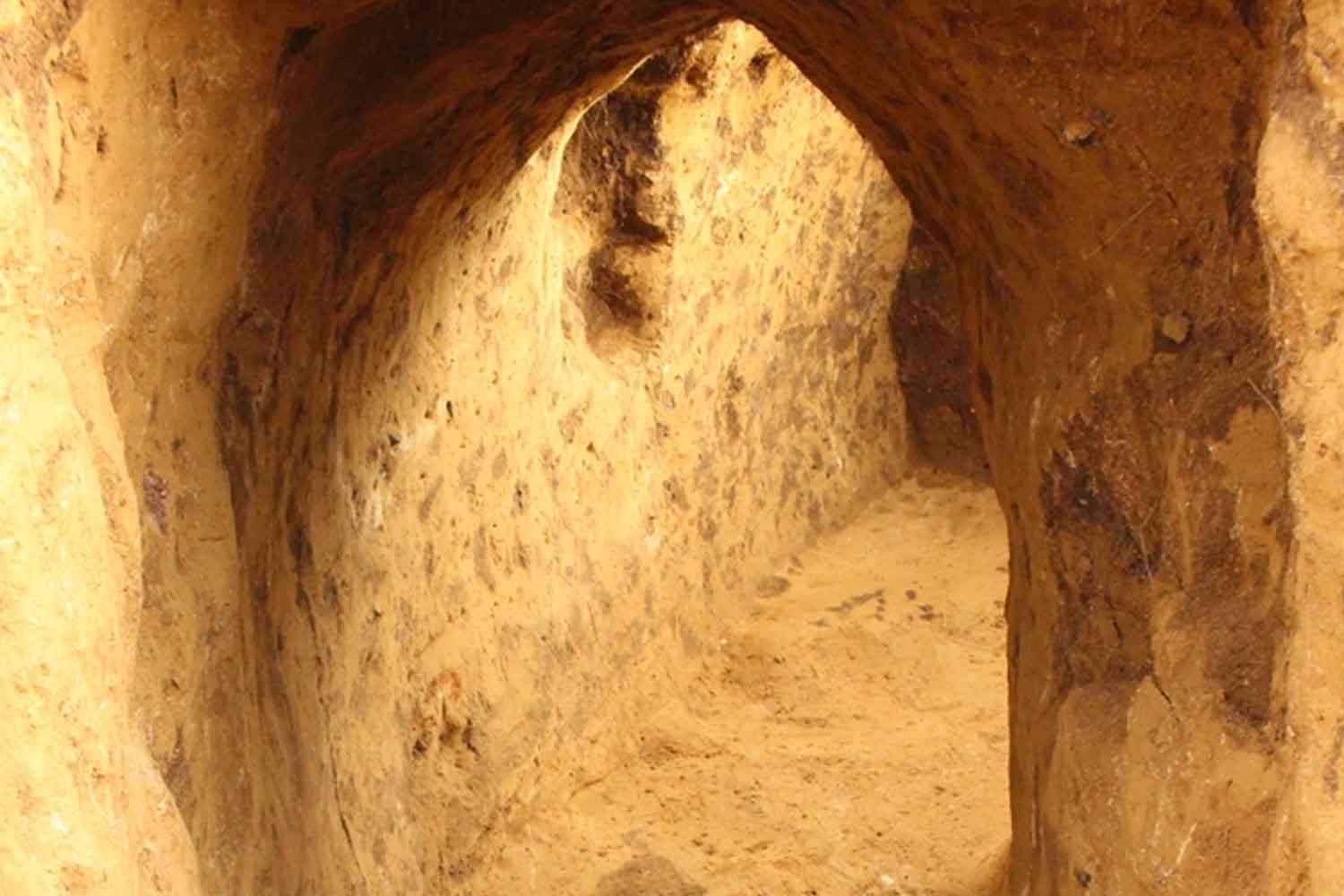
What happens when the energy transition meets the thousand-year history of a territory? In Germany, during work on the construction of a wind farma emerged secret medieval tunnel hidden beneath a Neolithic monument over 6,000 years old. A discovery that demonstrates, once again, how the future of renewables can intersect with (and protect) the most ancient traces of our past.
We are east of Reinstedt, in the state of Saxony-Anhalt. Here archaeologists from the Landesamt für Denkmalpflege und Archäologie Sachsen-Anhalt were carrying out the usual preventive checks before installing the wind turbines. Routine investigations, at least apparently. Then, something in the ground told a different story.
A 6,000 year old Neolithic ditch
The first element to emerge was a Middle Neolithic trapezoidal ditchattributed to the Baalberge culture and datable to the 4th millennium BC. A monumental structure, probably with a ritual or funerary function, already extraordinary in itself.
In the southern sector of the area, next to an oval pit covered by a stone slab, archaeologists noticed an anomaly. Initially a burial was thought of. But digging deeper revealed a narrow, low underground passage: a erdstalla type of medieval gallery still shrouded in mystery today.
The tunnel measures approximately one meter in height and between 50 and 70 centimeters in width. In some sections you can only advance by bending down or even crawling. It is not a space designed for comfort, but for precise and intentional use.
What is an erdstall
The erdstall they are underground tunnels widespread in various regions of central Europe, especially in the Germanic and Alpine areas. They are not mines. They are not traditional crypts. They are not simple cellars. And above all, we have no written sources that explain its function with certainty.
Even in the case of Reinstedt the findings are few but significant: a horseshoeit skeleton of a foxsome mammal bones and traces of a small fire lit for a limited period. At the entrance, some stones suggest a voluntary closure, as if someone had decided to seal it.
Preliminary analyzes place the construction of the tunnel between the 10th and 13th centuries, therefore in the middle of the Middle Ages. The real puzzle, however, is its location: why dig a medieval underground passage right under a Neolithic monument?
Scholars do not exclude that in the Middle Ages that site was still visible and recognized as an ancient place full of meaning. It may have been perceived as a sacred, powerful space to be reactivated or reinterpreted. Or it was a temporary refuge, used in times of danger. No hypothesis, for now, is definitive.
There is one aspect that deserves attention. Without the mandatory archaeological checks linked to the construction of the wind farmthis medieval tunnel would have remained hidden. The energy transition is not just shovels and turbines: it is also planning, study of the territory, respect for historical stratification.
Reinstedt’s case tells something important: investing in renewables does not mean erasing the past, but it can become an opportunity to rediscover it.
