
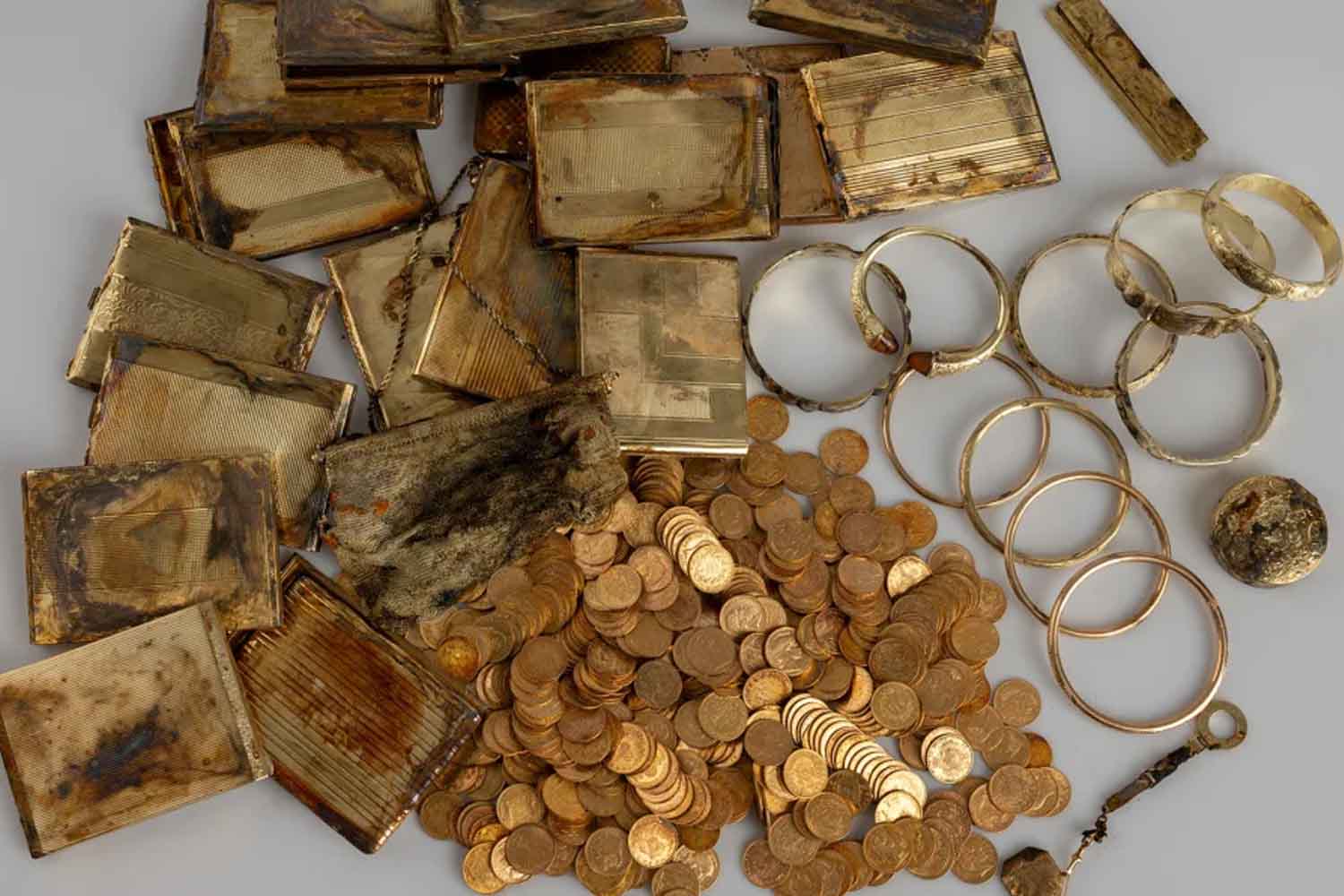
An incredible discovery took the north-east of the Czech Republicwhere two hikers have by chance found a treasure hidden among the rocks of Monti Krkonoše. The discovery includes 598 gold coins, 10 bracelets, 17 Portasigaria Cipria case and a combfor an estimated value of at least 360,000 dollars. The discovery immediately attracted the attention of the authorities and raised numerous questions about its origin.
The two hikers, who chose to remain anonymous, were traveling a path that is not very beaten in the Monti dei giantiwhen they noticed one aluminum box protrude from a rocky wall. Once open, the surprise: inside there was a booty of precious objects and hundreds of gold coins.
Without hesitation, they delivered everything to Oriental Bohemia Museumlocated in the nearby city of Hradec Králové. According to what was declared by Miroslav Novákdirector of the Department of Archeology of the Museum, the first contact took place directly with the numismatic of the structure, without any notice. Only after, the team of archaeologists was able to go to the place to examine the context of the discovery.
Historical hypotheses
The only certainty, for now, is that the treasure cannot have been hidden before 1921year shown on one of the coins. The era to which he could go back, according to Novák, is that prior to the Second World Warwhen many Czech families and of Jewish origin they left the border areas, or the [1945period of theGerman exodus.
The value of only gold contained in coins – 3,7 kgor beyond 8 pounds – It was calculated in about 8 million Czech crowns. But two gateway are still tightly closed, and the exact composition of the metal objects has not yet been determined. Historical and scientific investigations are still in progress.
An element that surprised the experts is the total absence of local coins. According to Novák, about half of the coins comes from France and the other half from Balkan region. The German and Czechoslovak coins, common in the findings of the twentieth century, are completely missing. The fact is even more curious if we consider that the place of the discovery is exactly on the former Ethnic border between Czechs and Germans.
Vojtěch brádlenumismatic expert in the museum, observed that some coins bring coinage brands of the former Yugoslaviaprobably affixed to 1920s or 1930s. This type of discovery, he added, has no precedents in the Czech region.
Another hypothesis suggested by the local community connects the treasure to aristocratic families of the place, like the Swéerts-športhistorical owners of the Kuks Tenutaa baroque complex with summer residence, monastery and spa overlooking Elba. There are also those who hypothesize that it is spoils of war that belonged to Czechoslovak legionaries.
Unstable boundaries and economic crises
According to the historic Mary Heimannprofessor at the University of Cardiff, the year 1921 He was particularly unstable for the young woman Czechoslovakia: finished the Soviet-Polacca war with the Line treatisethe country faced one serious economic crisis and high unemployment. In this climate of uncertainty, he would not surprise someone who has chosen to hide a treasure.
However, Heimann expresses doubts about the dating proposed by Novák: if the treasure had been hidden in 1945, more recent coins would probably be found. The fact that all come from other countries, in particular from border areas such as the Balkans or France, could suggest that the owner was a collector, a museum employee or a thief of numismatic collections.
According to Heimann, the border area between today’s Czech Republic and the Poland has always been subject to ethnic tensions, political instability And population movements. In such a context, it is not difficult to imagine that someone, frightened by what the future could reserve, has hidden their most precious assets.
The treasure will be kept in the museum and shown in an autumn exhibition
Once the exams on the materials and on the composition of the metals are finished, the objects will be integrated into the numismatic collection of the Oriental Bohemia Museum. There is one temporary exhibition For autumn, where the public will be able to admire the content of the discovery.
As for the property of the treasure, the Czech law is clear: every archaeological discovery becomes Property of the regional administration. However, those who make the discovery is entitled to a economic compensationcalculated based on the value of the metal or its historical importance.
Depot Zlatých Mincí, Šperket in Tabatěrek or Celkové Váze 7 kg Odevzali Dva nálezci do muzea vicodních čech v hradci …
Posted by Muzeum Východních Čech V HRADCI KRálové on Friday, April 25, 2025
