
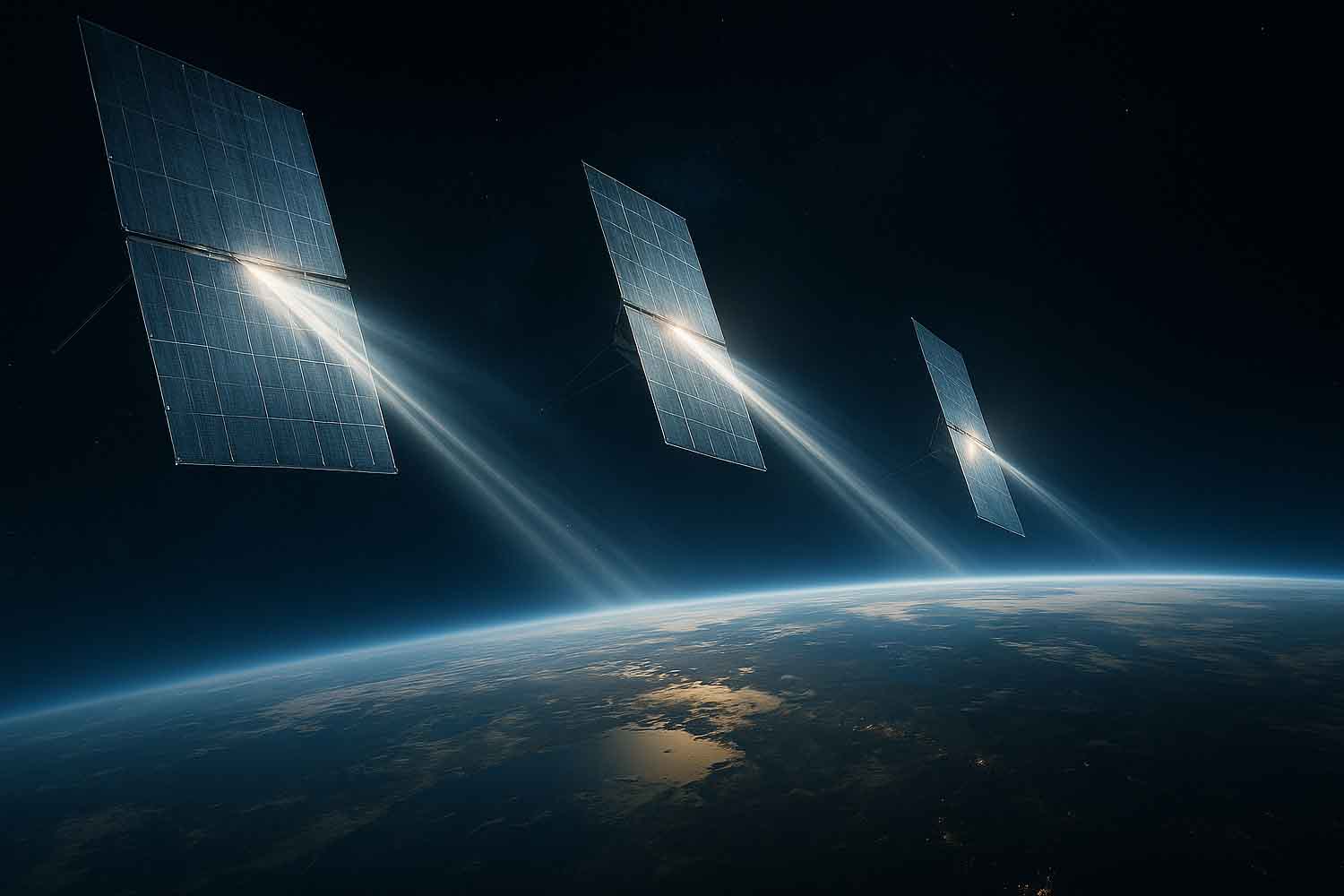
An ambitious, futuristic and – for many – terrifying project. The Californian start-up Reflect Orbital has asked the US government for authorization to launch a giant mirror into space in 2026. It will only be the first step in a constellation made up of more 4,000 space mirrorsintended to reflect the Sun’s light towards the Earth after sunset. The goal? Extend the hours of natural light, enhance solar energy production and – as they say – “turn on the world when the Sun sleeps”.
According to the plans filed with the Federal Communications Commission (FCC)the demonstration satellite, called EARENDIL-1will be launched into orbit in April 2026. Once it reaches its position, it will open a huge mirror measuring 18 meters per side capable of directing beams of light towards selected areas of the planet.
The company, which received $1.25 million in funding from theUS Air Forceclaims that its technology will be able to guarantee “light on demand” to public and private customers, lengthening the days and promoting crop growth even during the night.
“A sky brighter than four moons”
Behind the glossy language of innovation, however, lies a reality that worries scientists and environmentalists. Astronomers speak of an “announced catastrophe”.
John Berentinea researcher at the Silverado Hills Observatory in Arizona, warns that the reflections generated by the mirrors will be four times brighter than the full Moona flare destined to disturb not only astronomical observations but also terrestrial ecosystems:
Each satellite will continue to reflect light even after it passes its target, illuminating large areas and altering the circadian rhythms of animals and plants.
From the Royal Astronomical Society the same alarm comes. The Deputy Executive Director, Robert Masseyhe doesn’t mince words:
The central goal of this project is to literally light up the sky. And from an astronomical point of view, it is catastrophic.
Biodiversity experts also confirm the risk. David Smith from BugLife explains:
Artificial light breaks the natural cycle between day and night, interfering with the behaviors of thousands of species, from insects to migratory birds.
Recent data shows that the Earth’s artificial brightness grows by 10% every year. Where once 250 stars could be observed, today you can barely see 100. Astronomers call this phenomenon “the silent extinction of the starry sky”.
Reflect Orbital’s answer
Faced with the controversy, the start-up promised to study solutions to reduce the impact of reflections:
Our lights will not be continuous or global. Each beam will illuminate an area of about five kilometers for a limited time, producing a soft light, similar to that of the moon.
During the 2026 demonstration mission, the tests will be visible as “a bright moving star,” but the company assures that the reflectors will be oriented away from the ground once the use cycle is finished. Additionally, Reflect Orbital has announced plans to conduct a comprehensive environmental impact assessment before the launch of the constellation and to collaborate with scientific and environmental communities to assess ecological risks.
However, reassurances are not enough. Experts point out that, unlike Starlink or other satellite projects, this initiative does not generate light pollution as a side effect, but places it at the center of its purposeas Massey reiterated:
It is not a side effect. It’s the very heart of the idea.
Behind the fascination of technology lies an ancient question: to what extent can we manipulate nature to serve our energy needs?
While the idea of providing nocturnal solar energy and emergency lighting appears revolutionary, on the other hand it risks transforming the night into an eternal artificial twilight. A sky where the stars could now become just a memory.
