
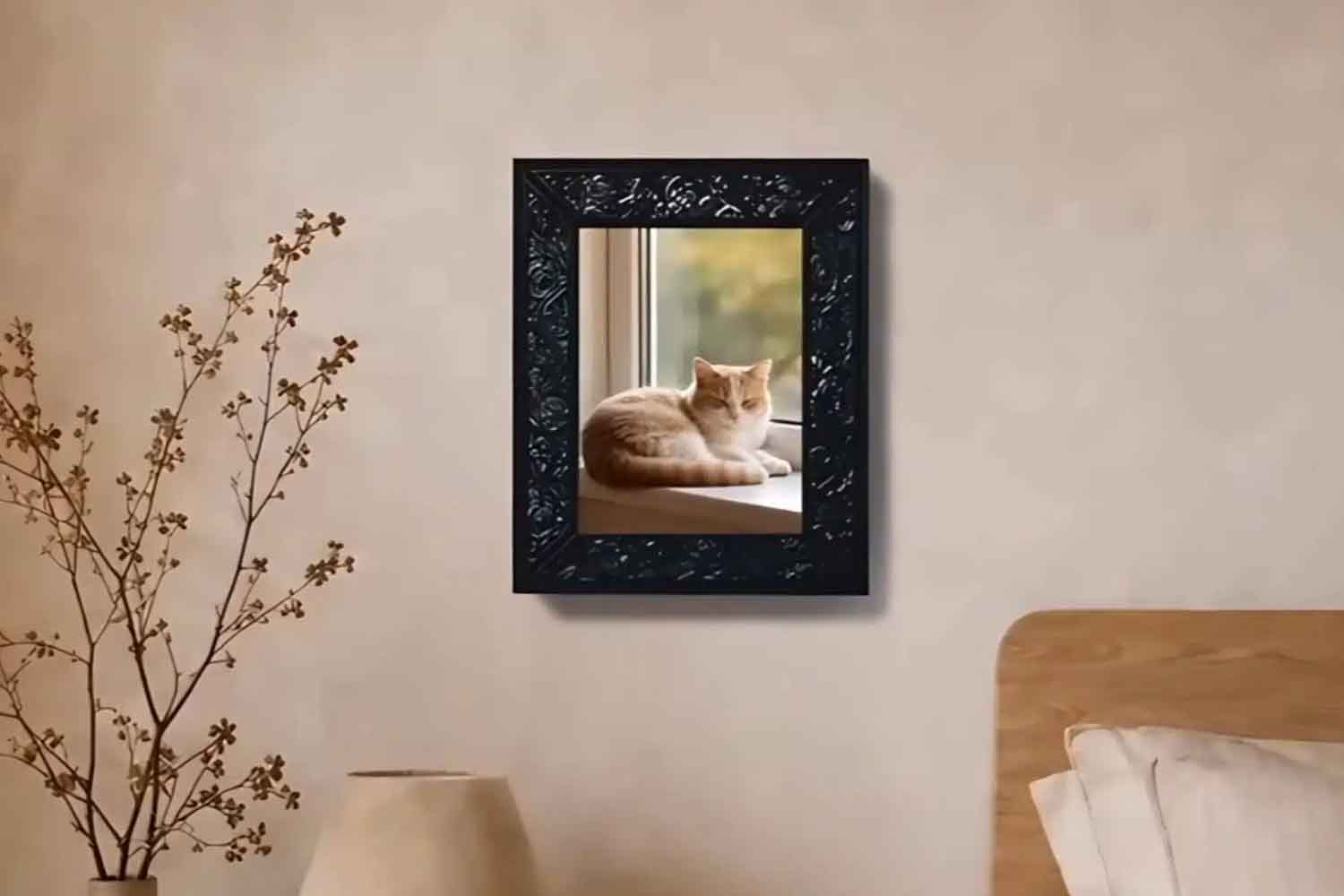
A digital frame hanging on the wall, without a cable running down to the electrical outlet. Inside, a family photograph, a landscape or a work of art that can change every day. It’s called Inkanva and it has a peculiarity: to recharge the battery it also uses the light present in our homes, including that of lamps.
The project, presented on Kickstarter, combines an electronic ink screen with a small perovskite photovoltaic panel. According to its developers, in a sufficiently lit room the frame can work without needing to be connected to the electricity. And when the light is scarce, a battery comes into play that promises up to four months of autonomy.
A digital frame that recharges with home light
The first difference compared to traditional digital frames can be seen when looking at the screen. Inkanva uses E Ink Spectra 6 technology, a particular color electronic paper that reflects ambient light, rather than emitting it through a backlight.
The result resembles a photographic print, with a matte surface and colors obtained through electronic pigments. It is a technology already used in digital signage, here adapted to an object to hang in the living room. As E Ink, the company that develops these displays, explains, electronic paper has extremely low energy consumption. In fact, once a photograph has been loaded, the image remains visible even without continuously powering the screen.
Energy is needed above all when changing photographs and for the operation of other components. A rather obvious advantage for a device that, unlike a television, could show the same image for weeks. The second peculiarity is hidden in the frame. The smaller models integrate a flexible photovoltaic panel made of perovskite, a semiconductor material capable of converting even artificial light into electricity.
The panel attaches magnetically to the structure and collects energy during the day, helping to recharge the internal 5,000 mAh battery. It is therefore not necessary to expose the frame to direct sunlight. Lighting a room can also contribute to charging, although the amount of energy collected depends on the light intensity.
In the specifications published by the designers, a precise condition is indicated: to obtain completely autonomous operation, the 13.3-inch model should be placed in a well-lit area and set to change image once a day. If the available light is not enough, it is still possible to recharge the device via a USB-C port.
Up to 4,000 photographs, without having to print them
One of the most interesting features of Inkanva concerns the possibility of changing the contents of the frame without physically intervening on the painting. Through a smartphone application you can upload personal photographs, choose artistic images and schedule updates. The internal memory allows you to store up to 4,000 images, which can be alternated according to your preferences.
A holiday photograph can leave room for a family portrait, while a painting by Van Gogh can replace the landscape chosen the previous day. All from the same frame, without having to print new images every time. However, there is a difference compared to common digital screens: changing the photograph takes from 8 to 15 seconds. Electronic paper takes longer to update pigments, which is why Inkanva is designed to show static images, rather than play videos.
The device can work even without an Internet connection. In local mode it generates its own Wi-Fi network to which you can connect your smartphone or computer. From an interface accessible through the browser you can upload photographs, organize albums and set the sequence of images.
For those who use home automation systems, integration with Home Assistant is also provided. Through an open programming interface, the frame can receive automatic content and updates, including those created with artificial intelligence tools. The external appearance can also be modified. The aluminum structure can be covered with interchangeable decorative frames, while the photovoltaic panel is designed to be removed and replaced.
How much does Inkanva cost and when will it be available
Inkanva is currently undergoing a Kickstarter funding campaign, with three sizes planned. The 7.09-inch model starts at $159, the 13.3-inch model starts at $349. Both have a resolution of 1,200 × 1,600 pixels and include the perovskite photovoltaic panel. There is also a larger version, 28.5 inches, with a resolution of 2,160 × 3,060 pixels and a promotional price of $1,599. In this case, however, the solar panel is not foreseen: to work, the device must be connected to the electricity supply.
The prices indicated are those of the promotional rewards of the campaign and may vary based on availability, with possible additional shipping costs. The first shipments are expected between the end of November and December 2026. Since this is a project financed through crowdfunding, the dates remain indicative and the rewards are not guaranteed as in a normal purchase.
A panel that consumes energy only when needed
The combination of electronic paper and indoor photovoltaics also makes Inkanva interesting from a consumption point of view. Unlike a normal display, the screen does not have to remain continuously powered to show a photograph. And the perovskite panel can recover some of the necessary energy directly from ambient light.
Of course, artificial light comes from lamps that consume electricity, so the system uses energy already used to illuminate the room. The advantage is the possibility of recovering a small amount of that light and using it to keep the battery charged.
According to the manufacturer, even without the contribution of the photovoltaic panel, a complete charge can guarantee up to four months of operation, considering only one image change per day. For the moment these are the performances declared by the designers, waiting for the device to arrive in homes and be tested in daily use.
The idea, however, is rather simple: use a screen that consumes very little and power it through the light already present in the house. The photograph remains hanging on the wall, changes when we decide and, with a little light available, it could even do without an electrical outlet.
View this post on Instagram
