
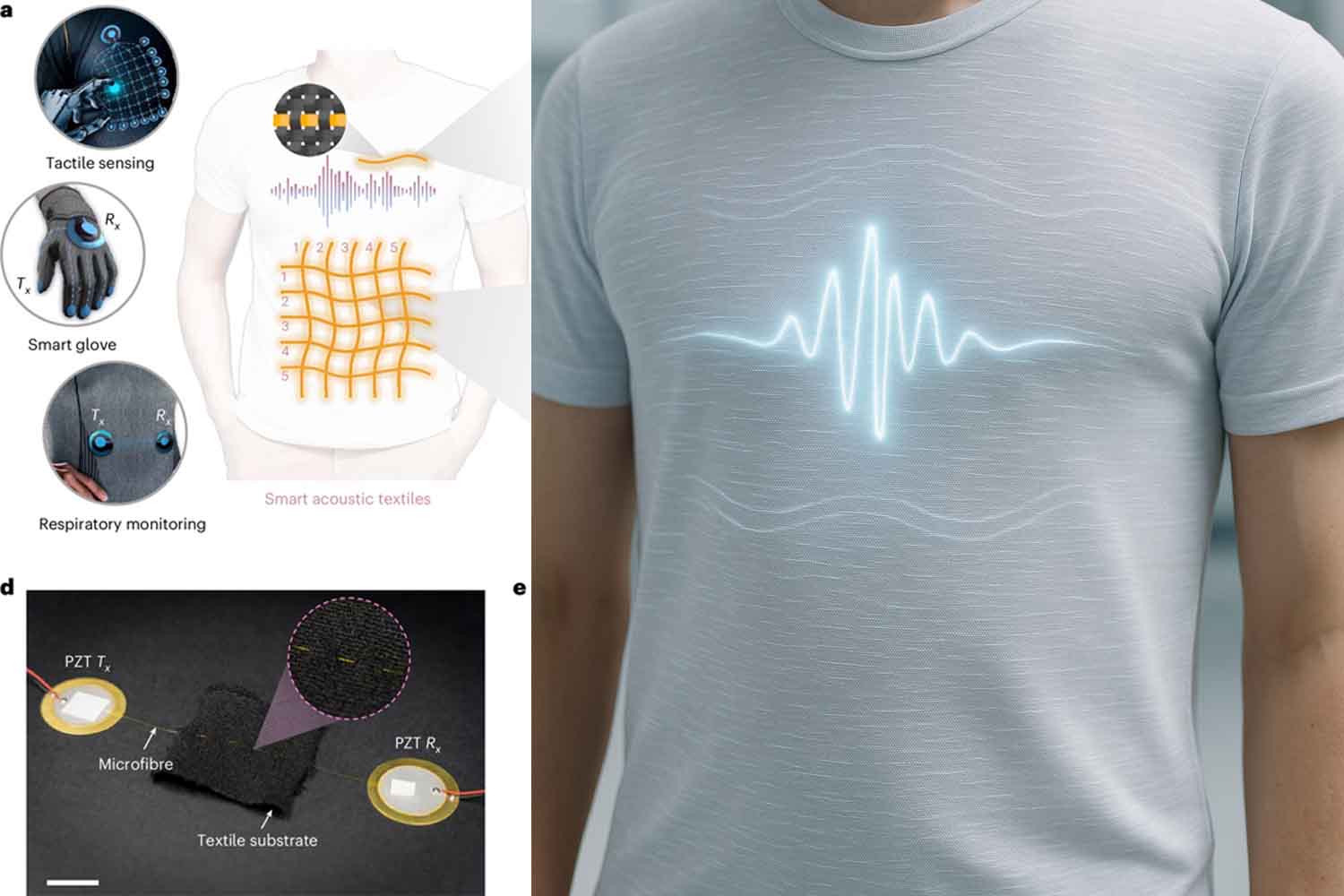
There is a new generation of fabrics that does not limit itself to covering the body: listens to it. A team from the Hed of Zurich, led by Professor Daniel Ahmedcreated smart shirts and gloves which, thanks to thin glass fibers intertwined in the fabric, detect movements, pressure and even the without rigid circuits, without bulky batteries: only almost invisible threads.
The real revolution lies in the use of Sound waves conveyed by glass fibers instead of electronics, a solution that makes these fabrics not only lighter, breathable and washablebut also more precise in the detection e decidedly cheapthanks to the use of easy -to -find materials and a very low energy consumption.
How they work
The project, baptized Sontextileshas transformed common fabrics into intelligent sensors capable of reacting to touch, pressure and movement. To illustrate the innovation is Yingqiang Wangfirst author of the study published on Nature Electronics: “Although previous searches exist on intelligent acoustic -based fabrics, we are the first to explore the use of glass fibers combine with acoustic signals of different frequencies “.
In practice, researchers have intertwined glass fibers inside the fabric at regular intervals. At the end of each fiber there is a transmitter which emits sound waves, while the opposite end is connected to a receiver which measures the variations. Each transmitter uses a different frequency, making the identification of variations is easierwithout requesting heavy data processing, as happens in many previous prototypes.
When a fiber moves – for example due to the effect of breath or a body movement – the wavelength of the acoustics changes, with consequent loss of energy. For this experiment, the researchers have chosen ultrasonic frequencies around 100 kHz, well above the human auditory thresholdwhich ranges from 20 Hz to 20 khz.
Future applications: from health to sport
Laboratory tests confirm the functioning of the system. The future applications Of the sonextiles there are multiple. For example, in the medical field, one Intelligent t-shirt could monitor the breathing of asthmatic patients and send an alarm in case of difficulty.
In the world of sport, athletes could receive a real time analysis of the movementsuseful both to optimize performance and to reduce the risk of accidents. In the communicative field, gloves with this technology could translate the movements of the hands into text or voicepromoting understanding of the signs language.
The system could also find space in the virtual reality and increasedoffering more immersive body interaction. Second Chaochao Sunco-author of the study, intelligent fabrics are also suitable for improvement of posture. They could provide real -time feedback to correct incorrect habits or Notify a person in a wheelchair when it is necessary to change positionthus preventing the formation of decubitus plagues.
Although the results are promising, Ahmed underlines that there is still space to improve the robustness of the system. In fact, the glass microfibre could break with daily use. “The interesting part is that we can easily Replace glass fibers with metalwhich leads the sound well, “says Ahmed. The next step will be to make the system more resistant and integrated in clothing, while expanding the application possibilities.
