
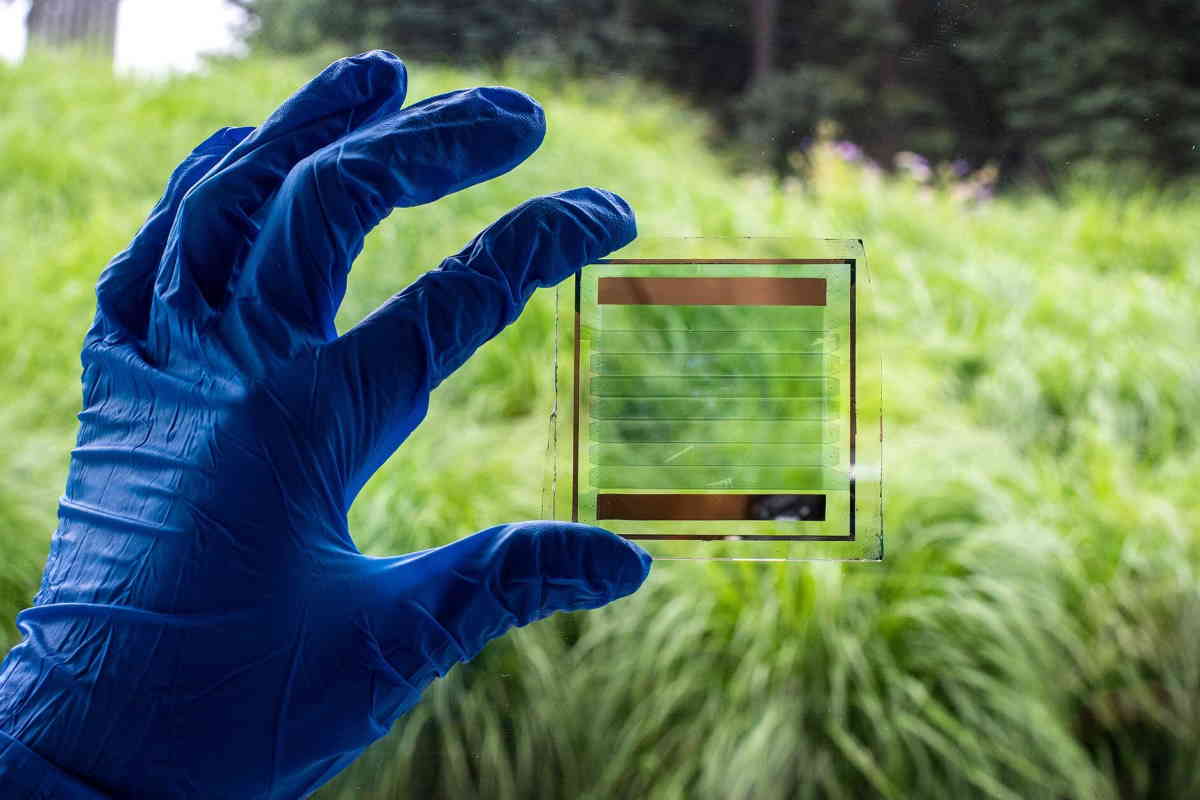
For a moment we forget the classic black and bulky solar panels on the roofs. A group of scientists from the University of Nanchino, in China, has just developed a technology that could change the way we produce energy in the cities. It is called cush and is a transparent solar concentrator, completely colorless, capable of transforming any existing window into a small power plant, without altering its appearance.
The aim is to integrate the production of solar energy directly into urban architecture, where space is often lacking to install traditional photovoltaic systems. The project is led by the researcher DEWEI Zhang, and the results of the study were published in July 2025 in the magazine Photonix.
A transparent film applied to glass
The real strength of this invention lies in its silent and invisible operation. The Cuscu concentrator is based on an advanced optical technology: a thin film composed of cholester liquid crystals (CLC), arranged on several layers and applied on the glass. These special films capture and direct the light towards the edges of the window, where there are small photovoltaic cells ready to transform the sun’s rays into electricity.
Everything happens without changing the transparency of the glass. No dark tint, no strange reflection: the window continues to look like a normal window, but in reality it is producing energy. An experimental prototype of only 2.5 cm in diameter has already managed to feed a small 10 Milliwatt fan. A symbolic result, of course, but which demonstrates the concrete potential of technology.
Less solar cells, more natural light
According to the researchers’ calculations, a two -meter wide window equipped with the cushion system can concentrate sunlight up to 50 times. This means that to produce the same amount of energy, 75% less than photovoltaic cells are needed than a conventional system. A huge savings in terms of space, materials and costs.
And that’s not all. The glass treated with this technology maintains a transparency of 64.2% and a color surrender index of 91.3. In practice, the light that enters the house remains natural and pleasant, without visual discomfort. This makes it suitable not only for commercial buildings, but also to homes, schools, offices and even historical monuments, where the aesthetic aspect is fundamental.
It applies on already existing glass
One of the great advantages of the cushion is its versatility: the film can be applied directly on the existing windows, without the need to replace them or modify the structure of the buildings. An ideal solution for energy requalifications in urban context, where there are often no available roofs or the bureaucracy makes the installation of panels complicated.
According to Professor Wei Hu, a member of the research team, this technology is a concrete response accessible to the challenge of the energy transition. It is not a utopia or a laboratory prototype: it is a realistic, scalable strategy, ready to be implemented, without impacting the aesthetics of buildings or on the quality of urban life.
In the future increasingly attentive to energy efficiency and reduction of emissions, the windows could become a silent and invisible ally in the fight against climate change.
Don’t you want to lose our news?
You may also be interested in:
