
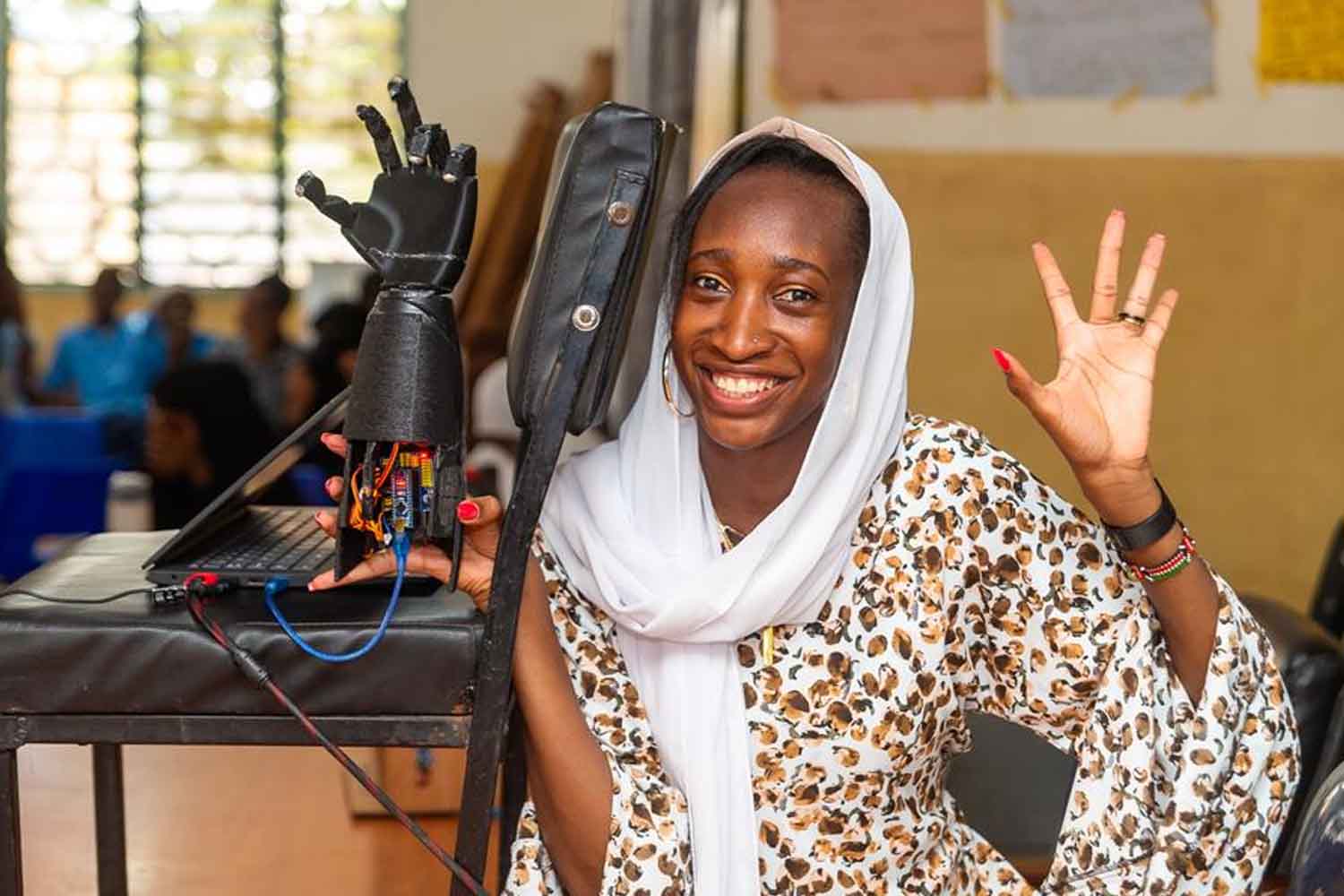
There is a mechanical hand on the desk. The teacher speaks, the fingers move and the lesson becomes sign language. The startup in Nairobi ZeroBionic is bringing this technology into schools to help deaf students take math, biology and other science subjects. But the most interesting passage comes a few meters further: it’s the deaf teachers who put on a suit and teach the robot new signs.
Why a robotic hand can be built. The vocabulary he has to use, much less.
ZeroBionic was founded by a group of young Kenyan engineers, including 22-year-old Norah Kimathi, a 2026 graduate of Strathmore University in Nairobi. The project had already won the university’s Ideas Festival in 2024: at the time it was still an experimental robotic prosthesis designed to make STEM subjects more accessible to deaf students. Today those hands are built in the startup’s small laboratory with 3D printing and recycled materials.
To teach the robot, signs were needed first
At Kasarani Treeside Secondary School for the Deaf in Nairobi, deaf teachers are experimenting with robotic arms by wearing a suit that records their movements. One sign after another, the system acquires and stores them. The work is mainly used to build a technical vocabulary for mathematics, science and biologywhere the gaps in machine-usable datasets become very real.
The problem, in fact, is not the absence of a Kenyan sign language. Kenyan Sign Language exists and is used in schools. Above all, what was missing was a large African digital database rich enough to train an automatic system even on the most specialized terms.
ZeroBionic therefore had to build it itself.
The database was developed with local organizations of people with disabilities and bilingual counselors and, according to the Zero Project, now includes more than that 9 million parameters dedicated to STEM content. The system can also adapt to local variations of signs through machine learning.
There is also in the laboratory Africa Onea humanoid robot built by the team and used to expand and refine the movements that the arms can reproduce. All around, prototypes and 3D printers. Less glittery sci-fi, more finger work.
One hand costs about 350 dollars and works even without internet
The technology listens to the teacher’s voice or receives a text, processes it and reproduces the signs. According to data collected by the Zero Project, translation requires less than two seconds and reaches at least the 92% accuracy in gestures. It is a performance declared by the project and not an independent measurement on all possible conditions, but it gives the dimension of how far the system has already emerged from the laboratory toy phase.
Then there is a less spectacular and probably much more useful feature: works offline. Therefore, you do not need a constant internet connection to use it in class.
Each hand costs in Kenya approximately $350 and it is also produced locally with recycled plastic, a choice that reduces both the price and the necessary material. ZeroBionic reports that the devices are already present in 78 schools in Kenya; the Zero Project meanwhile indicated over 120 institutions reached in four countries by 2025.
The size of the problem helps to understand why a $350 hand can weigh much more than its laboratory table. The Kenya Society for Deaf Children estimated around 2024 300 thousand deaf children and young people of school age in the country. Only 20 thousand were enrolled in schools and there were 141 schools specifically dedicated to deaf students.
Numbers that no robot can fix alone. The barriers concern access to school, teachers, facilities, services and discrimination. A mechanical hand can intervene on a very precise piece of that problem: allowing a student to follow an explanation that he would otherwise risk losing.
In Kasarani, Sharon Mumbe is 19 years old and witnessed the demonstration. She explained that the system could help her better understand concepts that are more difficult to address today.
And it is perhaps the least futuristic part of this whole story. In the Nairobi laboratory there is artificial intelligence, humanoid robots and 3D printed arms. Then there are teachers who put on overalls and patiently repeat their signs so that a machine can learn them. Before the robot can teach a student anything, someone must teach the robot how to make itself understood.
