
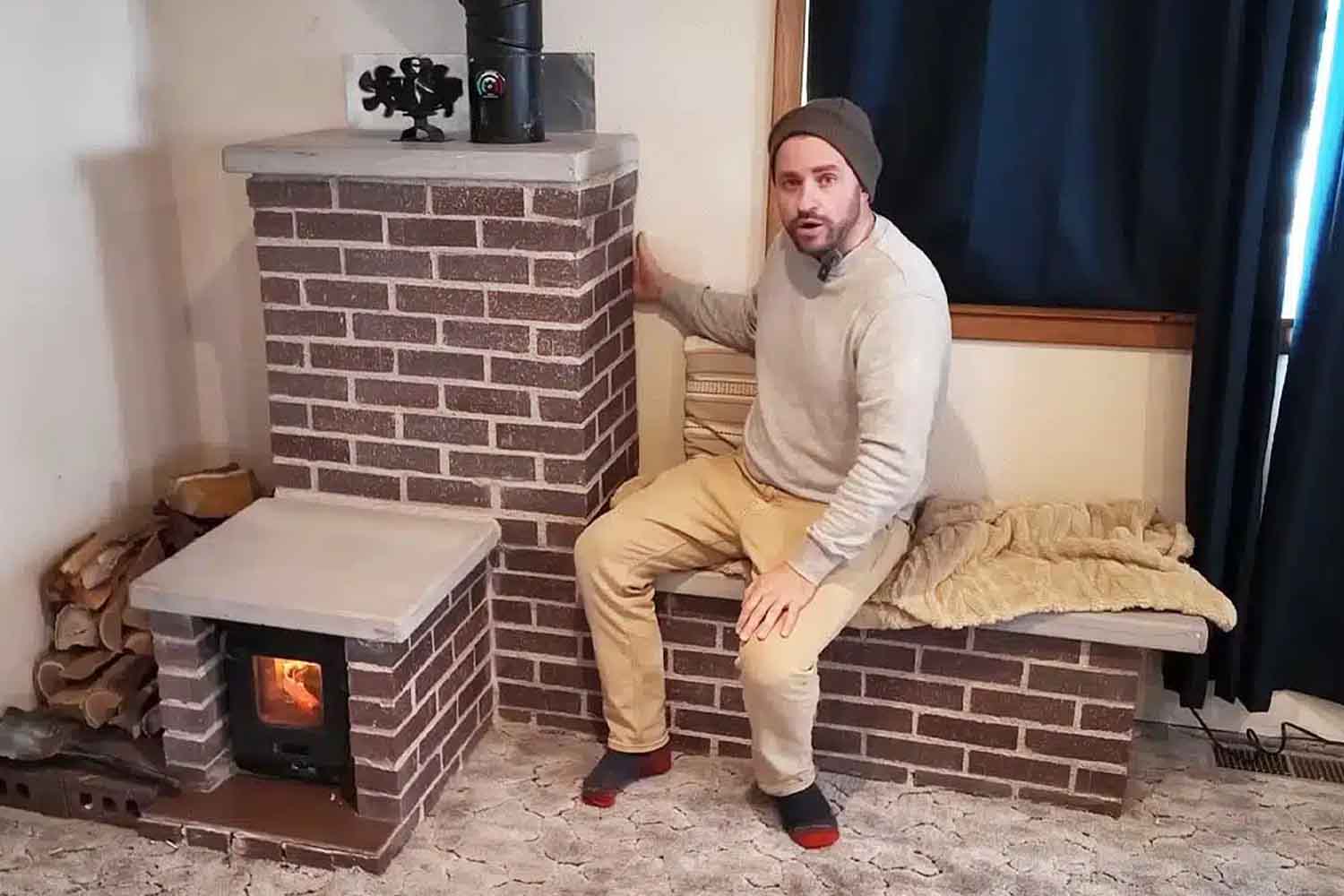
Drastically reduce wood consumption, continuing to heat the house for hours, even without electricity. It is not a slogan, but the concrete objective that pushed Stephano Creatini, creator and self-builder, to create a mass storage stove that is much more efficient than a traditional wood stove.
The project, documented on YouTube, was born from a simple and very current question: how to heat your home reliably, spending less and consuming fewer resources, especially in a context of energy crisis and possible blackouts? The answer is a stove that uses an ancient but often forgotten principle: accumulating heat instead of dispersing it.
A stove that burns better and heats for longer
Unlike classic stoves, which produce heat only as long as the fire is lit, the storage stove built by Creatini stores thermal energy within its structure, made with materials such as bricks and refractory clay. Combustion occurs quickly and completely, at very high temperatures, and the heat produced is absorbed by the mass of the stove, which releases it slowly over many hours.
According to tests carried out by Creatini himself, the system allows you to reduce wood consumption by 50 to 70%, while still maintaining a warm and stable environment. A result that depends above all on the highly insulated combustion chamber, designed to almost completely burn the wood and limit dispersions through the flue.
From theory to practice: how it was built
The creation of the stove required time, skills and a long experimentation phase. The work began with making the load-bearing structure of the building safe, then moving on to the construction of the brick base and the creation of an insulating layer approximately five centimeters thick, obtained with a mixture of perlite and refractory clay.
The heart of the project is the combustion chamber, assembled with great attention to air flows. The hearth door, made in a metallurgy workshop, is equipped with two air intakes, one of which is dedicated to secondary combustion, essential for increasing the efficiency of the system. Refractory bricks have been inserted inside the hearth, designed to resist the rubbing of the wood and protect the ceramic fiber insulating panels, thus increasing the overall life of the stove.
Once the structure was completed, the upper concrete slabs were poured and the door insulated, completing a project that combines self-construction, artisanal engineering and energy attention.
More yield, less waste
One of the most interesting aspects concerns performance. In traditional stoves a significant part of the heat produced is lost through the flue. In this case, however, the storage stove reaches an efficiency of around 80%, compared to the average 75% of classic wood stoves.
During tests, the system remained warm for over 20 hours, demonstrating how thermal storage can really make a difference, especially in winter. Less wood, fewer loads, fewer costs and simpler management of home heating.
Costs and limits of a do-it-yourself project
From an economic point of view, Creatini spent around 1,195 euros on the main materials, including clay, bricks and insulating panels. Added to these are approximately 1,280 euros for the flue and the elements necessary for crossing the roof, with a triple insulation external structure.
There was no shortage of errors. The stove was built too close to a wall, which reached high temperatures, up to 93 degrees. To remedy this, it was necessary to install an aluminum reflective panel and a small fan to contain overheating. Creatini also admitted that a more central position within the home and a larger storage mass would have further improved performance.
A thought-provoking idea
This is not a ready-made solution for everyone, nor a project to be improvised. But this mass storage stove clearly shows how it is possible to rethink domestic heating in a more efficient way, reducing consumption and waste, starting from simple and well-known principles.
In a period in which energy costs more and more and the reliability of networks is not a given, experiments like this bring a fundamental question back to the center: how much heat are we really throwing away every day?
You might also be interested in:
