
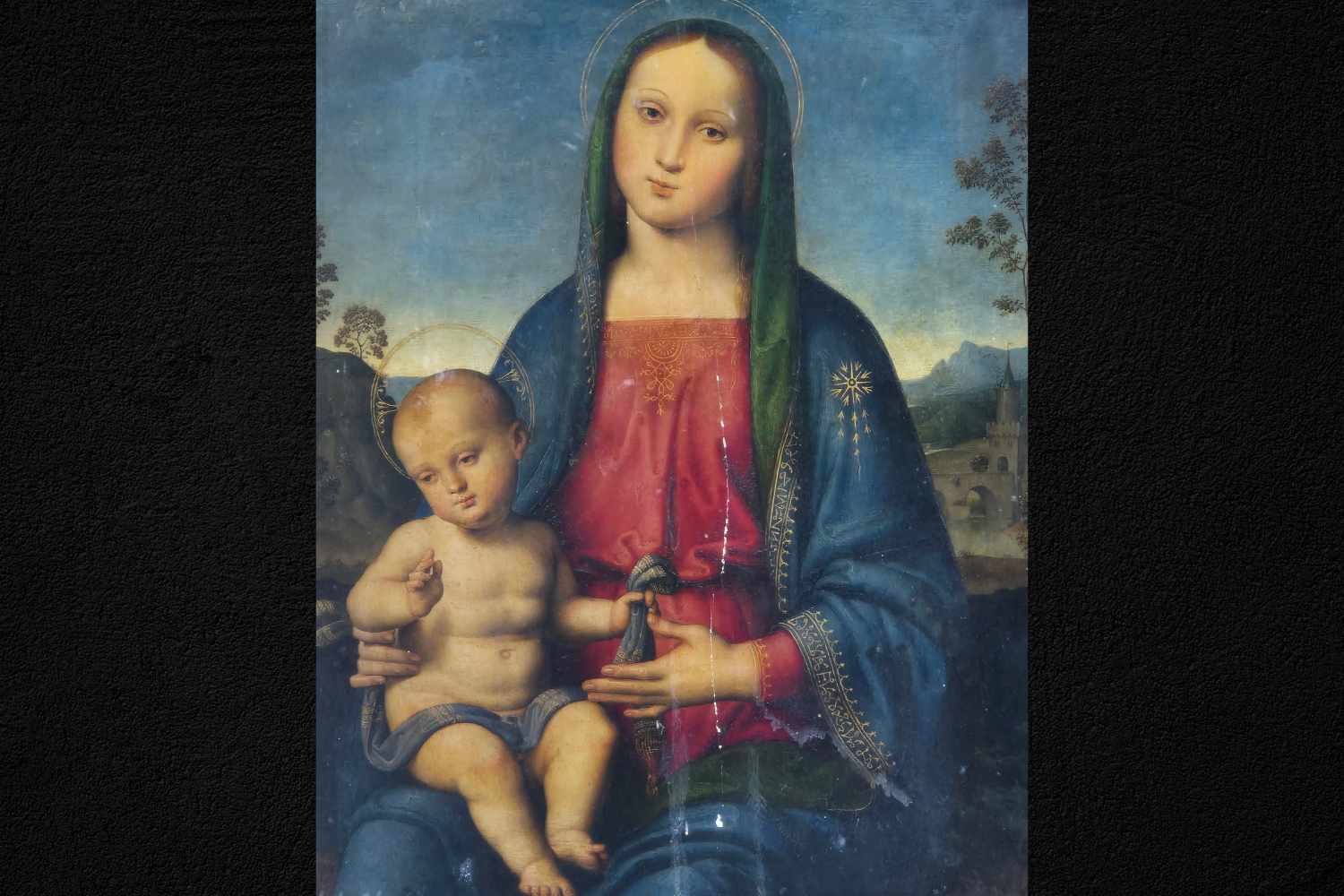
The stories of works that re-emerged from nowhere continue to exert a fascination that never ends. The protagonist of the story is an Italian painting that remained for years in a garage in Oxfordshire, England, before being auctioned for 685 thousand pounds, equal to approximately 780 thousand euros.
The discovery
The panel depicts the Madonna and Child and belongs to a resident of the area who had purchased it a long time ago, without suspecting its potential value or origin. It remained forgotten for a long time among boxes and stacked objects, and it is not even clear whether it spent its existence in the current owner’s warehouse or in that of the previous one. It is likely that it has passed through more than one residence, a silent witness to different eras and hands.
The panel, a small-sized oil (39 by 50 centimetres), was entrusted to the JS Fine Arts auction house in Banbury, also in Oxfordshire. From there a surprising amount of attention arose: a private collector won it after a quarter of an hour of intense bidding online, with the phones in the auction room not stopping ringing.
An exceptional auction
Joe Smith, the auctioneer who directed the sale, described the intensity of the moment, defining it as one of the moments that every professional in the sector dreams of. Interest reached every corner of the world, turning the sale into an episode followed far beyond British borders.
The final value far surpassed the previous JS Fine Arts record, set at £312,700 and belonging, curiously, to another work that emerged from nowhere, “Bathing Machine, Aldeburgh” by Eric Ravilious. A leap that confirms how the art market can reveal huge surprises when the works of the great masters of the past are at stake.
The attribution to Perugino
Officially the panel is described as the work of an “ancient Italian master”, but several experts favor the attribution to Pietro di Cristoforo Vannucci, known as Perugino, active between 1448 and 1523. The owner has already appointed a restorer-conservator to start the necessary investigations.
If the authenticity were to be confirmed, the Madonna and Child would enter the same market segment as the certified works of the great Umbrian present in the most renowned museums. Just think of the Victoria and Albert Museum in London, which acquired one of his works as early as 1862.
The master of the Renaissance
Perugino occupies a pivotal position in the Italian Renaissance. He trained in Verrocchio’s workshop, where he shared an apprenticeship with Leonardo da Vinci. His career also led him to collaborate with Sandro Botticelli on the frescoes of the Sistine Chapel, leaving an important mark on the sacred painting of the period.
His most important legacy probably remains the influence he exerted on Raphael, to whom he transmitted the sense of balance and grace that would mark the mature Renaissance age.
The future of opera
It remains to be seen what path the painting will follow in the coming months. The buyer, who has invested a considerable sum, could keep it in his collection or consider a future sale. The arrival in a museum would represent a fascinating epilogue for a work that went from a dusty garage to the attention of the international community.
The story reminds us of how artistic heritage can hide in the most unexpected places, waiting for the moment when someone decides to have it evaluated. A choice which, in this case, has brought to light a potential Renaissance masterpiece, transforming a forgotten object into a truly sensational discovery.
