
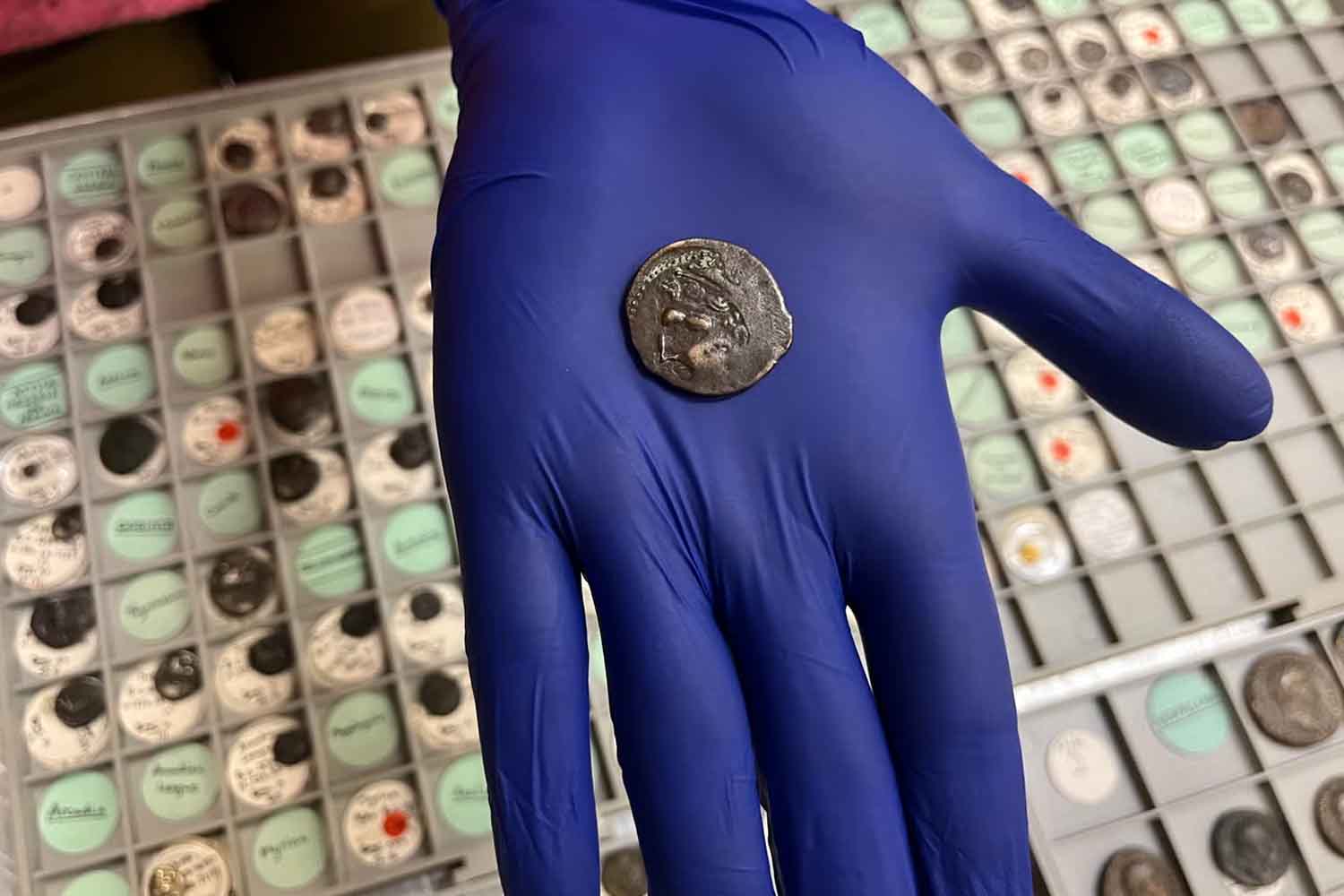
The story of money tells much more than simple economic transactions. Some coins become true silent witnesses of distant eras, crossing empires, wars and continents, reaching us with paths so unlikely that they seem to come out of a novel.
That’s exactly what happened to one Phoenician coin over two thousand years oldwhich re-emerged completely unexpectedly in the heart of England, after being used in the 1950s to pay for a bus ticket. A story that seems almost impossible, yet it is real. And today that coin, which has survived millennia of history, has become a small archaeological enigma.
A Phoenician coin over two thousand years old forgotten for decades
It all begins in Leeds in the 1950swhen a passenger boards a city bus and pays for the ticket with a rather unusual coin. The driver immediately notices that something isn’t right: that piece of metal looks strange, it doesn’t look like British currency and he would probably never have been able to make ends meet for the day.
Thus the coin is set aside and ends up in the hands of James Edwardschief cashier of the Leeds Transport Company. For him it becomes a simple curiosity, one of those objects that are preserved without knowing exactly why. He puts it in a jar together with other memorabilia and, years later, decides to give it to his nephew Peter Edwards. The boy keeps it in a wooden trunk and it remains there, forgotten, for about seventy years.
Only recently did Peter decide to have it analyzed by experts at the University of Leeds. And here comes the surprise: what seemed like any coin is actually one Phoenician coin minted over 2,100 years ago. From a simple curious object it suddenly transforms into a historical artefact. Today it will become part of the collection preserved at the Leeds Discovery Centrewhere it will be studied and preserved.
From ancient Mediterranean trade routes to modern Britain
To really understand this story we need to go back over two thousand years, to 1st century BCwhen the coin was minted in the city of Gadirpresent-day Cadiz, in southern Spain. At the time, Gadir was one of the most strategic points in the ancient world. Located just beyond the Strait of Gibraltar, it represented a gateway between the Mediterranean and the Atlantic, a fundamental crossroads for traders and navigators.
The city was one Phoenician colonyheir to the great maritime tradition of Carthage. The Phoenicians were extraordinary navigators and traders, capable of building commercial networks that connected territories very distant from each other. After the defeat of Carthage in the Punic wars against Rome, many Phoenician cities tried to preserve their cultural identity while adapting to the new political and economic balances of the Mediterranean. The currency also reflects this strategy.
The Phoenicians understood that in order for their currency to circulate in international ports, it had to appear familiar to foreigners as well. This is how they decided to depict it Melqartthe main deity of the city of Tyre, but with a strikingly similar appearance to Herculesthe hero of Greek mythology.
This choice was not random. Many tales attributed to Hercules could have roots in the legends linked to Melqart. Making the Phoenician god similar to the Greek hero meant creating a kind of “universal” currency of the Mediterraneaneasily recognizable and accepted in ports frequented by merchants of different cultures. An ingenious solution, worthy of a people who had made trade their strength.
The mystery of the Phoenician coin that arrived in Leeds
The most fascinating question, however, remains: How did this Phoenician coin arrive in England? Archaeologists can only formulate hypotheses. The most plausible theory looks to the twentieth century, and in particular to Second World War. During the conflict thousands of British soldiers fought in the Mediterranean.
When they returned home they brought with them many small objects collected during their military service: ancient coins, pottery fragments, improvised souvenirs. It may have been one of these soldiers who collected the coin in the 1940s and brought it back to Britain. Later, perhaps for fun or distraction, someone may have used it as payment on a bus.
An apparently banal gesture that transformed an archaeological find into a curious news episode. Scholars call phenomena like this “currency migration”. Coins, more than any other man-made object, are made to move. They change hands, cross borders, travel for centuries without leaving a trace.
This small Phoenician coin has survived the fall of Carthage, the end of the Roman Empire, the era of colonial empires and even the recent history of Europe. And after more than two thousand years of travelshe found herself paying for a bus. Today it finally rests in an air-conditioned museum case. His long journey through history has stopped, but the mystery of his journey remains open.
