
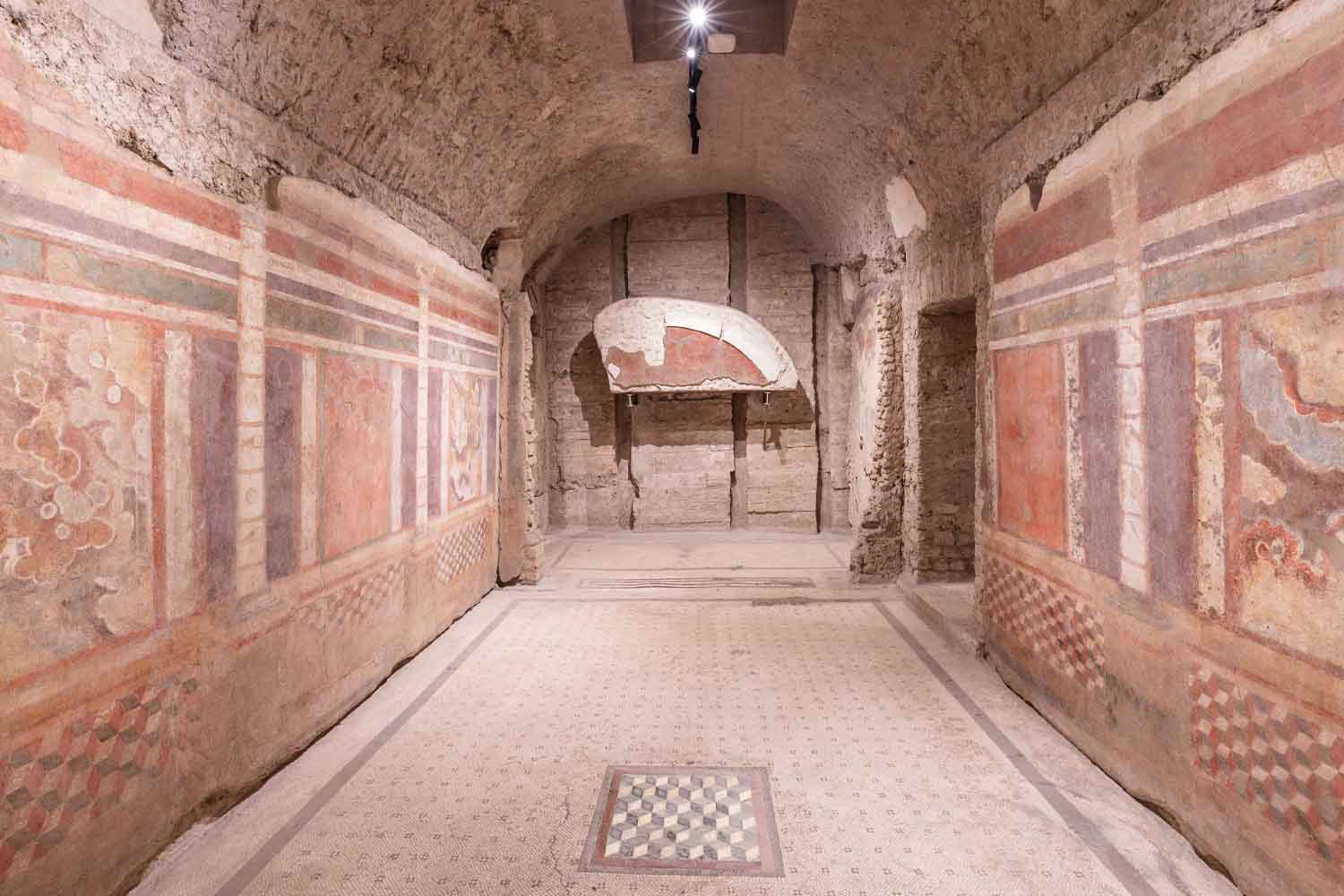
For over two thousand years it has remained hidden under our feet, protected by the earth and silence. Now the House of Grifi, one of the oldest and most fascinating Roman residences on the Palatine, finally becomes accessible to the public. Not in the traditional way, however: what makes it visitable is a system of live streaming guided tours, designed to protect a fragile heritage and, at the same time, offer a concrete alternative to the overtourism that suffocates Rome.
The House of Griffins is a domus from the Republican era, built between the 2nd and 1st centuries BC, when the Palatine was the most exclusive neighborhood of the city. Members of the Roman aristocracy lived here, attracted not only by the strategic position, but also by the symbolic value of a hill destined to become the heart of imperial power.
The name of the house comes from two white stucco griffins, mythological creatures half lion and half eagle, which decorate an internal portico. An apparently decorative detail that tells a lot about the taste and wealth of the owner, probably a patrician belonging to the ruling class of republican Rome.
Inside the domus there are elegant rooms, with mosaic floors, completely frescoed walls and decorations which recall, in style and colours, some famous houses in Pompeii. In one of the best preserved rooms, green marble slabs and reflective surfaces are still visible, signs of a luxury that had nothing to envy of the most famous homes of antiquity.
Buried to build the imperial palace
The history of the House of Griffins changes radically with the advent of the imperial age. Between the 1st century BC and the 1st century AD, Emperor Domitian began the construction of his immense palace on the Palatine. To make room for the new complex, many republican homes were demolished or buried.
The House of Griffins also suffered this fate: the upper part was destroyed, while the lower floors were buried. A gesture that erased a piece of history at the time, but which today proves decisive. The burial protected frescoes and mosaics from light, atmospheric agents and urban transformations, allowing them to reach us in an exceptional state of conservation.
Precisely this extraordinary conservation has made the domus extremely delicate. Underground environments are sensitive to humidity, temperature variations and even carbon dioxide produced by human presence. For this reason, despite being well known and studied by archaeologists, the House of Griffins remained an invisible place, accessible only to researchers and professionals.
Opening it to the public with traditional visits would have meant putting the frescoes and decorations at serious risk. Hence the need to find an alternative solution, capable of reconciling protection and disclosure.
How the new opening of the Casa dei Grifi works
The answer comes from the Colosseum Archaeological Park, which has chosen to experiment with a form of sustainable digital use. The House of Griffins opens to the public for the first time through live streaming guided tours.
A guide physically enters the underground environments, wearing a smartphone mounted on his head, and explains the site step by step. Visitors, in small groups, follow the tour from an elevated space, observing every detail in real time without compromising the conservation of the frescoes.
As the director of the Park, Simone Quilici, explained, it is a concrete example of integration between archeology and technology, a model destined to become increasingly central for the management of the most fragile sites.
You might also be interested in:
