
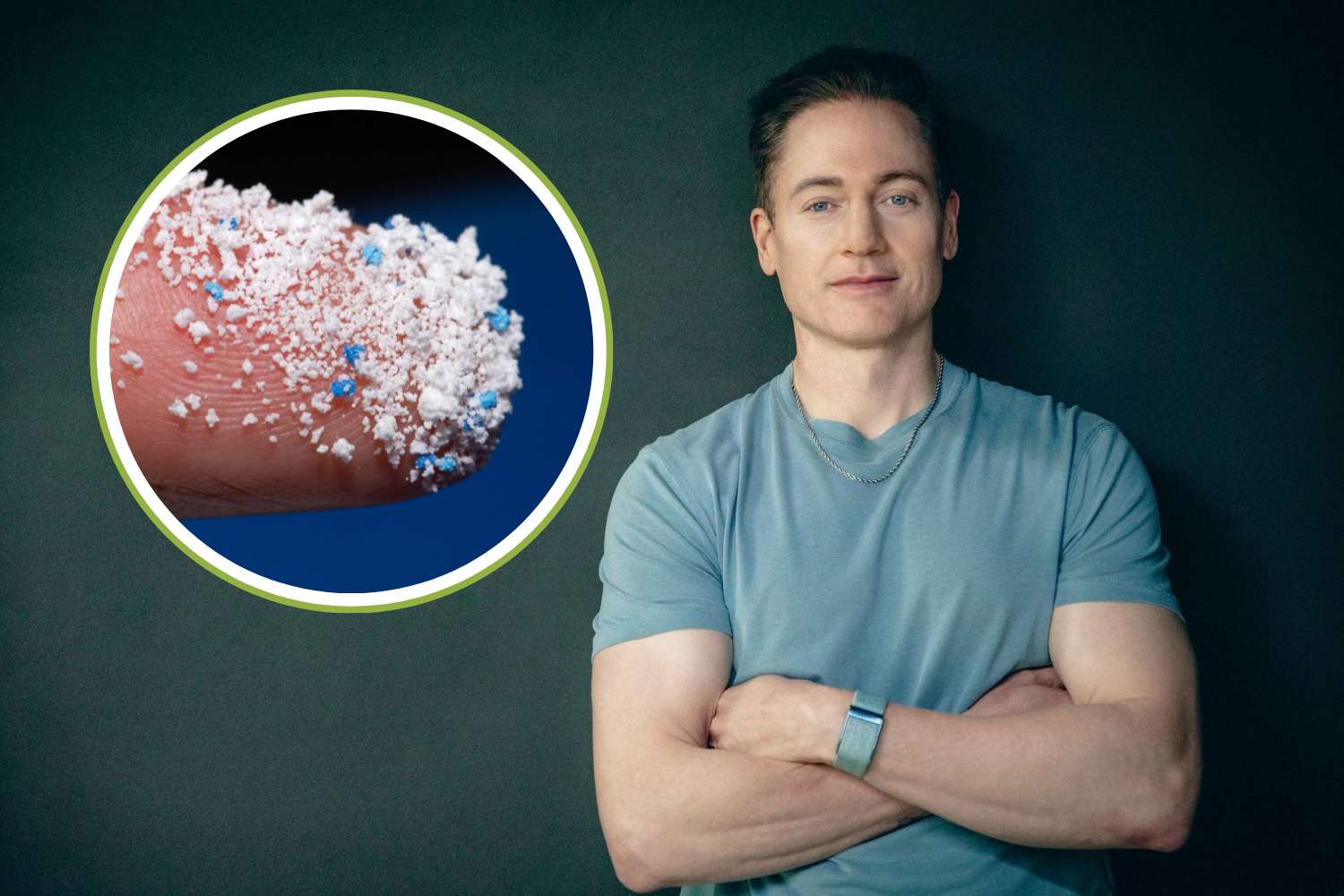
Bryan Johnson, an American tech entrepreneur already known for his investments in biohacking and for spending around $2 million a year trying to reverse his biological age with the help of a medical team, is back in the spotlight with a surprising statement regarding the microplastics present in his body.
Last summer, Johnson shared a rather embarrassing fact with the world: his testicles contained more microplastics than his blood. Precisely, 165 particles per milliliter in his semen. The man recently came back to the fore with a stunning new claim: he claims to have eliminated 85% of microplastics from his ejaculate in less than a year, bringing levels from 165 to just 20 particles per milliliter. A similar result would also have been obtained in blood.
How would he have done it? According to Johnson, the recipe includes three main ingredients:
Johnson said it was the sauna in particular that made him “sweat out” the plastic, along with other environmental toxins.
I eliminated 85% of microplastics from my ejaculate.
Nov 2024: 165 particles/mL
July 2025: 20 particles/mLNearly identical drop in my blood same time period:
Oct 2024: 70 particles/mL
May 2025: 10 particles/mLImportant as a meta-analysis of 36 studies reveals that… pic.twitter.com/YeQwvJxZM1
— Bryan Johnson (@bryan_johnson) October 21, 2025
There is no scientific proof
There is one small detail that Johnson seems to overlook: there is no scientific evidence to support the idea of “sweating microplastics”. In fact, human physiology suggests exactly the opposite.
Sweat is made up of 99% water. The remaining 1% includes salts such as sodium and potassium, lactate and urea. Its main purpose is to regulate body temperature, not to eliminate toxins. For that, the human body already has a sophisticated and highly efficient system: the liver and kidneys.
It is true that infinitesimal traces of heavy metals or chemicals such as BPA and phthalates can be found in sweat, but in quantities thousands of times lower than those that the liver and kidneys process daily. And here’s the crux: we’re talking about dissolved chemicals, not solid polymer particles.
Microplastics are microscopic but solid fragments, present in the blood and deposited in the tissues. There is no known biological mechanism by which a plastic particle can be transported by the bloodstream or testicles to a sweat gland for excretion through a pore. Just as you cannot expel a splinter by sweating, you cannot expel microplastics with sweat.
Among other things, some scientific studies have shown that frequent use of the sauna has negative effects on the quality of sperm, given that intense heat compromises sperm production. Johnson probably knows this well, so much so that he admitted to using an ice pack on his groin during sauna sessions to counteract this effect.
But if Johnson didn’t actually “sweat” the plastic away, what really happened? The most likely answer lies in the less conspicuous part of his experiment: the reverse osmosis filter.
This technology, which forces water through an extremely thin semi-permeable membrane, has proven incredibly effective at removing microplastics from drinking water. It is one of the best solutions available on the market. Likewise, eliminating plastic cutting boards (which release millions of particles when cutting food) and stopping heating food in plastic containers in the microwave are sensible, research-backed choices.
In other words, Bryan Johnson probably hasn’t discovered a magical way to expel plastic from the body. He simply stopped ingesting it. Our body already has excellent mechanisms for eliminating harmful substances: if we stop taking them, they are often eliminated naturally over time.
However, Johnson must be recognized for an important merit: he turned the spotlight on a very urgent problem. Microplastics are now everywhere – in our blood, in our lungs, even in sperm. They are so ubiquitous that some scientists consider them a marker of a new geological era, “Plastilene.”
