
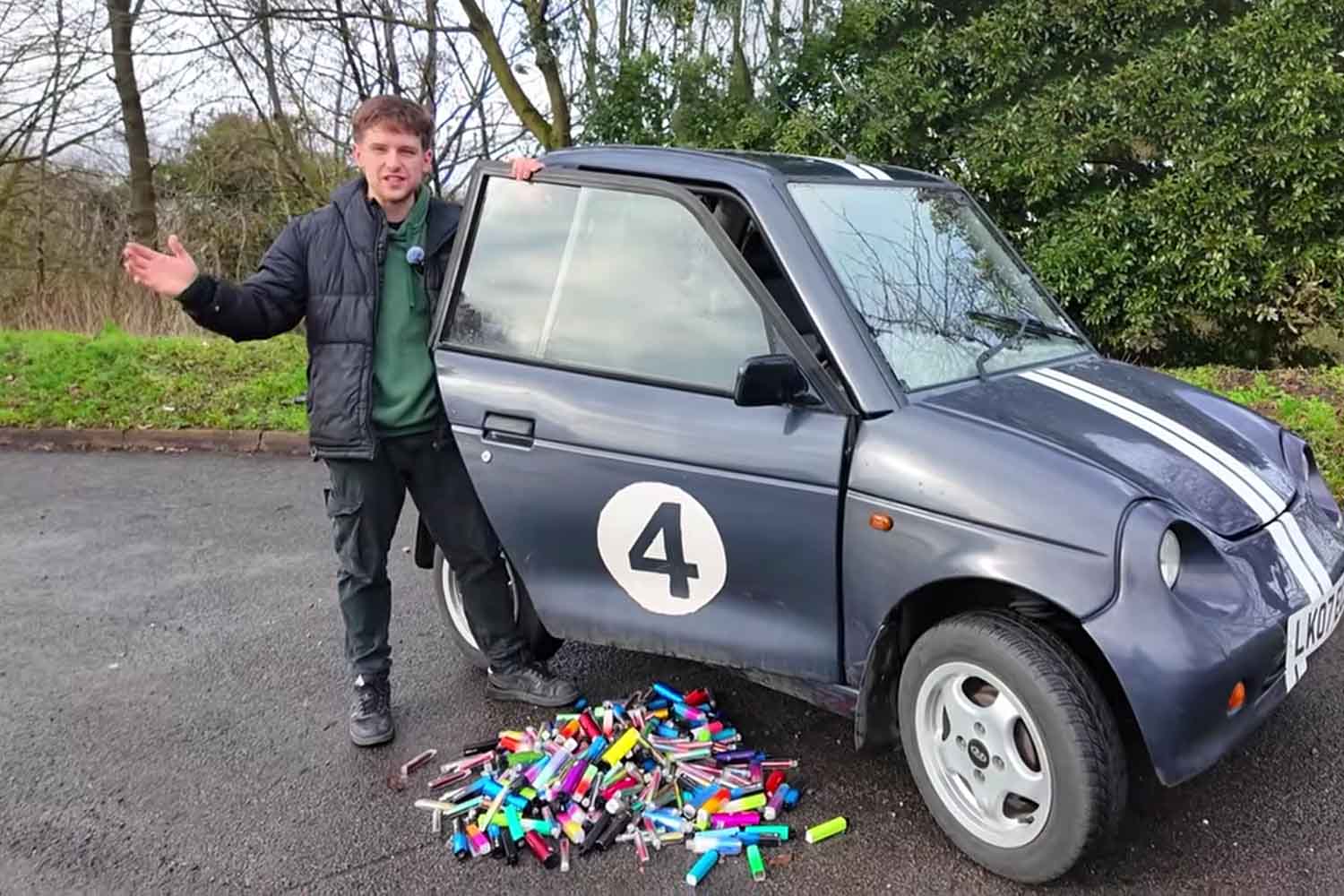
There are objects that enter our lives with a promise of convenience and exit with disarming speed. Disposable e-cigarettes are one of the most obvious examples of this contemporary paradox: a few days of use, a perfectly functioning lithium battery and then the silent journey to the bin.
Inside those small colored cylinders, however, something is hidden that we rarely consider. A rechargeable battery, designed to store energy, which ends up unused after a few hundred puffs.
It is precisely starting from this contradiction that a young English engineer decided to do something that seems to have come out of a nerd novel full of improvised experiments in the garage: recover hundreds of batteries from disposable e-cigs and use them to power an electric car. His name is Chris Doel, he is 27 years old and has a self-definition that already says a lot about the character: “the engineering equivalent of a mad scientist”. And, judging by what he managed to build, perhaps he isn’t entirely wrong.
Disposable electronic cigarette batteries
The story begins with a rather simple question: how much energy are we throwing away every day without realizing it? Chris Doel works as an engineer and began to look with technical curiosity at the disposable electronic cigarettes that accumulate in waste bins or in specialized shops. Inside each device there is a small rechargeable lithium battery, designed to sustain numerous charging cycles, yet destined to end up in landfill after just a few uses.
The idea came to him almost for fun: recover those batteries and build a huge domestic accumulator. So, in May last year, he showed up at an e-cig shop in his area with an unusual request: to be able to collect the devices returned by customers. What retailers simply call “returns”, i.e. products returned and destined for disposal. He returned home with bags full of about 2,000 disposable e-cigarettes.
At that point the real work began, the one that requires patience rather than genius: dismantling every single device, extracting the lithium battery, testing it and storing it. For six months, in his free time, Chris spent his evenings doing just that. By the end he had accumulated hundreds of perfectly functional cells. He used 500 of them, organizing them in a complex system: groups of batteries connected in parallel and then assembled in series, inside a protective structure designed and created with 3D printing.
The result was a huge home battery pack. When he plugged it into his home for the first test, the experiment worked better than expected: The house stayed powered for about eight hours before the power ran out. A result sufficient to give him another idea. More ambitious. Definitely crazier.
The experiment that amazed even the engineers
The next step came during a conversation with a colleague. Chris said he would like to power an electric vehicle with the battery pack built from electronic cigarettes. The problem, however, was technical: modern electric cars use high voltage systems, often around 400 volts. Too much for his system.
The solution came from an idea as simple as it was brilliant: finding an electric car with a much smaller battery. So Chris bought a 2007 G-Wiz, an electric microcar also famous for being defined by Top Gear as the worst car of the year. Not exactly a gem of automotive engineering, but perfect for the experiment.
This small car, in fact, runs on a battery of just 48 volts. Chris paid around £800 for it and began work on the transformation. For five months he dedicated every free moment to the project: five hours after work on weekdays and up to twelve hours on weekends. He completely dismantled the vehicle’s electrical system, rewired every component and designed a safety system to contain any battery problems.
The battery pack built with cells recovered from disposable e-cigarettes was placed inside a large protective container, designed to withstand even the worst-case scenario. Chris explains it without mincing words: if something were to go wrong, it’s better for the flames to remain inside an isolated structure. Finally it was time for the test. Little G-Wiz got moving.
For two consecutive hours, the car traveled about 18 miles (almost 29 kilometers) using only the energy stored in the e-cig batteries. Top speed was about 50 miles per hour, more than enough for an urban microcar that can carry two adults and two children. All thanks to batteries recovered from objects designed to be used for a few days.
From experimentation to daily life
A project like this inevitably involves some risk, especially when we’re talking about hundreds of lithium batteries connected together. For this reason Chris Doel decided to take out a specific insurance policy, spending around 700 dollars for a year of coverage. A figure that he himself defined as surprisingly low, considering the experimental nature of the project.
After the test, the battery pack built from the e-cigarettes was removed. Today the microcar uses two Tesla battery modules, managed through modified software that convinces the vehicle’s electronic system to be installed on a Tesla Model 3. The result is that the little G-Wiz has become his daily car. In the meantime, Chris continues to document his experiments on his YouTube channel, followed by over 160 thousand people, where he shows every technical step of his projects.
Behind this story there is also a broader reflection on an object that we now encounter everywhere: disposable electronic cigarettes. Chris Doel does not hide his position. Consider these devices one of the clearest examples of planned obsolescence in the world of consumer electronics. Inside each e-cig there is a rechargeable battery and precious materials, but the entire device is designed to last a few days. The result is an increasing amount of e-waste that is difficult to recover.
The English engineer’s experiment demonstrates a very simple thing: even the most banal objects hide energy resources that we often ignore. You just need someone curious enough to open them up, take them apart, and see what’s really inside. And perhaps this is precisely the most interesting point of the whole story: the technology we discard every day tells much more than it seems.
You might also be interested in:
