
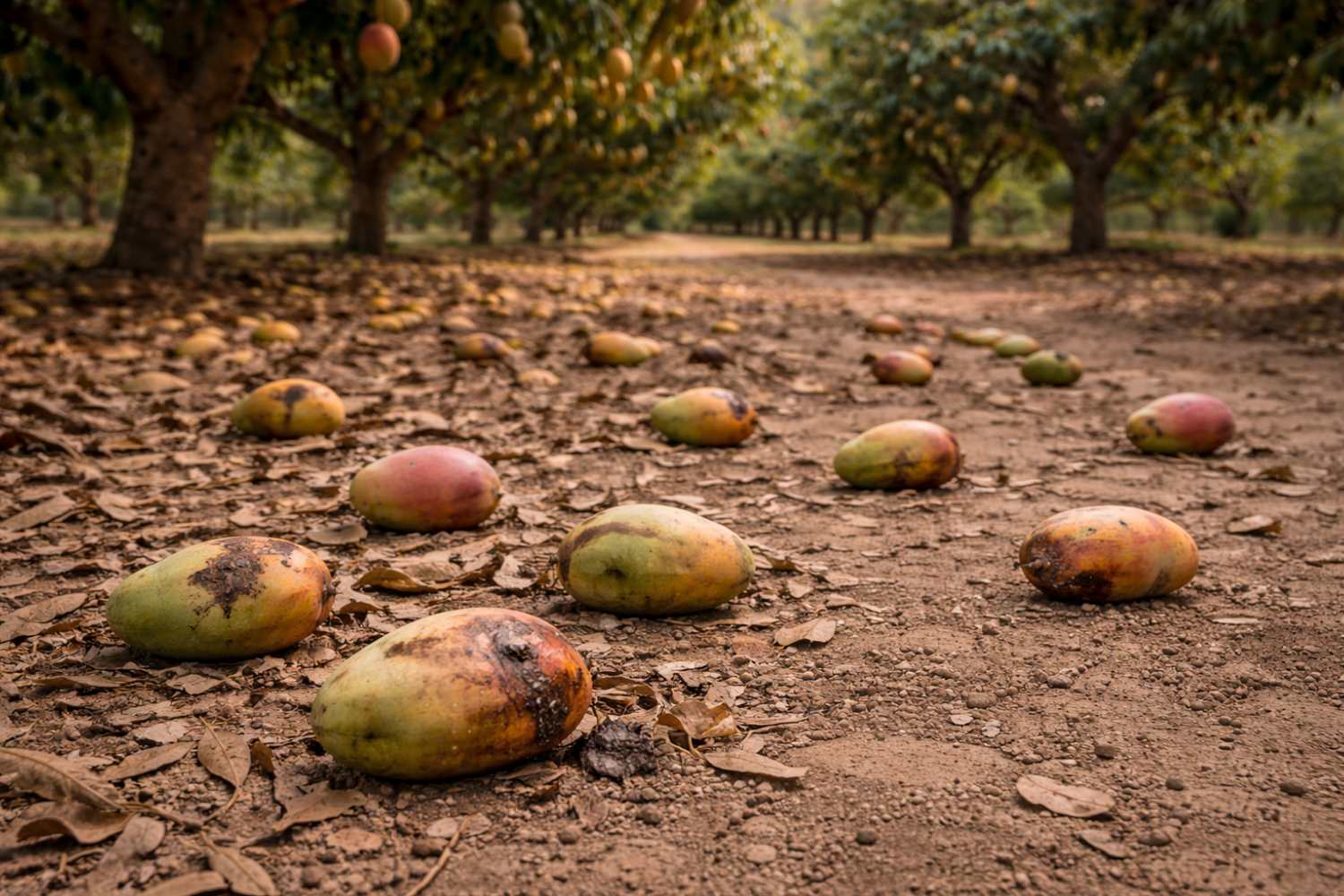
The crisis affecting Israel’s agricultural exports is unprecedented. According to testimony gathered by Israeli public broadcaster Kan 11, citrus and mango producers are facing devastating losses, with orders from Europe and Asia virtually zero.
“We have been operating at a loss since the war began” said Nitzan Weisberg, who manages plantations at Kibbutz Givat Haim Ichud. His orchards are now at risk of being permanently eradicated, despite the high quality of the product, as Israeli fruit has become something unwelcome on international markets.
Daniel Klusky, secretary general of the Israeli Citrus Growers Organization, confirmed the total blockade: “Before the conflict we exported as far as Scandinavia. Now not even a container has left“.
The emblematic case of the mango
In the north of the country, the situation is very critical. Moti Almoz, a farmer in the region, left 25% of his harvest to rot on the ground: “They don’t want our mangoes. In Europe they only contact us if something is missing… If they have an alternative, they avoid buying from us“.
Robert Amrosi, a veteran grower from Moshav Migdal, left over 100 tons of fruit on the trees: “Collecting them would cost more than I could get from selling them“. On 200 hectares of family orchards, he harvested just 100 tons, losing almost a million shekels. Another producer speaks of 700 tons out of 1,200 produced that will remain on the trees or rot on the ground: “It is an unprecedented crisis in our history“.
But how did we get to this situation?
The boycott in favor of Gaza and other causes of the crisis
The international boycott of Israeli agricultural products linked to what is happening in Gaza is undoubtedly the main factor that has drastically reduced demand on global markets. At an international level, Israeli fruit no longer goes unnoticed: more and more consumers are choosing not to buy it as an act of moral responsibility and solidarity towards a population that is suffering genocide. This concrete and organized boycott demonstrated how much citizen pressure can impact the economic dynamics of an entire sector.
But there are also other problems to make everything worse. The blockade of the Red Sea by Yemen’s Houthis has forced shipping companies to take longer and more expensive routes, increasing shipping times and complicating access to Asian markets. Ronen Alfasi, a farmer from Hibat Zion, reports delays of 90-100 days for the arrival of containers, resulting in serious quality problems and ripe or rotten fruit before reaching customers.
Added to these logistical difficulties is the climate crisis: extreme heat waves, with temperatures close to 50°C, have accelerated the ripening of the fruits, causing them to fall before harvesting and compromising entire productions. In short, the combination of boycotts, transportation problems and climate change has created a domino effect, transforming what was a solid and globally recognized agricultural supply chain into a sector on the verge of collapse.
An economy on its knees
The Israeli agricultural crisis fits into a broader economic framework. Sectors such as technology and investment are also suffering, with foreign investors increasingly reluctant to partner with a state at the center of international disputes.
The only remaining export market appears to be Russia, in what local media have ironically called “the alliance of the boycotted”.
Farmers are aware of the gravity of the situation and are urgently calling for government intervention. The fear is that Israel will find itself without export agriculture: a sector that took decades to build may collapse in a few months, but will take years to rebuild.
The paradox is stark: while Israeli agriculture drowns in excess production and leaves its fruit to rot, a few kilometers away the population of Gaza is dying of hunger. However, global markets seem to have chosen a side.
Sources: Middle East Monitor /Ynetnews
