
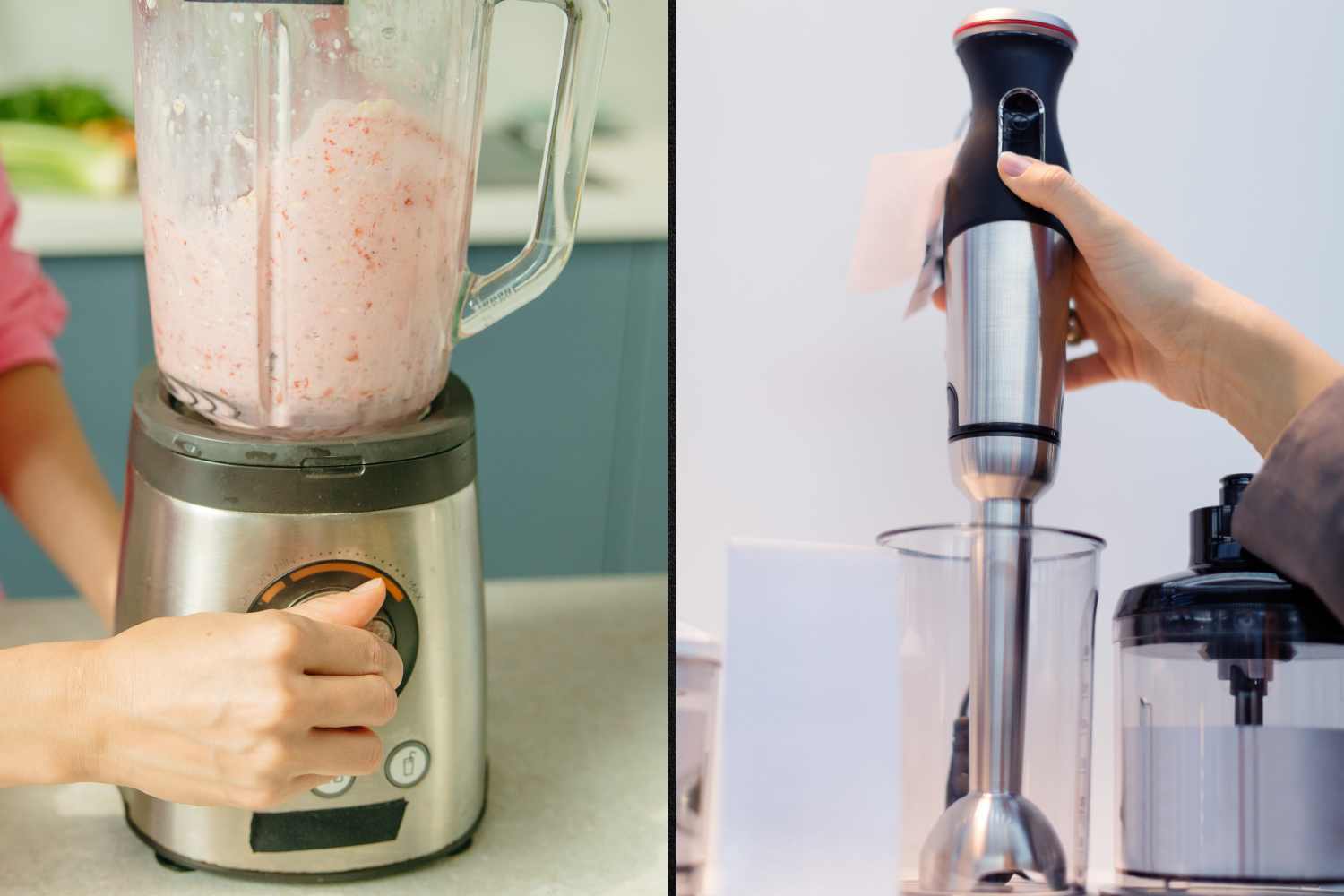
In the kitchen, each tool plays a precise role, able to satisfy different aspirations. For example, there are those who love their hands dirty by kneading for a long time, others prefer to rely on technology and someone else seeks the right balance between practicality and result. In this sense, the blender, in all its variants, is one of those allies that we often underestimate, at least until we need it, and in that case the fateful question arises: better an immersion blender or a traditional one?
The question concerns multiple aspects, not only space and power and power, but also – and above all – versatility, speed and ease of cleaning, in addition to the methods of use, that is, the “how and when” we use certain tools.
The traditional blender: the classic that convinces
The traditional blender, the one with the glass or plastic glass mounted on the motorized base, is the first one we think when it comes to blending large quantities of food. It has a solid structure, resistant blades, different speeds and some models allow you to even chop the ice and work the softer doughs.
Does it make sense? Certain. When you want to prepare a smoothie for several people, a creamy velvety, or a sauce with a uniform consistency, the traditional blender makes its profession very well: put everything inside, close the lid, press the button and wait.
The result is almost always impeccable. The fixed structure and the power make it a reliable tool, and then, let’s face it, the idea of having a container that collects everything, without sketches and with a kitchen sheltered from the disasters, makes a throat.
But as the proverb says, all that glitters is not gold. The glass has an important volume, which in certain kitchens can be an obstacle, the cleaning operations are not always simple, especially if the residues are encrusted between the blades, and finally it is not very comfortable for small quantities. Half clove of garlic, a handful of pine nuts, a spoonful of yogurt: here, in those cases it becomes cumbersome.
The immersion blender: small, agile, fast

On the other hand, the immersion blender – often called minipimer – has its own charm. It occupies little space, slips into the drawer, you can also hang on the wall and take it in hand like a ladle, to be immersed directly in the pot.
Just this last feature elevates it to the counterparty. Have you just cooked the vegetables for the soup? You will not have to transfer them: just immerse the blender, turn it on and in a few seconds you will get a cream ready to serve. Less passages, less dishes to wash, less lost time.
Also perfect for emulsifying, mounting and preparing fast sauces, without forgetting that some models include accessories, such as chdies, whips and dosers’ dosers who can give you an extra hand, especially if you cook often and if you love experimenting.
But the limits come here. First of all, the power is not always comparable to that of fixed blenders, then the final consistency, which depends a lot on your hand – if you are hasty, the risk is to obtain a uniform compound – and the effort due to the large quantities, given that the minipimer must be kept in a long time.
Versatility: the real stake

Let’s talk about versatility, because it is on this ground that the real challenge between the two contenders is played.
The traditional blender wins in stability, strength and ability. It is perfect for complex recipes, for abundant smootie, for granitas and liquid doughs to work for a long time. In certain preparations, it is truly irreplaceable.
The immersion blender, precisely because of its agility, wins in practicality. It is immediate, discreet and adaptable, it allows you to work directly in the cooking containers, avoiding unnecessary passages. And if you just have to blend a cream on the fly, or a homemade pesto, it becomes almost indispensable.
Then there is another aspect, often neglected: the frequency of use. The minipimer pulls it out every day, even just for a small intervention, while the traditional blender tends to remain at rest for longer, relegated only to weekends and special occasions.
Which to choose, then?
It depends a lot on your habits, as always.
If you love the protein smoothies of the morning, if you often prepare abundant portions and if you need an appliance capable of working even the hardest ingredients, the traditional blender will be played your primary choice. It requires a little more space and more attention, but it will repay you with greater power.
If, on the other hand, you often cook quick dishes, you like to have your hands free and want a slender tool that you can also use for small doses, the immersion blender is for you. You will use it more often, you will clean it in an instant and find out that it can become an unsuspectedly precious tool.
To conclude
The immersion blender is more versatile if we talk about everyday use, speed and simplicity. The traditional one remains unbeatable in power and homogeneous results for more complex preparations. More than rivals, they are allies. And when they coexist in the same drawer, it is your cuisine that earns us.
The truth? If you have space, keep them both, because neither of them is really better: they are both, in a different way. And in the kitchen, as in life, having the possibility of choosing makes all the difference in the world.
Don’t you want to lose our news?
