
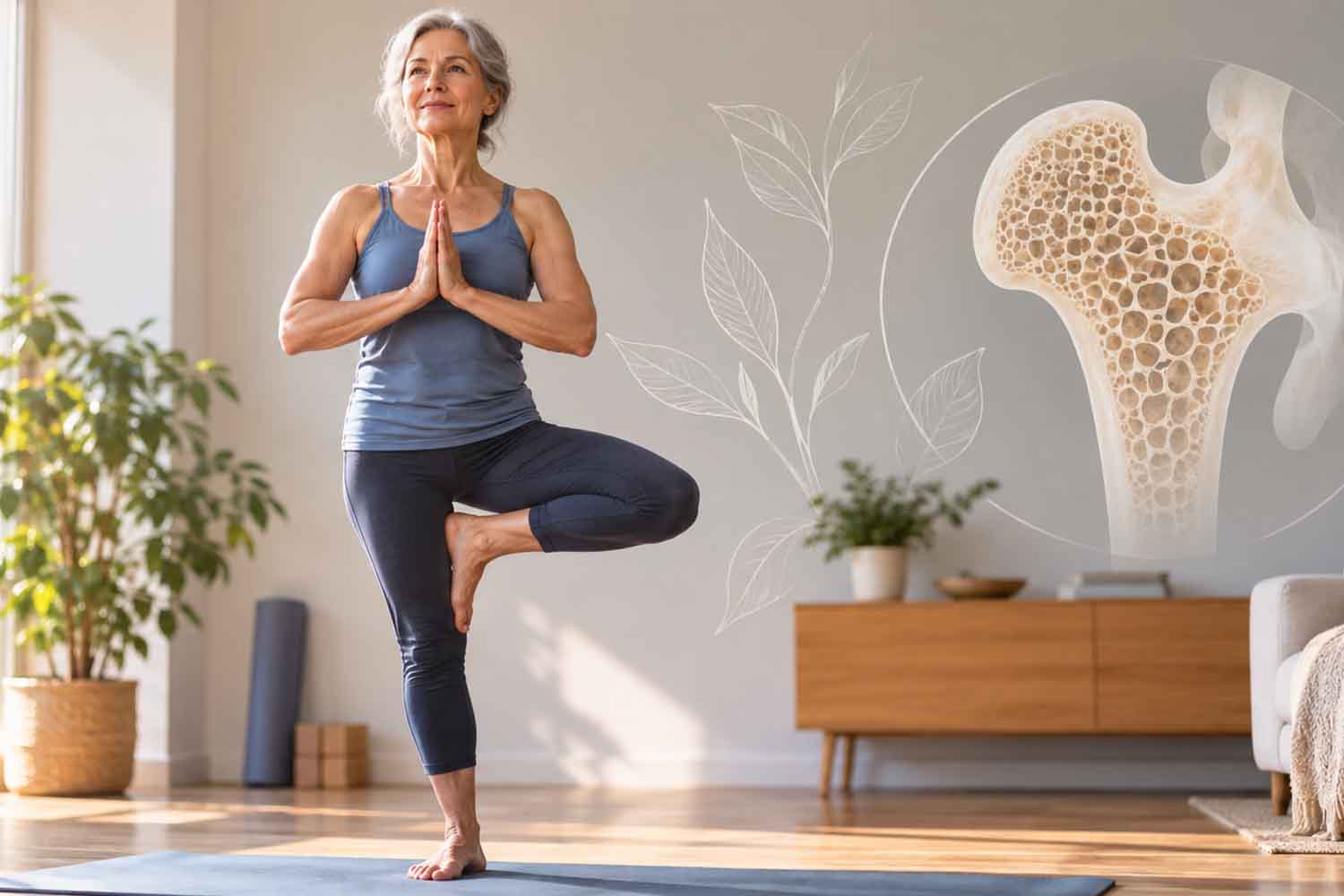
Is two minutes of tree pose added to your daily exercises enough to achieve improvements in balance? In a small study of 32 women with postmenopausal osteoporosis, researchers observed encouraging results after incorporating this yoga pose, known as Vrksasanain a twelve week training program.
The research, conducted by Istanbul Medeniyet University and published inAmerican Journal of Physical Medicine & Rehabilitationsuggests that an exercise that is as simple as it is challenging, at least for those who tend to lose balance, can help improve the stability of the body. A particularly important benefit for people with osteoporosis, in whom a fall can have much more serious consequences than a few bruises.
Two more minutes in your daily routine
Tree pose is one of the most recognizable in yoga. You start standing, shift your weight onto one leg, lift the other foot, placing it on the inside of the supporting leg, avoiding the knee, and try to maintain the position with a straight back. The arms can remain in front of the chest or rise above the head.
It seems easy, at least until you try to stay still. The body must continually make small adjustments to avoid swaying, involving muscles, joints and sensory systems that work together to maintain balance.
To test the effects of position, the researchers randomly divided 32 women with postmenopausal osteoporosis into two groups. The first followed a conventional exercise program of 30 minutes a day, while the second performed the same activity adding two minutes of Vrksasana.
The experiment lasted twelve weeks, during which the participants underwent various tests to measure static balance, dynamic balance and the ability to maintain stability in different conditions.
What happened after six weeks
Already in the sixth week, an interesting difference appeared: the women who also practiced the tree pose achieved significantly better results in the one-legged balance test than the participants who only followed the conventional exercises.
During the twelve weeks, both groups also showed improvements in several measures, from the Berg Balance Scale, used to evaluate balance in daily activities, to static and dynamic balance tests and tandem walking, which consists of moving forward by placing one foot in front of the other.
The comparison between the groups therefore identified a specific advantage of Vrksasana in the ability to remain on one leg. According to the authors, adding this position to traditional exercises can contribute to improving balance in women with postmenopausal osteoporosis.
Why improving balance is important when you suffer from osteoporosis
Osteoporosis makes bones more fragile and increases the risk of fractures, especially in the wrist, vertebrae and femur. Furthermore, as age advances, muscle strength and the ability to quickly recover stability when you stumble or lose your footing may decrease. Training balance therefore becomes an important component of prevention.
The UK NOGG osteoporosis guidelines also recommend exercises aimed at improving strength and balance to help reduce the risk of falls. The tree position fits into this strategy because it requires you to control the distribution of body weight and maintain stability on a reduced base of support.
Of course, the Turkish study involved only 32 women and assessed improvements in balance, without directly measuring a decrease in falls. The results are promising, however, and suggest that even a very brief addition to an exercise program can be beneficial.
How to practice tree pose safely
For those suffering from osteoporosis, especially in the presence of balance problems or previous fractures, it is important to adapt the exercises to your abilities and consult a healthcare professional before starting. The position can be modified by using a wall or a stable chair as support, without necessarily trying to lift the foot up to the thigh. The goal is to gradually work on stability, avoiding exposing yourself to the very risk you would like to prevent.
The results of the study therefore offer a practical indication: dedicating a couple of minutes to balance, within an already consolidated exercise routine, can be a useful addition. For women with postmenopausal osteoporosis, the ability to stand more firmly on one leg also deserves attention. Especially when one stumble is enough to cause a fracture.
