
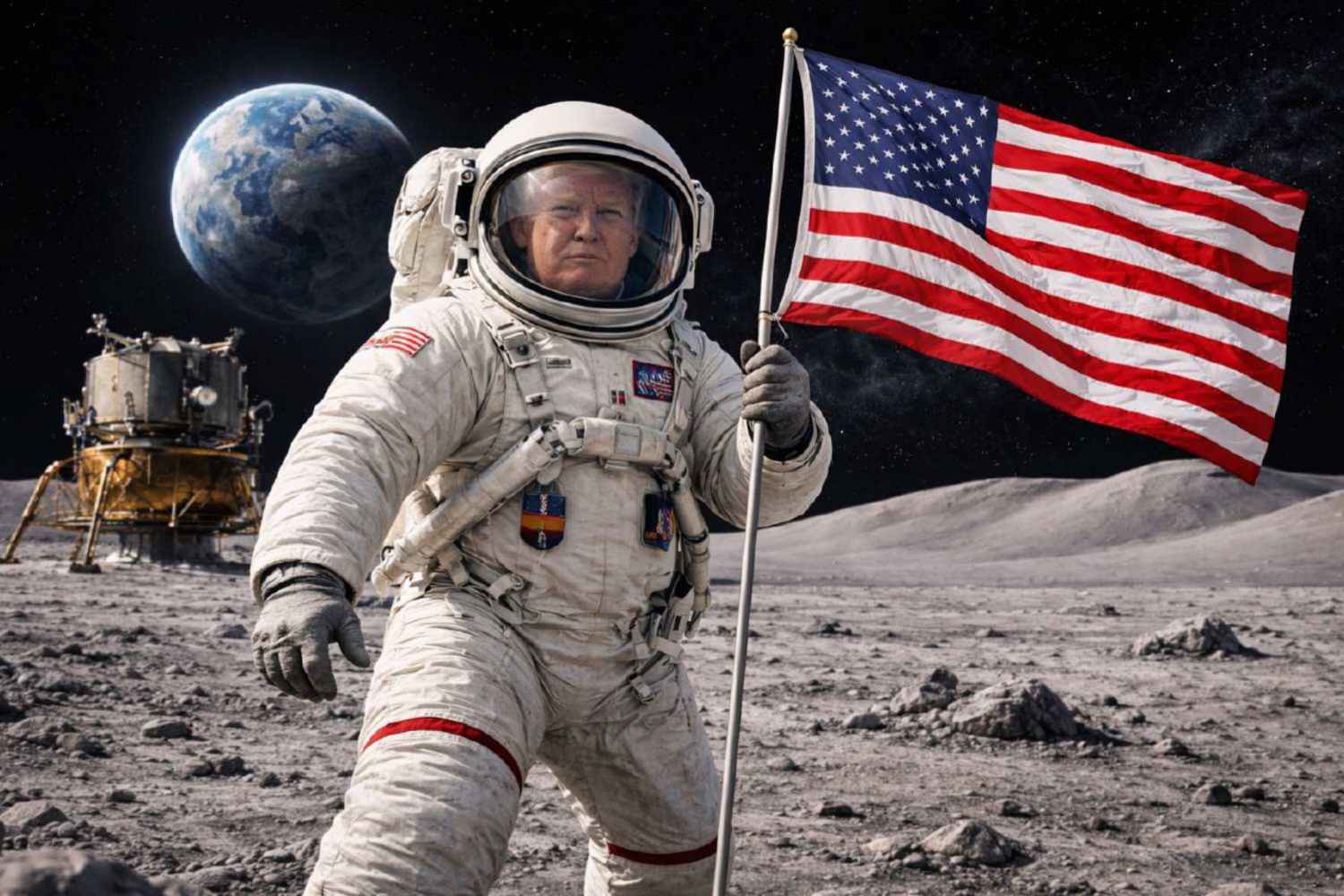
Greenland remains at the top of Donald Trump’s mind. Not as a diplomatic extravagance, but as an emblem of a vision of power that is measured in territorial extension, strategic control and gestures destined to leave their mark. The idea of “buying it” never really disappeared from his political horizon. Indeed, it seems to have opened a trajectory that today points even further, beyond the Earth’s atmosphere, up to the Moon.
This is not a provocation. Before Christmas, Trump signed an executive order committing NASA to return American astronauts to our satellite by 2028, before the end of his possible second term. A political deadline, rather than a scientific one, which transforms space exploration into a question of personal legacy.
View this post on Instagram
From Arctic ice to deep space
The thread that links Greenland and the Moon is less imaginative than it seems. Both represent highly symbolic territories, borderline places where geopolitical ambitions, technology and the narrative of power are concentrated. The first is crucial for the control of the Arctic and future trade routes; the second is the maximum possible stage to reaffirm American supremacy.
Philip Johnston, political commentator and columnist for the Daily Telegraph, writes that in front of the pyramids of Giza even the loudest political maneuvers seem fragile. Cleopatra is closer to us than she was to Cheops, yet those monuments continue to tell the same obsession: leaving a sign that survives time.
It is no coincidence that Johnston recalls, in an article in the English newspaper, Ozymandias, the sovereign celebrated and at the same time downplayed in Shelley’s poem. A leader convinced that his name could last forever. The Moon, today, performs a similar function to the colossal statues of Ramesses II in Abu Simbel: it not only responds to a practical logic, but to a need for grandeur.
The myth of space and modern illusions
The fascination of space has often fueled narratives bordering on myth. Johnston recalls the figure of Erich von Däniken, author of Chariots of the Gods?, who attributed the pyramids to extraterrestrial interventions and provocatively asked: “Was God an astronaut?”. Discredited theories, but capable of intercepting a public willing to believe that humanity could not have built such complex works on its own.
Yet the numbers tell another story. The Voyager 1 probe, launched almost fifty years ago, left the solar system only in 2012 and at the end of 2025 was just one light-day away from Earth. The closest star with a potentially habitable planet is over four light-years away. Space, for now, remains above all a symbolic horizon.
Artemis, billions and terrestrial priorities
In recent days the Space Launch System rocket and the Orion capsule have been moved to the launch pad at the Kennedy Space Center. Artemis II is expected to launch soon with four astronauts in lunar orbit, without landing on the moon. Artemis III could return humans to the surface as early as next year. Subsequently, other missions are planned to create a permanent base, designed as a bridge to Mars.
The United States Congress also financed the program thanks to the development of reusable carriers, including the funds in the law renamed by Trump One Big Beautiful Bill Act. But the bill remains very high: billions of dollars of public resources. Already in the 1970s the Apollo program was contested due to its costs, and today the question returns with greater force.
The return to the Moon is presented as a technological achievement, but it remains above all a political choice. While billions of dollars are projected out of Earth’s orbit, issues on Earth that do not allow for postponement, such as the climate crisis, remain unresolved. The most difficult distance to bridge today is not the one between the Earth and the Moon.
