
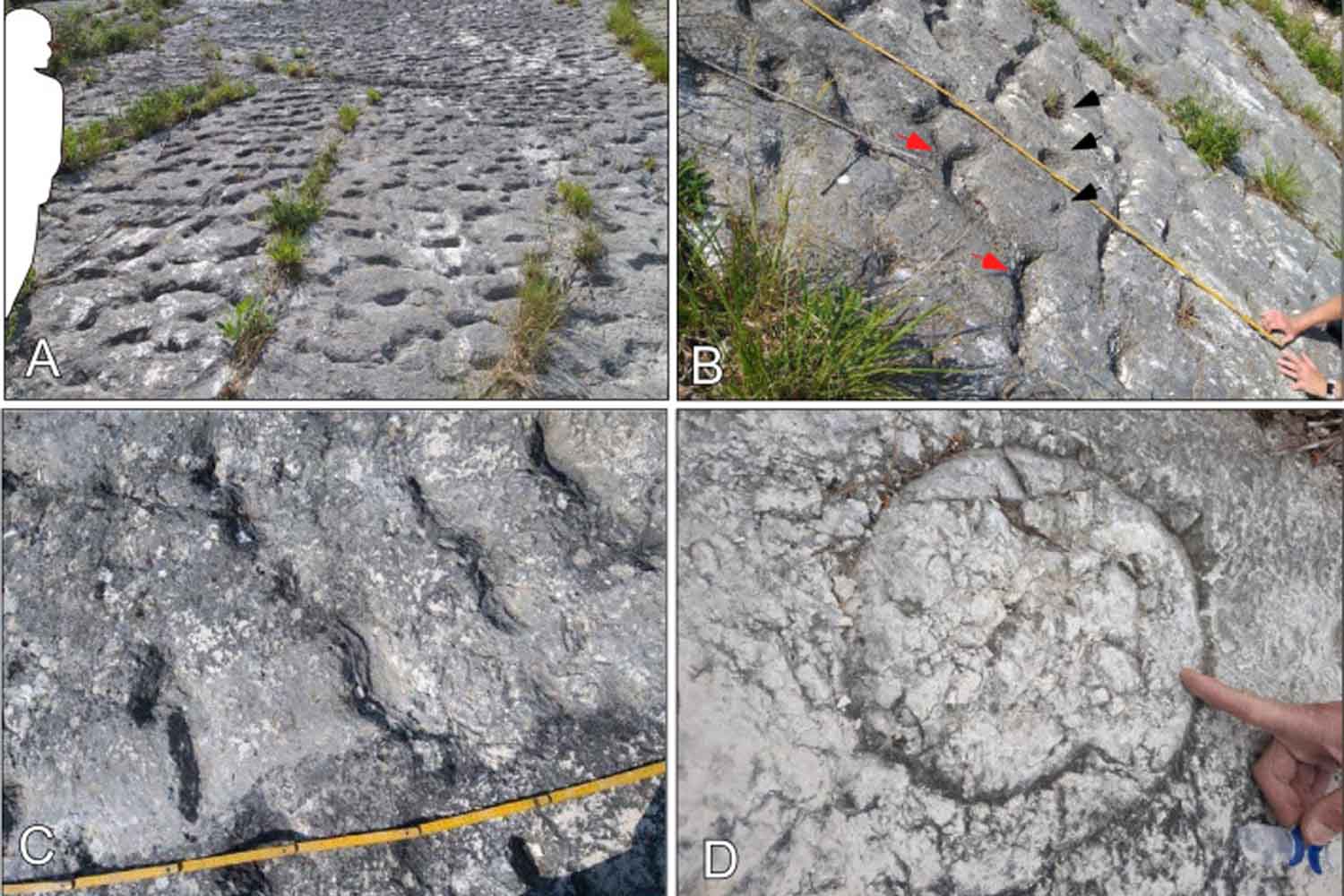
On the Monte Coneroin the Umbria-Marche Apennines, overlooking the sea, there is a rock wall that doesn’t speak: it screams. A thousand small crescents engraved in the stone tell a story that no human being has seen, but which today we can almost imagine as a geological still image. It’s the story of a sudden panicof a earthquake Cretaceous and of a group of sea turtles who, a moment before fleeing towards the sea, left footprints destined to last longer than our own species.
This “still” of prehistory was discovered by three climbers who, ignoring the prohibition of the Municipality of Ancona due to the risk of landslides, reached a point on the cliff called The Sailing Plaques. There, in the middle of summer, they found themselves in front of a limestone slab of about two hundred square meters, lined with a thousand small footprints, very close together, ordered like an army marching in the same direction. Except it wasn’t a march: it was an escape.
Those footprints don’t resemble anything on Earth. The crescent shape, repeated everywhere, immediately made scientists think of fins immersed in shallow water, not of legs resting on a dry surface. And it is likely that it happened exactly like this: 80 million years ago, the current Conero was at the bottom of a shallow sea, suddenly shaken by an earthquake.
The three hypotheses
The geologist Paolo Sandroni immediately recognized that those footprints could not be of fish: they left signs that were too regular, too “physical”. Together with a team of scholars, including Alessandro Montanari of the Coldigioco Geological Observatory, he documented everything, from drones to stratigraphic analyses, up to the publication on Cretaceous Research.
The candidate animals are three great protagonists of the Cretaceous seas: plesiosaurs, mosasaurs and sea turtles. All solitary, except the last ones, which still today know how to gather in hundreds during egg-laying.
At that point the picture recomposed itself almost by itself: a group of turtles, engaged in reproduction, surprised by a shock. A sudden shiver in the seabed, a flicker of fear, the rush towards the open sea. A clumsy and rapid escape, halfway between a run and a swim, with the fins cutting into the seabed like live fossils.
Then, a moment later, another consequence of the earthquake: an avalanche of sand and sediment. It was she who buried the traces and preserved them for us, as if the Earth had closed a book and reopened it 80 million years later. Scientists, however, are cautious: they have not found any shells, bones or other remains. Only footprints. And precisely for this reason they invite paleontologists from all over the world to have their say. For now, the “turtle escape” is the most elegant, coherent and surprising hypothesis.
An event that also excites science
The wonder of the discovery lies here: we have not only an ancient sediment, but a behavior. It is very rare for nature to preserve such a precise moment, a gesture, an instant of collective fear. It’s as if Conero had recorded the audio of a lost era and returned it to us in the form of stone.
The footprints do not tell the story of the death of these animals, but theirs successful escape. No remains have been found in the area: they probably all survived. A small victory in the mists of time. And today, we find ourselves observing that ordered chaos, intuiting for the first time something that prehistory always tends to hide: life that escapes, fear that moves, instinct that saves.
