
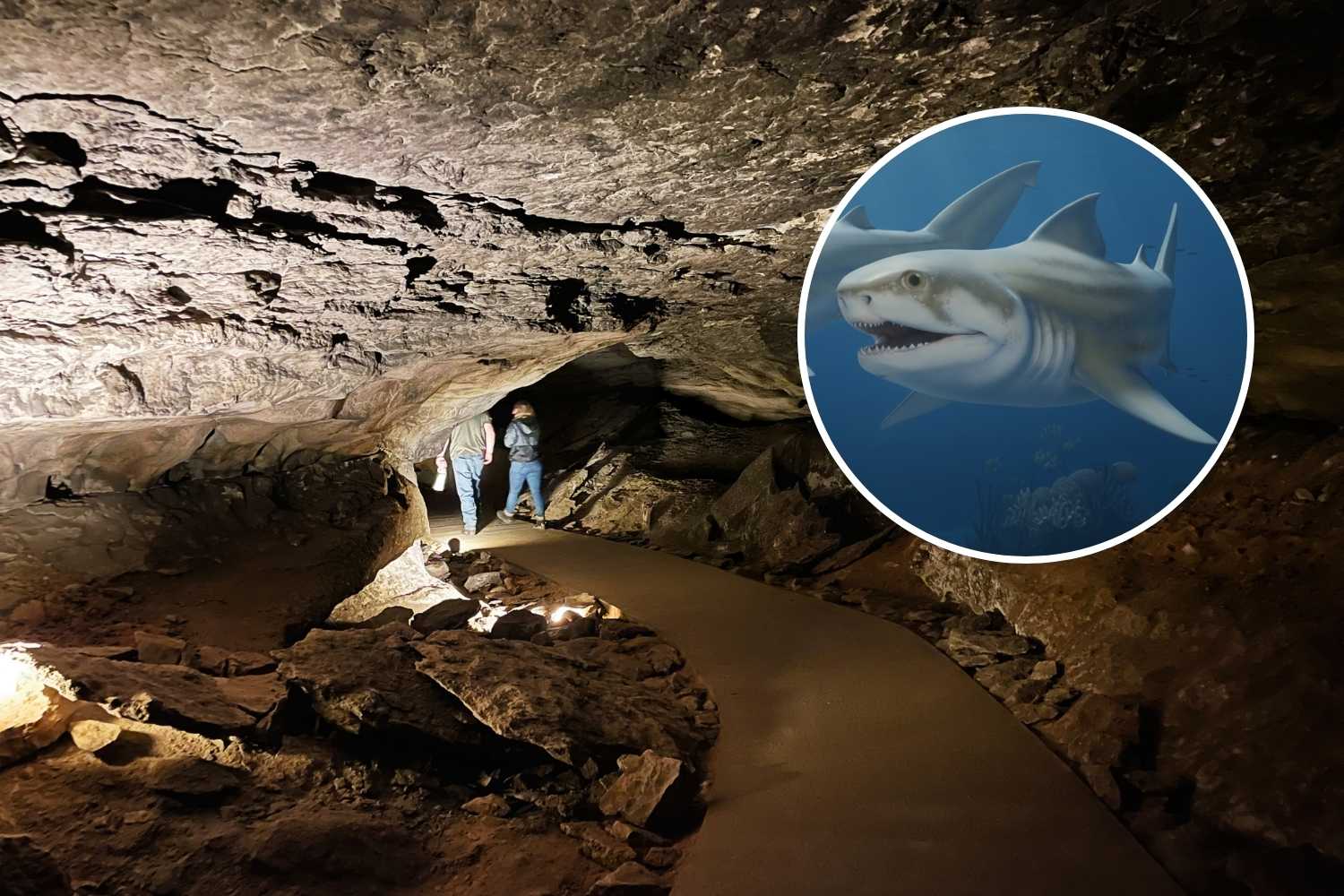
For over three hundred million years they remained there, hidden under layers of rock and silence. Now, in the heart of the United States, twoprehistoric sea monsters they return to tell a story that talks about warm seas, giant sharks and a territory that, long before becoming land, was submerged by the ocean.
The discovery comes from Mammoth Cavein Kentucky, a place already known for being the largest cave system on the planet, with over 675 kilometers of tunnels explored. An underground world that, once again, proves to be much more than a geological curiosity.
Today, Kentucky is synonymous with forests and hills. But about 325 million years agoduring the Mississippian period, this same territory was covered by a shallow, warm sea teeming with life. It is precisely in those waters that they swam Troglocladodus trimblei And Glikmanius careforumtwo sharks belonging to the group of ctenacantiancient marine predators of impressive size.
We are talking about animals between three and three and a half meters long, comparable in size to a modern shark. Their fossil remains were found within the cave’s limestone formations, deposits that formed when the sea covered much of eastern North America.
Rare and delicate fossils that help understand how sharks evolved
The discovery is particularly important because it concerns cartilaginous animals. Cartilage, unlike bones, is preserved with extreme difficulty over time. Yet, among the findings that have emerged, there is also one portion of the jaw of a young specimen of Glikmanius careforum which allowed scholars to observe very rare anatomical details.
These fossils tell much more than a simple presence. They offer concrete clues about how sharks diversified as continents slowly began to merge, shaping the future Pangea. It is a fundamental piece for reconstructing the evolution of ancient marine ecosystems.
Getting to these results was not easy. The study, published in Journal of Vertebrate Paleontologyis the result of years of work carried out in difficult environments, including narrow passages, ancient underground waterways and areas of the cave accessible only to expert speleologists. The study was led by paleontologist John-Paul Hodnett, together with the National Park Service, with the support of the Cave Research Foundation, to which the name is dedicated Glikmanius careforum.
Each fragment was recovered with extreme caution. One wrong movement is enough to compromise remains that have survived hundreds of millions of years unscathed, protected by the climatic stability of the cave.
Coastal predators and seas that changed over time
The two sharks likely shared the same coastal environment. Troglocladodus trimblei it was distinguished by a branched set of teeth, ideal for holding prey, while Glikmanius careforum it had a short head and a powerful bite, suited to hunting smaller fish and ancient squid-like cephalopods.
By following fossils in different rock layers, researchers are able to reconstruct how sea levels have risen and fallen over time, modifying habitats and influencing the evolution of these species. It is a slow but precise snapshot of past climatic and geological changes.
To date, they have been identified within Mammoth Cave over seventy species of fossil fish. A fact that confirms how this place is an extraordinary natural archive, capable of offering new discoveries even in areas that have been studied for decades.
The two sharks just described are only the latest arrivals in a catalog destined to grow. Future explorations, supported by new mapping and analysis techniques, could reveal other fragments of that ancient sea that once connected territories that are now very distant, from America to Europe, up to North Africa.
