
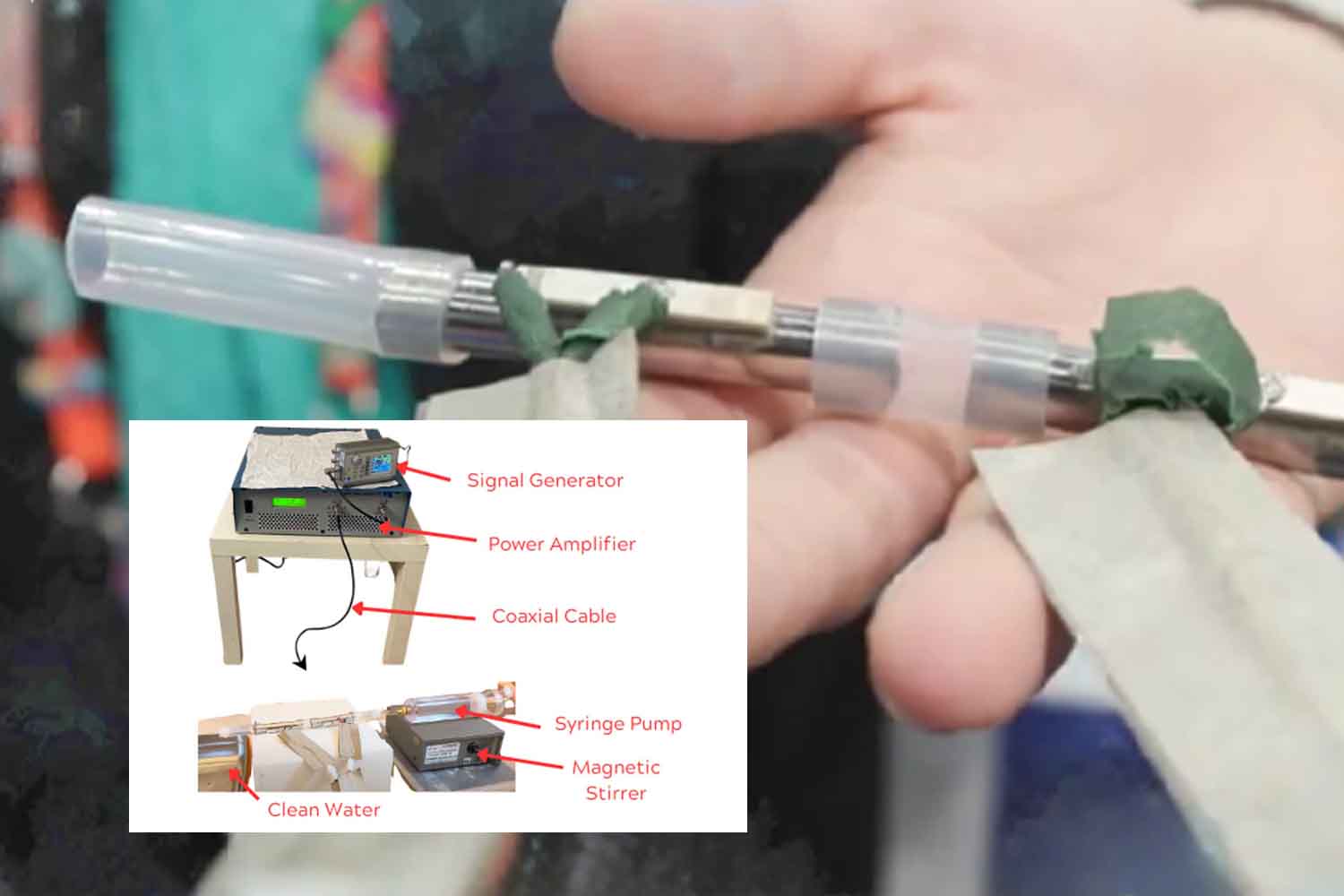
There is a simple, almost naive question from which this story was born: What if sound could help clean water? Not a philosophical provocation, but the starting point of concrete research, carried out by two Texan students who, far from large laboratories and millionaire funding, decided to tackle one of the most difficult environmental problems to solve.
Microplastics, fragments invisible to the naked eye, escape traditional filtration systems and end up everywhere: rivers, seas, drinking water. From there they enter our body, pass through the tissues and even reach the blood. It is on this ground that they worked Victoria Ou And Justin Huangboth seventeen years old, starting from an idea as simple as it was counterintuitive: not to trap plastic, but push it.
When physics meets the environment
Instead of using increasingly dense filters, destined to clog or become expensive, the two students chose another path. They used carefully calibrated high-frequency acoustic waves capable of exerting pressure on microplastics suspended in water. The result is surprising in its simplicity: the particles are pushed towards each other, aggregate, become larger and therefore finally filterable.
In laboratory tests, this technique made it possible to remove over 80% of microplastics in a single passwithout the use of chemicals and without sophisticated membranes. The prototype, about the size of a pen, works with reduced energy consumption and could, at least on paper, also be used in contexts far from large infrastructures, such as rural areas or areas affected by water emergencies.
This is not science fiction or a vague promise. It’s applied physics, and that’s exactly what makes the discovery interesting: a well-known principle, ultrasound, used in a new way to tackle a real problem.
An idea that has already attracted the attention of the international scientific community
The work of Victoria Ou and Justin Huang has not gone unnoticed. Their project was awarded at the Regeneron International Science and Engineering Fairone of the world’s largest science competitions for students, where they received a $50,000 award. An award that does not mark a point of arrival, but rather a beginning.
The device, in fact, is still in the experimental phase. There is no version ready to be installed in aqueducts or homes, and further studies will be needed to understand how this technology can work on a large scale, in conditions other than the controlled ones of a laboratory. But now we know there is an alternative path, and it’s worth exploring.
