
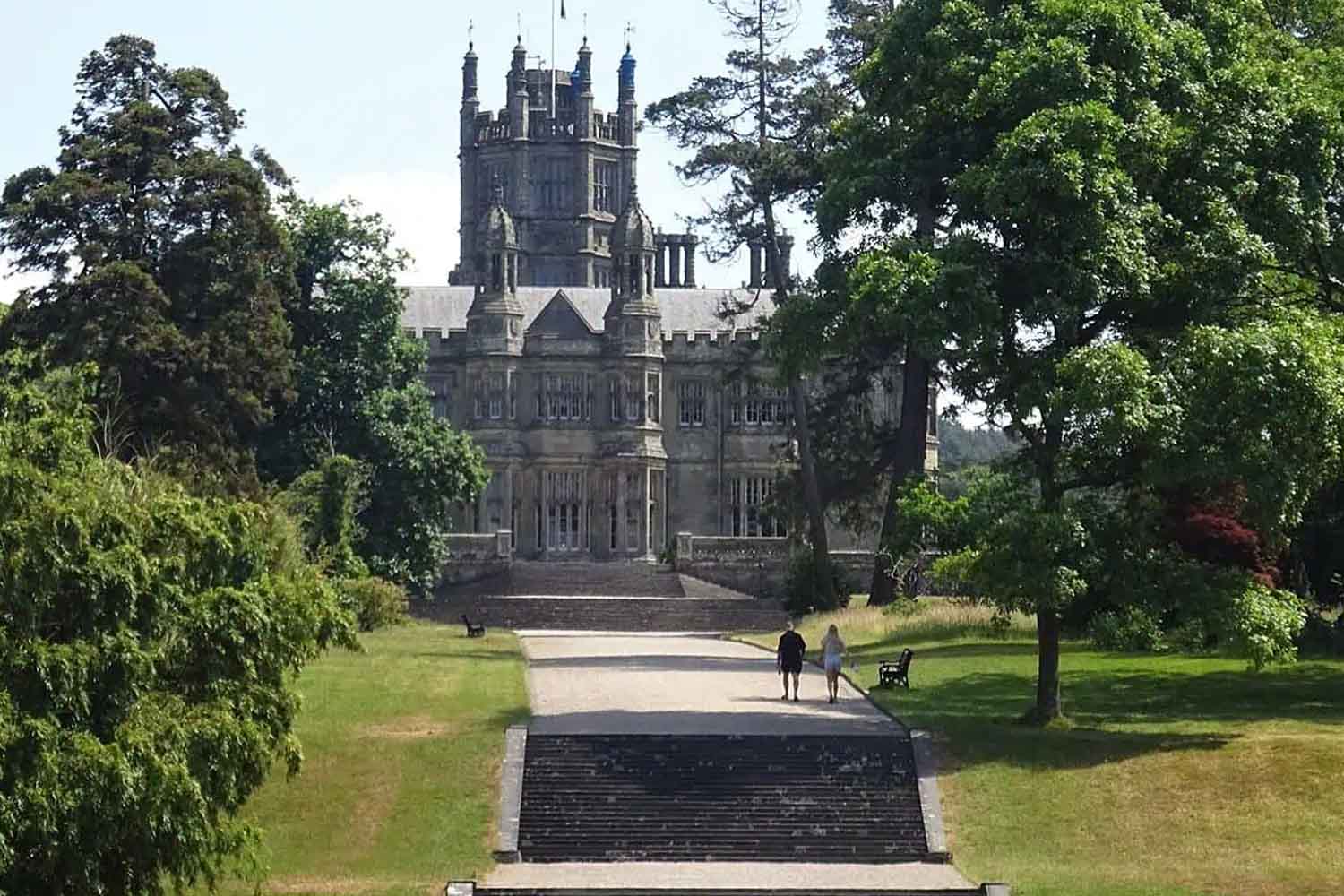
Under the tidy grass of a park, in a corner of Wales that many associate more with industry than archaeology, a story that had been buried for over fifteen hundred years has resurfaced. TO Margam Country Parknear Port Talbotexperts have identified one Roman villa of exceptional dimensionsset to offer valuable and hitherto unpublished information on the national history of Wales.
The discovery is the result of ArchaeoMargama heritage research and valorization project born from the collaboration between Swansea UniversityNeath Port Talbot Council and the church of Margam Abbey Church. The initial aim was to bring attention back to Margam’s pre-industrial heritage. No one, however, expected to come across such a large and well-preserved Roman complex.
A discovery that fills a thousand-year historical void
For Margam, a land rich in evidence of the Bronze Age, the Iron Age, the Middle Ages and the post-medieval era, the Roman period remained surprisingly little known. This villa represents, in the words of scholars, the true “missing piece of the puzzle”.
Project leader Alex Langlands, associate professor and co-director of the Center for Heritage Research and Training at Swansea University, explained that the team had expected to find traces of the Romano-British era, but not such a clearly legible structure full of potential. Geophysical investigations already allow us to formulate hypotheses on the role that this site may have had in the social, cultural and economic development of Wales throughout the first millennium AD, without risking precise dating or definitive interpretations for now.
A monumental villa, protected by time and landscape
The identified structure extends within a defended area of approximately 43 by 55 metres. A fence that could be the legacy of a previous Iron Age settlement or the sign of a late Roman period marked by instability and the need to defend itself from external threats. Next to the main building, to the south-east, a large nave construction emerges, probably intended for agricultural storage or, in a later phase, used as a meeting space for local leaders in the post-Roman period.
The level of conservation is one of the most surprising aspects. The credit also goes to the history of the place, which remained a park for centuries and was never subjected to intensive agriculture. This protected walls, floors and buried structures, allowing an extraordinarily clear reading of the site today. The investigations were conducted by the company Terradatwhich used high-resolution magnetometry and ground-penetrating radar, managing to map the villa, the surrounding moats and the overall organization of the area in three dimensions.
A center of power between landscape, community and identity
According to Langlands, one thing is already evident: Margam was not a marginal place. Its geographical position, between the mountainous areas of western Wales and the fertile lands to the east, placed it in a strategic point. It is not excluded that this site had such a central role that it even contributed to the name of the historical region of Glamorgan.
The ArchaeoMargam project is financed through public funds dedicated to culture, tourism and events, with the declared aim of making heritage a tool for connecting people. It is no coincidence that students, schools, volunteers, young archaeologists and local entities were involved from the beginning. In just a few months there have been hundreds of participations, including field activities and educational initiatives.
There is also an aspect deeply linked to the landscape. The fact that the villa has remained intact is precisely due to the “green” history of the place: for centuries the area was a park, never attacked by intensive agriculture or invasive constructions. A concrete example of how the protection of the territory can transform, over time, into a form of memory preservation.
View this post on Instagram
