
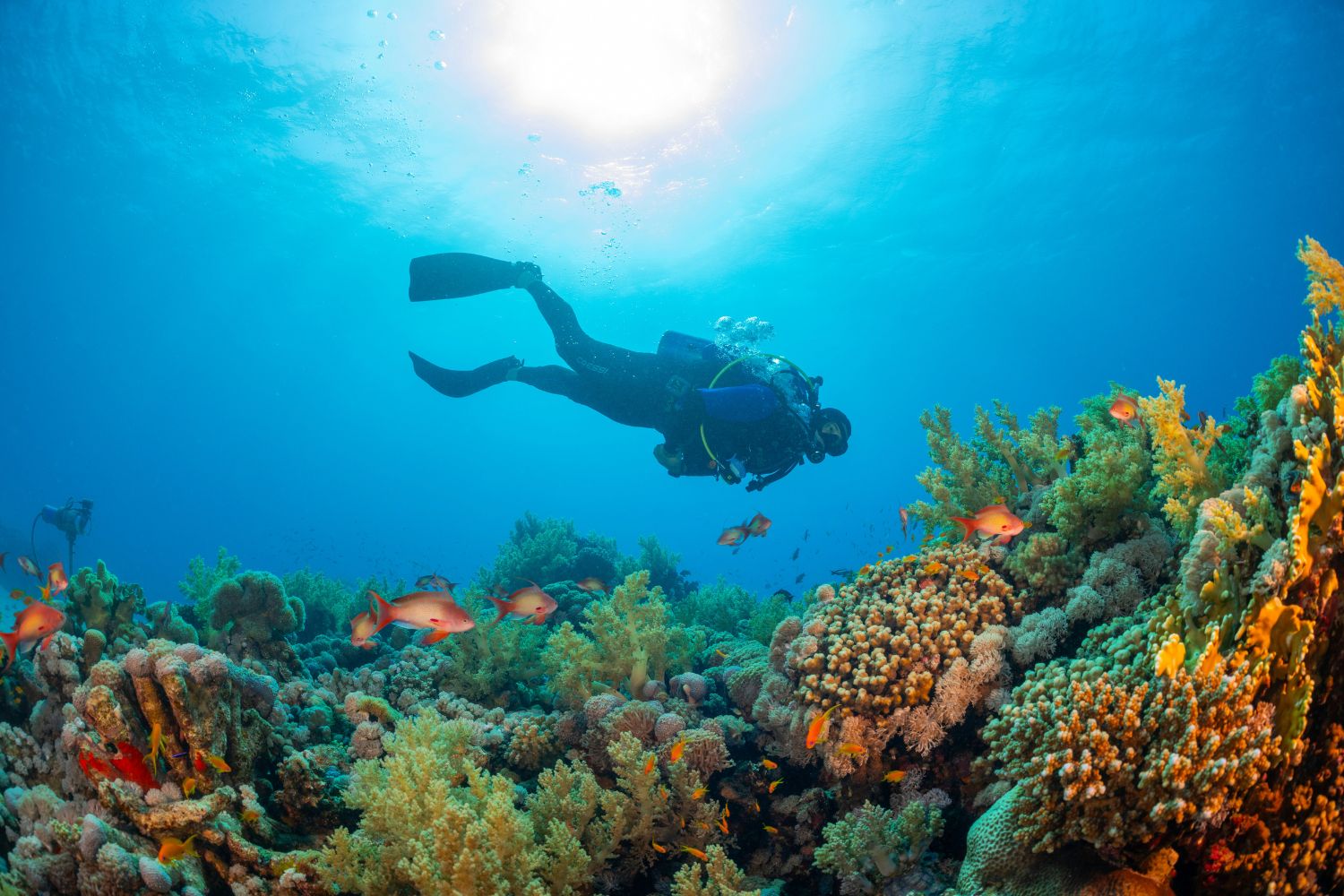
“From up here the Earth is beautiful. Without borders or boundaries”: this was what the Soviet cosmonaut said Yuri Gagarin who left for space on April 12, 1961. An immersive amazement, which connects you with nature and which sees no boundaries. Now a search led by Northeastern University (USA) has demonstrated that the same sensation is felt by aquanauts, those who live and work underwater. It is the ‘Underview Effect’, very similar to its “twin” ‘Overview Effect’.
‘Overview Effect’ and ‘Underview Effect’
The feeling of awe and planetary connection felt by astronauts observing Earth in orbit is known as ‘Overview effect‘, a term coined by Frank Whiteauthor of numerous books on space exploration and science.
Now researchers have documented a similar cognitive change among aquanauts, people who live and work underwater.Underview effect‘, and it’s not just a scientific curiosity: sharing this sense of wonder and affinity with nature with the public could be fundamental to understanding and preserving the ocean environment, which really needs to be protected.
We are at this point where we realize that a classical approach to interacting with nature, and in particular with the ocean, will not be enough – explains Brian Helmuth, co-author of the study – If we don’t reformulate the way we interact with the ocean, we will be in trouble
Yes, because the ocean is not “another world”, it is ours: the waters cover approximately two thirds of the globe and underwater life is closely linked to that above the surface.
Considering that every breath people take comes from a marine organism – Helmuth points out – using the ocean as a landfill without regard for its health is a very bad omen not only for the planet, but also for humanity
How the study was conducted and what it showed
In the course of the work, the scientists interviewed 14 aquanauts – one of whom is also an astronaut – about the psychological, behavioral and cognitive changes they experienced while living underwater for long periods of time.
Aquanauts have been little studied,” reports Kristen Kilgallen, lead author of the study. “This is the first research of its kind to look beyond the physiological or safety implications of living underwater for days and weeks at a time, a phenomenon known as saturation diving.
Aquanauts are individuals who live and work underwater, using special underwater laboratories as a base. Because the pressure is equal inside and outside the dive station, unlike submarines, aquanauts can dive outdoors for eight or more hours a day without having to take a break to decompress.
It means you have unlimited time to live on the bottom
precise Helmuthwho participated in several aquanaut missions
Normally, divers can only descend to a depth of 18 meters for 45 minutes before having to resurface, which gives them limited time to observe the ebb and flow of ocean life, while saturation divers concentrate their decompression into 24 hours at the end of their underwater stay.
Helmuth he compared this difference to that of Jane Goodalla recently deceased world-renowned primatologist who could live in the forest and study chimpanzees, compared to the experience of being dropped in a helicopter for 30 minutes at a time.
Even short diving excursions can induce feelings of awe and transcendence, as anyone who has scuba dived or snorkeled on vacation can understand, of course. But being underwater for prolonged periods greatly amplifies this effect.
An important change occurred, very similar to that experienced by astronauts: the big picture effect
Indeed, aquanauts reported that living underwater led to more intense perceptions and an amplification of the sense of engagement and connection with the natural world: among those interviewed, 70% reported greater awe and gratitude and 64% reported greater engagement with their surroundings due to the challenge of living under the sea.
Astronauts and aquanauts
Only one difference with astronauts: there is generally a sense of connection with the specific marine environment rather than with the Earth as a whole. Aquanauts are literally immersed in their environment and so it’s kind of a unique relationship.
This study, the researchers explain, is fundamental to develop a deeper understanding of the implications of life underwater, but also to develop strategies to protect the splendid and fundamental underwater life, which unfortunately is constantly threatened by the wicked choices of human beings.
The work was published on Environment & Behavior.
Sources: Northeastern University / Environment & Behavior
