
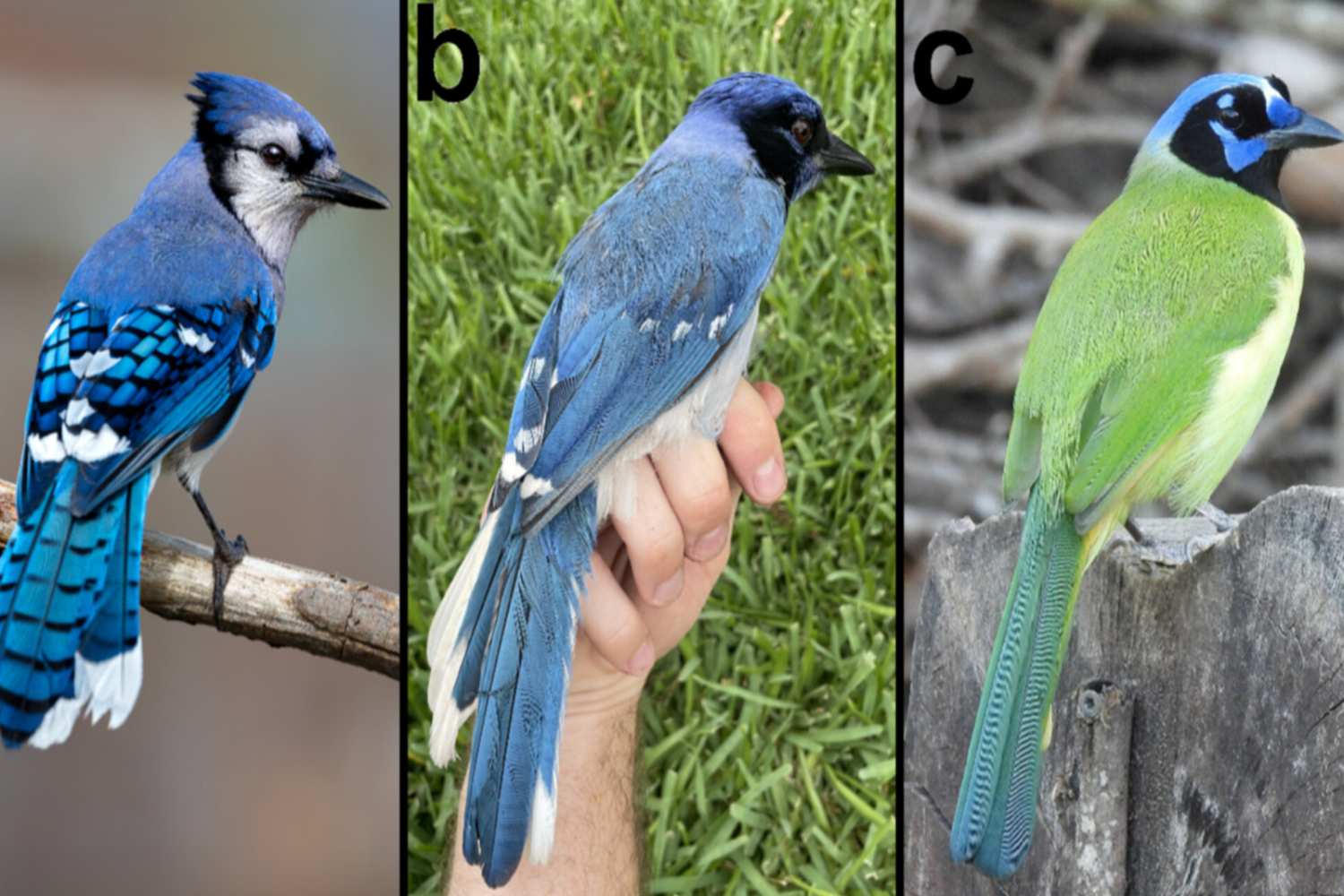
In Texas, ornithologists have documented a unique event in recent history: the sighting of a hybrid bird never observed first in nature. The specimen, characterized by a brilliant blue plumage, was recognized as the result of the meeting between two distinct species, the blue acorn (Crystal cyanocitta) and the green acorn (Cyanocorax Yncas).
It is an extraordinary case, since the two species were separated by about 7 million years of evolution and until a few decades ago their habitats did not overlap. The discovery took place by chance, when a woman from San Antonio photographed the animal in her garden and shared the image online. The shot attracted the attention of Brian Stokes, a researcher in ecology and evolution, who then led the study published on the case.
The role of climate change
Scholars believe that the birth of this hybrid has been made possible by the expansion of the natural areas of the two species, a phenomenon accelerated by climate change. The increase in temperatures and the transformation of ecosystems led the blue and green acorns to meet where before it was impossible.
The genetic and morphological analyzes clarified the origin of the specimen: the coupling would have occurred between a green acorn female and a blue acorn male. To confirm the discovery, the researcher temporarily captured the animal, taking a blood sample and applying an identification ring, before issuing it again in nature.
The hybrid has been revised several times in the same garden, even after months, allowing scholars to monitor it over time. This has made it possible to an in -depth evaluation of its state of health and its adaptability to the environment.
The case recalls an experiment of the seventies, when another hybrid between the same two species had been generated by man in captivity. That example, now preserved in the Museum of Sciences and History of Fort Worth, shows characteristics very similar to those of the new Texan bird, with the fundamental difference that the current hybrid was born spontaneously in nature.
According to experts, this meeting between species demonstrates how climatic changes can also have direct consequences on the evolution of animals. The “never seen first” acorn is therefore not only a scientific rarity, but also an alarm bell on the future of biodiversity.
You may also be interested in:
