
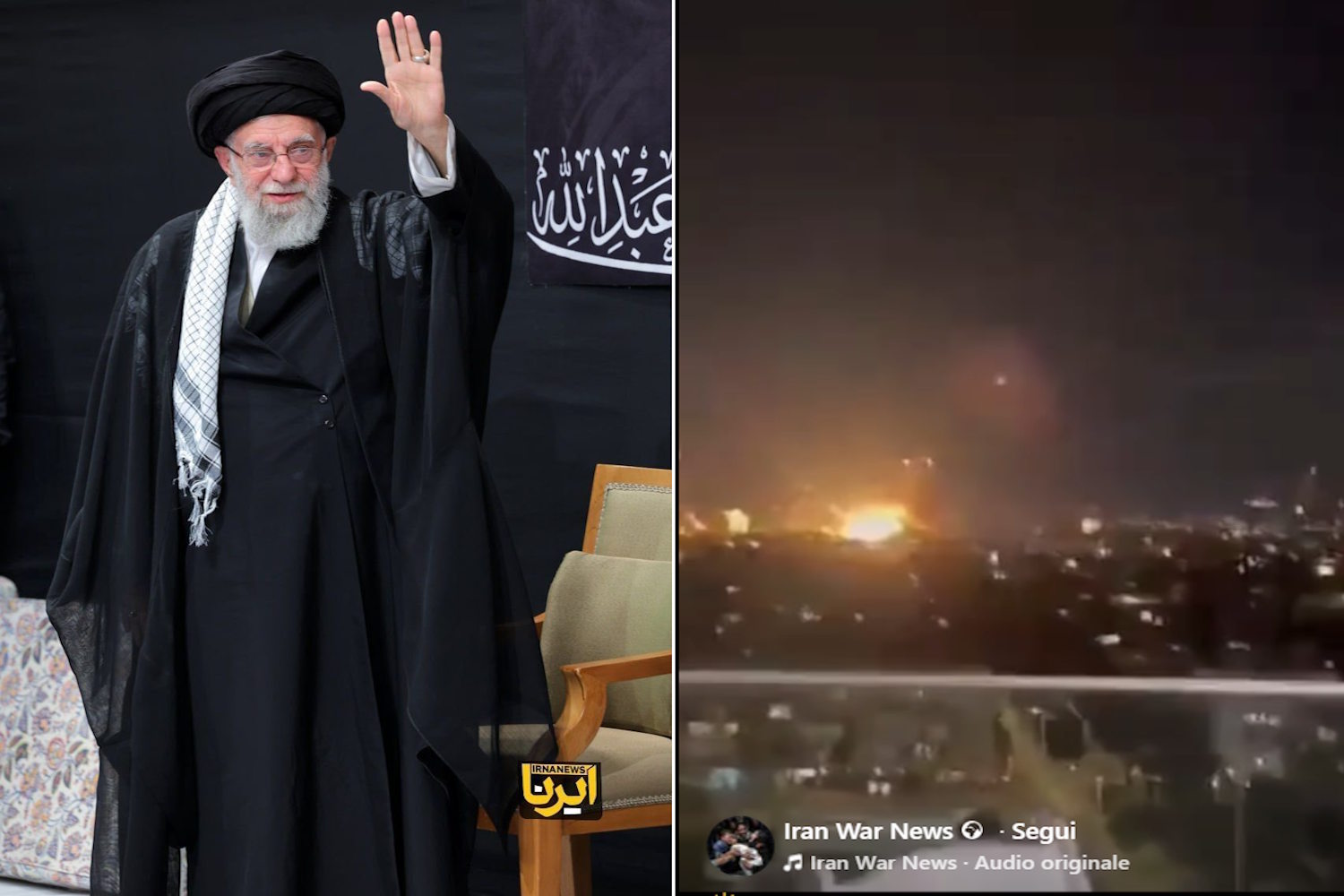
The Middle East has entered one of the most critical phases of recent decades. While on the one hand the United States and Israel launched a large-scale military operation against Iran, targeting political and military leaders, strategic infrastructure and sites linked to the missile system, on the other hand Tehran did not wait to respond with widespread attacks against Israel and on US targets and allies in the Gulf region.
The result of all this? Hundreds of victims, military bases hit, oil tankers on fire, airspace closed, global transport in haywire. And a question that looms over everything: how far can this escalation go?
But why did the United States and Israel attack? According to that genius Trump, what he calls “Operation Epic Fury“(that’s the name…) would have the objective of preventing Iran from obtaining a nuclear weapon. In a video message released on Truth, he stated that the intention is “destroy Iranian missiles and annihilate their missile industry”.
The US Central Command (Centcom) explained that the action aims to “dismantle the Iranian regime’s security apparatus“, hitting sites considered an imminent threat. While Israeli Prime Minister Benjamin Netanyahu spoke of the “existential threat” represented by the Iranian regime. In other words, everyone is terrified and therefore a war is on the way. Tehran, for its part, has always maintained that its nuclear program would have exclusively civilian and peaceful purposes.
What we know so far
The explosions affected large areas of the country: Tehran itself, Karaj, Isfahan, Qom, Kermanshah. According to the Israel Defense Forces (IDF), around 200 fighters participated in raids against Revolutionary Guard Corps (IRGC) facilities, air defense systems, missile and drone launch sites, and military airports.
Among the most sensational news, as we now know, is the killing of the Iranian Supreme Leader, Ayatollah Ali Khamenei, announced by Trump and confirmed by the Iranian Supreme National Security Council.
According to BBC:
The Iranian Red Crescent also reports over 200 dead and more than 700 injured on Saturday alone and at least 153 victims in an explosion at a school in the south of the country.
Iran is also almost isolated from an information point of view: the internet is in blackout and the airspace is closed until further notice.
Who will be Khamenei’s successor?
In all this, who will succeed the Supreme Leader? The Islamic Republic has activated the constitutional mechanisms for succession. Meanwhile, a triumvirate was immediately established (hokumat-e enafareh) to lead the country until the new permanent leader is appointed.
They include:
According to the 1979 Constitution (amended in 1989), power temporarily passes to a collegial body until the Assembly of Experts elects the new Supreme Leader “in the shortest possible time”. The Assembly is made up of 88 Shia religious elected directly by the people every eight years.
How succession works
Formally, the choice is up to the Assembly of Experts elected in 2024. In theory, the leader should be a Marja-e Taqlid, that is, a religious authority of the highest rank. But the constitutional reform of 1989 – wanted by Ruhollah Khomeini – introduced a substantial change: the Guide can also be an Islamic jurist (faqih) without the highest religious title, provided he possesses:
It was thanks to this reform that Ali Khamenei was able to become Supreme Leader in 1989, despite not being a Grand Ayatollah at the time.
Among the possible candidates, three main figures emerge.
- Gholam-Hossein Mohseni-Eje’i: current head of the judiciary and member of the triumvirate, represents the continuity of the institutional apparatus. He is considered close to the conservative wing and has a solid profile within the power structures
- Hassan Khomeini: grandson of the founder of the Islamic Republic, Ruhollah Khomeini. It has symbolic and religious legitimacy, but less concrete influence on the security apparatus. He is perceived as more moderate than other candidates
- Mohammad Mehdi Mirbagheri: ultra-conservative religious, close to the most rigid circles of the clerical establishment. He directs the Academy of Islamic Sciences in Qom and is known for strongly anti-Western positions
Other names are circulating, such as Hashem Hosseini Bushehri (vice president of the Assembly of Experts), but with less public visibility.
The Mojtaba Khamenei knot
Among the most discussed hypotheses is that of Mojtaba Khamenei56-year-old son of the former Supreme Leader. Considered very influential and with strong ties to the Revolutionary Guards (IRGC) and the Basij militia, he however does not hold official positions nor does he have the highest religious rank. It must be said that a dynastic succession is traditionally frowned upon in the Shiite establishment, and Khamenei himself had ruled out this possibility in his lifetime.
The key role of Ali Larijani
Before the attack, Khamenei had already taken preventive measures to ensure system continuity. He had delegated extensive operational and strategic functions to Ali Larijanihis close advisor and current head of the National Security Council. Larijani formally announced the activation of the constitutional succession mechanism and, according to Iranian sources, would be at the center of the political and military emergency management.
Khamenei also allegedly set up a network of multi-level replacements for key civilian and military officials, including Parliament Speaker Mohammad Bagher Ghalibaf and military advisor Yahya Rahim Safavi.
This indicates that the Iranian leadership had foreseen a war scenario and organized a continuity of power.
In short, at a time when the Middle East is on the brink of a broader escalation, the succession to Khamenei becomes a crucial point for the entire regional balance.
What does all this mean for the world
Well, it’s not just a regional war, but a crisis that affects global energy security, maritime trade routes, financial stability, oil and gas prices, geopolitical balances between the West, the Gulf and Asian powers.
But, above all, it is a human crisis. Beyond the strategic declarations, there are civilians killed, schools hit, cities under bombardment, families unable to communicate due to the blackout, thousands of people stranded without flights
The risk is not only military escalation, but the definitive erosion of any diplomatic space and the point is to understand who will be willing to stop first. Because when the Strait of Hormuz closes and oil tankers are set on fire, war inevitably becomes a global affair.
